
They say that as you age, you find yourself resembling your parents more and more. One aspect of that for me is how infrequently I watch movies, despite the convenience of home streaming. I started logging my views on letterboxd back in the first winter of the COVID-19 pandemic, and in almost six years I have logged less than 40 movies.
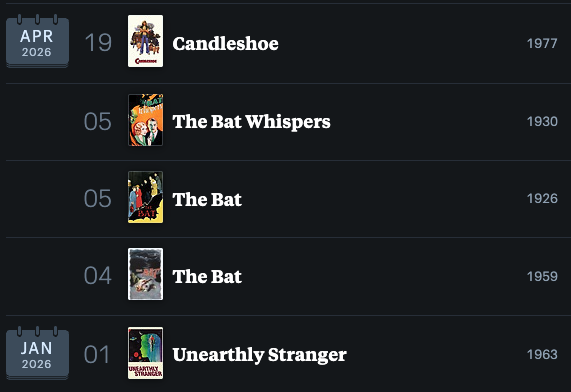
My log for the first half of 2026 is rather bizarre. On New Year’s Day, I watched the weird cheap science fiction film Unearthly Stranger from 1963 because I was intrigued by a review of it on the Terry Talks Movies YouTube channel.
I didn’t see another movie until April, when I watched three different versions of The Bat, from 1926, 1930, and 1959, as part of crafting a blog post about Mary Roberts Rinehart mysteries.
Later that month, the Once Upon a Record YouTube channel featured Candleshoe. I decided to revisit it, since I hadn’t seen it since it premiered back in 1977, when I was 11 years old. The experience was the movie equivalent of re-reading a childhood book like Henry Reed’s Journey.
Last week I drove down to the Regal Warren in Broken Arrow with some friends for MST3K: The RiffTrax Experiments — Sting of Death. It was first time I’d been in a cinema since The Marvels in November 2023.
I’ve always enjoyed RiffTrax cinema events, and the experience reminded me that I have a collection of movies on optical disc that I had saved up to watch during my retirement. I’d been retired for 2.5 months and had yet to load a single disc.
So I finally pulled out the four-disc set a friend purchased for me last Christmas from my Amazon wish list: the Agatha Christie’s Miss Marple collection of Margaret Rutherford films from 1961 through 1964. I’ve read all of Christie’s mysteries and realize that Joan Hickson’s television movies from 1984 to 1992 are the most accurate adaptations. However, I saw one of the old Margaret Rutherford movies years ago — I’ve no idea which one it was of the four — and thought it would be a hoot to see them.
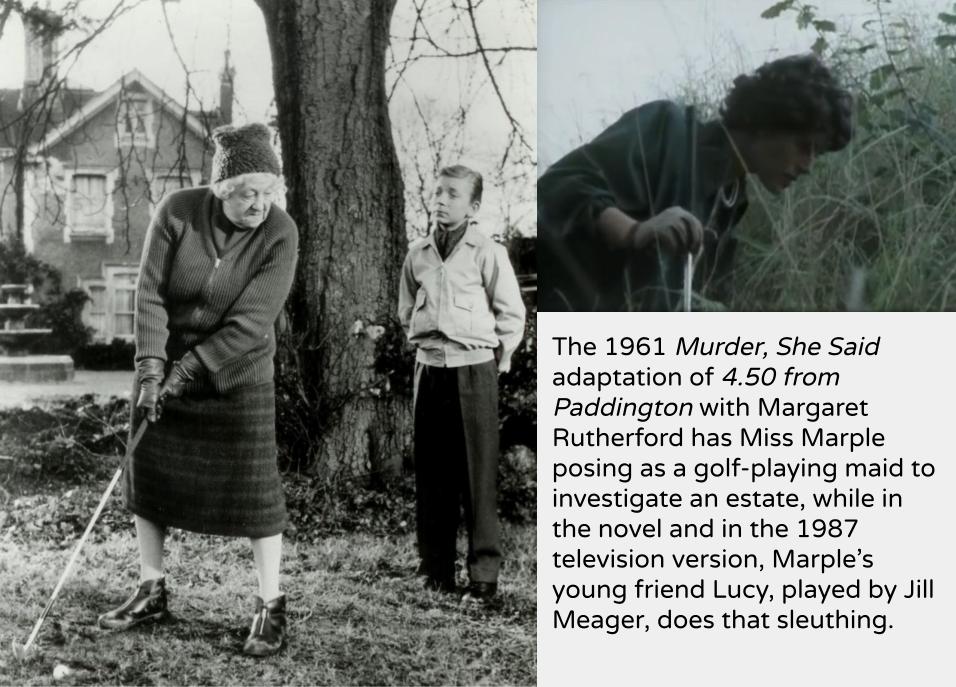
I have subscriptions to Apple TV, which reportedly can stream over 40,000 movies, and to Amazon Prime Video, which has over 20,000. But availability can vary over time, especially with old foreign titles, and the streaming services have a bitrate that is considerably lower than what an optical disc can provide. Hence my addition of the Rutherford collection on my Amazon wish list.
I cracked open the set, and realized that the discs were DVDs, not Blu-rays, let alone 4K Ultra HD Blu-rays. That meant the resolution was limited to 720×480, rather than 1920×1080 or 3840×2160. I wasn’t surprised that the old movies hadn’t been released on Blu-ray, given their limited appeal, but I was an early adopter of the failed HD DVD discs in 2006 and switched to Blu-ray in 2008 and had an Ultra HD Blu-ray player by 2019, so DVD has seemed obsolete for a couple of decades.
However, I’m also old enough to have rented VHS videocassette players to watch VHS tapes in the early 1980s before having enough money to buy my own player. Accessing many old movies that way, at the equivalent resolution of 333×480, was great for the time, but I was delighted when DVDs came out in the late 1990s with their sharper digital imagery and sound. So I wasn’t going to turn up my nose at a DVD, so long as the aspect ratio was close to being right.
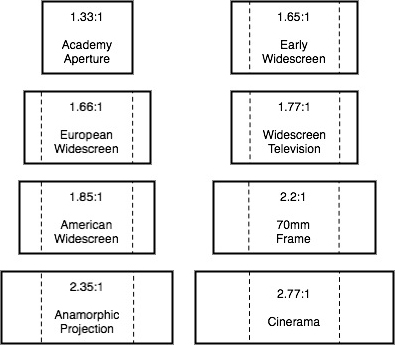
Movies over the decades were released in a ludicrous variety of aspect ratios — the graphic is only a sampling. By 1961, it was unlikely that Murder, She Said had been released in the old 1.33:1 Academy Aperture. I consulted the internet, and it said the film was released in the European Widescreen ratio of 1.66:1.
The disc had WIDESCREEN on it, so at least it wouldn’t be a “pan and scan” rendition in the old 1.33:1 ratio. I popped in the disc, and the old black-and-white movie filled my widescreen television. So it was an anamorphic DVD in which the film has been “squished” into a 720×480 pixel 1.33:1 recording but a flag had been set to signal the television to stretch it back out to 16:9 or 1.77:1.
That’s close enough to the original ratio for the movie to look fine, despite the matting the studio used to make it 1.77:1, and I was surprised at how good much of it did look. Only in a couple of scenes did the image quality noticeably deteriorate, indicating that Warner Bros. hadn’t managed to source a better element for scanning.
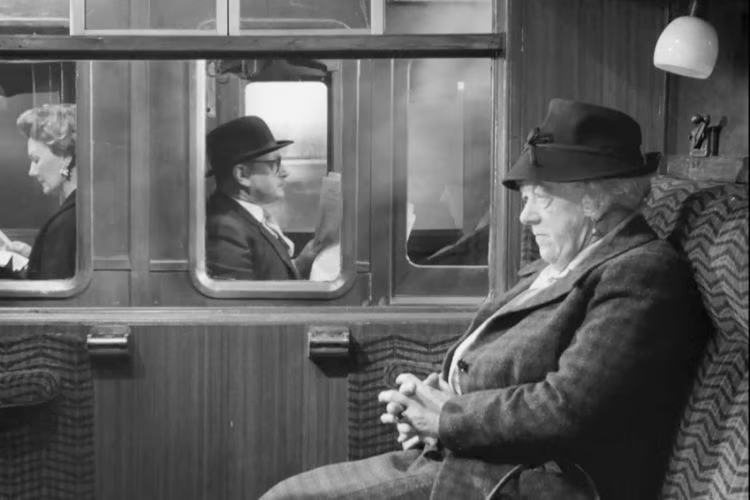
I suppose someday artificial intelligence will be used to colorize this old movie, something the late great Roger Ebert would abhor, while I’m indifferent in this case, since Murder, She Said is certainly not on par with a classic like Citizen Kane. However, I was content to view it as shot.
There were some nice artistic moments, such as at the end of the title sequence when billowing smoke from a train is used with a scene dissolve, and the scream of the trains becoming the scream of a strangled woman.
I enjoyed the interactions of Miss Marple and a library assistant, Mr. Stringer, despite no such character appearing in the novel. I was amused to discover that the actor was Stringer Davis, Margaret Rutherford’s husband, who was cast at her request. In the movie, Miss Marple witnesses a strangulation on a passing train, while in the novel the witness is a friend of hers. Rutherford Hall in the novel became Ackenthorpe Hall in the film, to avoid distraction due to the lead actress’s surname. I understand making such changes for the film version, and despite the film’s differences from the novel, Agatha Christie dedicated her 1962 novel The Mirror Crack’d From Side to Side “To Margaret Rutherford in admiration.”
A particular surprise was that Joan Hickson played a character in the film, little knowing that she would portray Miss Marple herself, quite accurately, decades later.
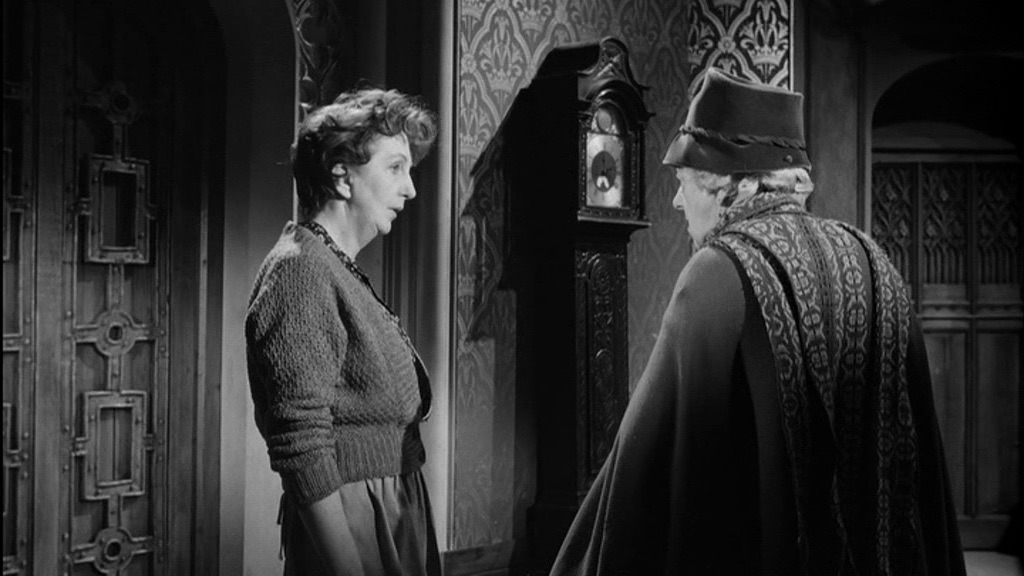
So I was quite happy with my Christmas present, and I look forward to viewing the three remaining DVDs. DVD lives…but in one of the strange coincidences of life, a few hours after watching the disc I happened to upgrade my Mac Mini to macOS 27 Golden Gate, and I noticed a “DVDPlayback” section in an Ars Technica review of that new operating system. It noted that Apple had not introduced a Mac with an optical drive built-in for over 15 years, and while the DVD Player software component is still present and functional, it is slated to be removed in a future macOS release.
Whenever that happens, perhaps I’ll no longer be able to slip a DVD into the external optical drive I have attached to my Mac. Thank goodness I’ll still have my 4K Ultra HD Blu-ray player in the living room that can play obsolete physical media.





 Meador Manor