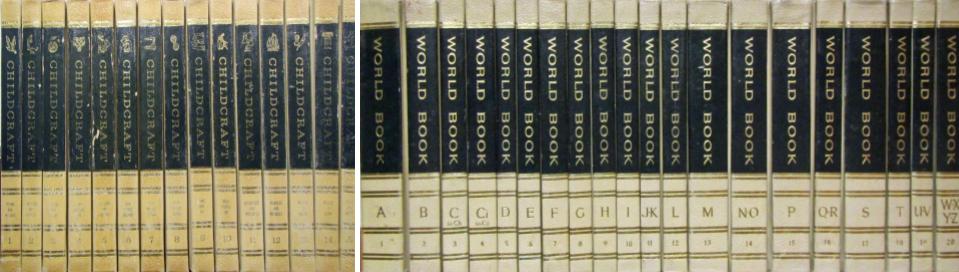
Polly Hotchkiss, Field Enterprises Educational Corporation representative #5592514, was 46 years old when she made the sale. It was March 9, 1968 when she convinced a 31-year-old mother in the Western Village neighborhood of Oklahoma City to invest $228.35 for a 20-volume set of the World Book encylopedia. It was bundled with a 15-volume set of Childcraft books for the mother’s 19-month-old son.
That was a hefty purchase, translating to over $2,000 in 2024 dollars, and my mother paid it in three monthly installments.
These books cost my mother a pretty penny back in 1968
I would grow up consulting the Childcraft books, which had simple text and illustrations designed to make learning fun. It had these categories:
Poems and Rhymes
Stories and Fables
World and Space
Life Around Us
Holidays and Customs
How Things Change
How We Get Things
How Things Work
Make and Do
What People Do
Scientists and Inventors
Pioneers and Patriots
People to Know
Places to Know
Guide for Parents
Here’s a sample page from volume 4, with an illustration by Charley Harper:
My parents kept the World Book in a barrister’s bookcase
Although our set proclaimed Our 50th Year on their covers, Childcraft books actually dated back to 1934; the proclamation referred to the origin of the World Book by the same company. Chicago publishers J. H. Hansen and John Bellow had enlisted Michael Vincent O’Shea, a professor of education at the University of Wisconsin, to help them create it in 1917. Editor O’Shea wrote in the preface, “encyclopedias are apt to be quite formal and technical. A faithful effort has been made in the World Book to avoid this common defect.”
Field Enterprises, which had been founded by Marshall Field III, the founder of the Chicago Sun newspaper, purchased World Book in 1945. At one time, it employed over 40,000 salespeople who sold the encyclopedias door-to-door to families across the country, including one Polly Hotchkiss.
My Childcraft books weren’t the rainbow edition, but the less colorful white-and-green binding
By the time I was in fifth grade, I had been making extensive use of the World Book, and my parents took advantage of the offer to exchange the 1968 volumes for new ones at a discounted price anytime from five to ten years after the initial purchase. On September 25, 1976 they paid $152.49 in three monthly installments, which would be over $800 in 2024 dollars. That was about a 50% discount.
I found these to be fascinating
I remember being impressed by the human anatomy transparencies in one of the new volumes, where you could build up figures layer by layer.
The informal style of World Book suited me well. But by junior high, I recognized its limitations. So I tried to consult the more prestigious Encyclopædia Brittanica in our junior high library, but I was annoyed by its three-part structure: the Micropædia of short articles, the Macropædia of long articles that might run anywhere from 2 to 310 pages, and a Propædia outline volume.
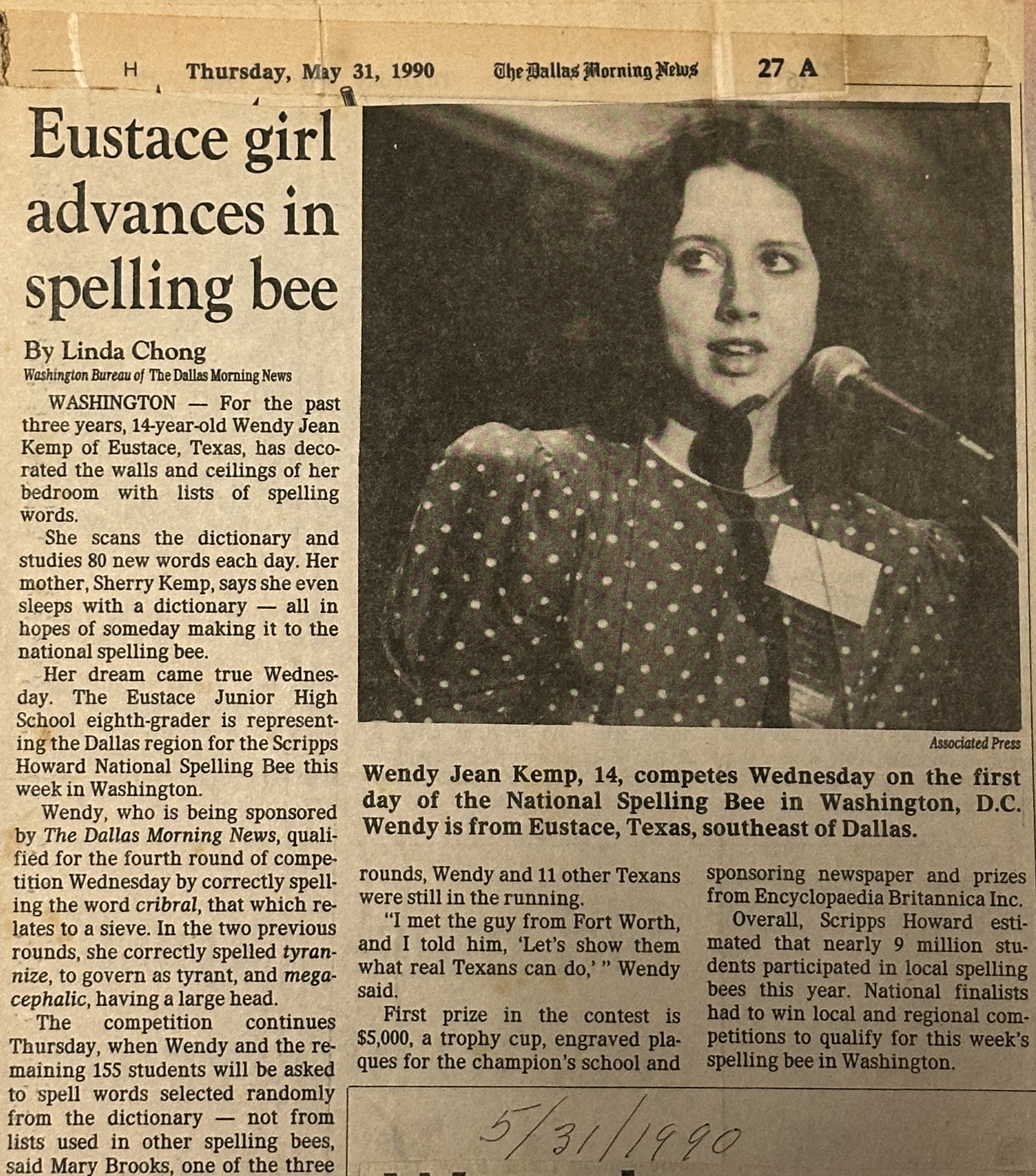
Speaking of the Britannica, my wife, Wendy, won a set of them a decade later in 1990, when she was a 14-year-old from tiny Eustace, Texas. Wendy won The Dallas Morning News Regional Spelling Bee. Being the best speller among over 10,000 students who competed in spelling bees across 700 schools in northeast Texas scored her the $1,600 set of books, which would be over $3,800 in 2024 dollars.
And yes, she was fascinated by the same sort of anatomical transparency overlays in her set of encyclopedias!
My wife is an incredible speller
1990 ad for the Encyclopædia Brittanica; Wendy won a set
Before she won the Brittanica, Wendy’s family had the Funk & Wagnalls encyclopedia, which they had bought on an installment plan. But printed encyclopedias were soon facing stiff competition…on optical discs.
Compton’s put out a multimedia encyclopedia on CD-ROM in 1989, and in 1993, Microsoft launched its Encarta CD-ROM, which was initially based on Funk & Wagnalls after Britannica refused to partner with them. Britannica was in financial difficulties by 1996 and was bought out. Encyclopedias began moving online and by 2004, the free, online, and crowd-sourced Wikipedia was the world’s largest. Encarta itself only lasted until 2009.
Britannica‘s last print edition was in 2010, concluding 242 years of printed publication. World Book still had 45,000 door-to-door representatives in the late 1980s, but sales plunged, and it shifted its focus to selling sets to libraries. As of 2024, the only place they sell their printed set is online, with it consisting of 14,000 pages across 22 volumes, for $1,200.
World Book 2024: 17,000 articles on 14,000 pages across 22 volumes for $1,200
Why someone would purchase a printed encyclopedia with 17,000 articles versus just using Wikipedia for free, which has almost 6.8 million articles, is beyond me. I presume some are still concerned about the accuracy of the world’s greatest encyclopedia, but this article shows such concerns are overblown.
I love Wikipedia enough that I donate $2.85 each month to support it. I consider that a great deal: I could pay it for the rest of my life and still not match, after adjusting for inflation, what my parents spent in 1968 and 1976 on the World Book. What price do we put on having the world at our fingertips?
Cordwainer is an obsolete term for a shoemaker. It derives from the Old French word cordoanier, referring to someone who worked with cordwain or cordovan, which was equine leather produced in Cordova. I only know the term because two authors of science fiction incorporated it into pseudonyms.
The talented but irascible misanthrope Harlan Ellison wrote the stories that evolved into my favorite episodes of two 1960s science fiction television series: Demon With a Glass Hand for The Outer Limits and The City on the Edge of Forever for Star Trek. Harlan’s original story for the latter had to be rewritten to be practical, affordable, and compatible with the show.
Harlan Ellison, aka Cordwainer Bird
Harlan was so incensed that he threatened to take his name off the story credit and apply his infamous pseudonym “Cordwainer Bird”, something he did whenever he felt his work was mangled. He’d done that with The Price of Doom in Voyage to the Bottom of the Sea. Star Trek creator Gene Roddenberry knew that would hurt the show’s chances of getting stories from other notable authors, so he threatened to blackball Harlan in Hollywood if he did so. It was one of the few battles Ellison lost, and he never forgave Roddenberry.
The strange pseudonym was actually a tribute to fellow science fiction writer Paul A. Linebarger, who used the pen name Cordwainer Smith. Linebarger thought his pen name about shoemaking and blacksmithing implied industriousness, while Harlan said Cordwainer Bird was a reference to a shoemaker for birds, which could be taken to mean “this work is for the birds”.
In high school I came across Cordwainer Smith’s most famous short story, which was his first or second published in science fiction, in The Science Fiction Hall of Fame, Volume I, which was edited by Robert Silverberg and published in 1970.
Scanners Live in Vain was written in 1945 and had been rejected by several magazines before being published in the obscure Fantasy Book in 1950. Thankfully science fiction writer and editor Frederik Pohl had co-authored a story with Isaac Asimov that appeared in the same issue. He was so impressed by Smith’s story, despite having no idea who actually wrote it, that he republished it in 1952 in a more widely-read anthology. That helped put Cordwainer Smith on the map, and Linebarger would go on to have a number of his stories published before his untimely death at age 53 in 1966, while keeping his true identity obscured.
Many of his stories were set in a shared universe, the Instrumentality of Mankind, with tales starting in the year 2,000 and extending to the year 16,000. What is striking about Scanners Live in Vain, besides its sheer originality, is that he included multiple unexplained references to that shared universe.
The story is contained to a single day out of a 14,000 year history that he would build out in later stories, not in a chain of sequels but instead in what Algis Budrys described in 1965 as “tesserae in a mosaic” providing glimpses into “a completely consistent phantom universe.”
An illustration for Scanners Live in Vain generated with DALL-E 3
I hadn’t thought of Cordwainer Smith in four decades. He was brought back to mind by Matt of Bookpilled:
Bookpilled on The Instrumentality of Mankind short story collection
I find Matt’s opinions to be cogent and persuasive, so based on his recommendation, I purchased the Cordwainer Smith short story collection The Instrumentality of Mankind as a used paperback from a seller in Webster, New York.
I read the first five of the 14 stories in it, and decided I needed to read everything Smith wrote in that series, following a timeline that was cobbled together by John J. Pierce. That meant I needed to fill in many gaps.
John J. Pierce’s timeline of The Instrumentality of Mankind
The 681-page hardcover collection I purchased
Cordwainer Smith’s works are not nearly as well known as other greats of the golden age of science fiction. Consequently, I could find some, but not all, of his work in Kindle format. So I purchased the 681-page hardcover book The Rediscovery of Man: The Complete Short Science Fiction of Cordwainer Smith. It was published in 1993 by the New England Science Fiction Association Press.
I had already read the first four stories in that collection, so happily next came Scanners Live in Vain, which I had last read about 40 years ago.
Egad! What a treat, now that I had read enough of his later stories to know what he meant when he mentioned a Manshonjagger, a Beast, and an Unforgiven one. I was now familiar with the long weird history behind the antagonist Vomact, who led the Scanners through their strange rituals, a bizarre yet believable blend of psychological conditioning and Robert’s Rules of Order.
What a strange and wonderful man. There has been speculation that Linebarger might have been the patient in The Jet-Propelled Couch, a famous psychoanalytic case history about a man who spontaneously found himself living a heroic life as “Lord of a planet in an interplanetary empire,” far in the future. Back in 2009, Mark Frauenfelder of Boing Boing convinced Harper’s to make that famous case history freely available: Part I, Part II. If you have ever enjoyed the case histories of Oliver Sacks, you might enjoy the tale of Kirk Allen, who might have been Paul Linebarger, alias Cordwainer Smith.
I am skeptical that Linebarger was the patient in question, but with that possibility in mind, I am struck by what Linebarger wrote to a friend, as relayed by Jeffrey Irtenkauf:
Life is a miracle and a terror. The progress of every day, any day, in the individual human mind transcends all the wonders of science. It doesn’t matter who people are, where they are, when they lived, or what they are doing—the important thing is the explosion of wonder that goes on and on—stopped only by death.
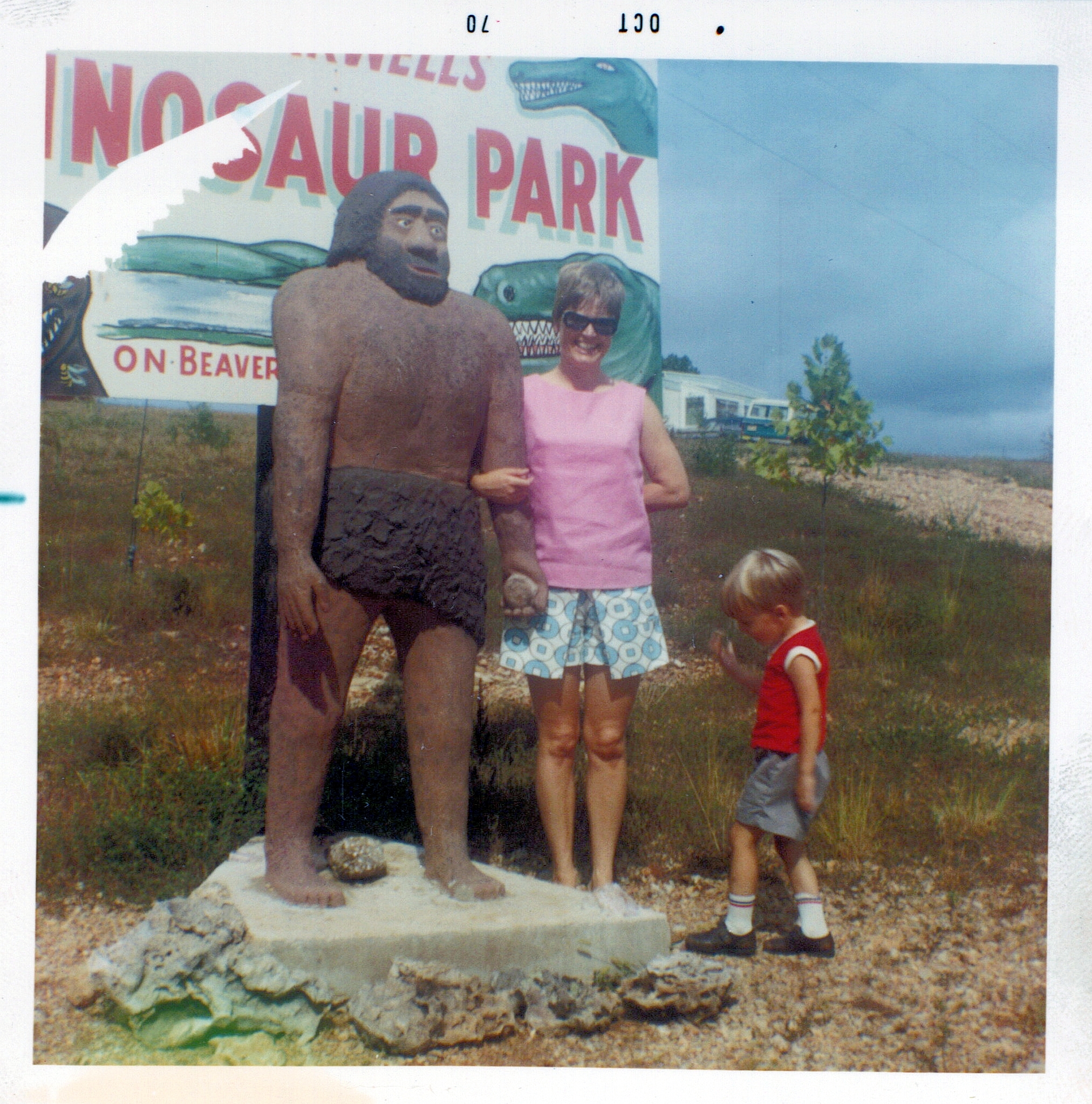
I first visited Farwells Dinosaur Park in 1970, when I was four years old. For almost 40 years, it was one of the more bizarre tourist attractions near Eureka Springs, Arkansas.
My parents had bought a tiny one-bedroom cabin on Table Rock Lake a couple of years earlier in Orville Farwell’s Sunset Heights, and his father’s Dinosaur Park was a half-hour drive away in northwestern Arkansas, or only nine miles across the Missouri-Arkansas state line if one were a pterodactyl.
With my mother at Farwell’s Dinosaur Park in the summer of 1970
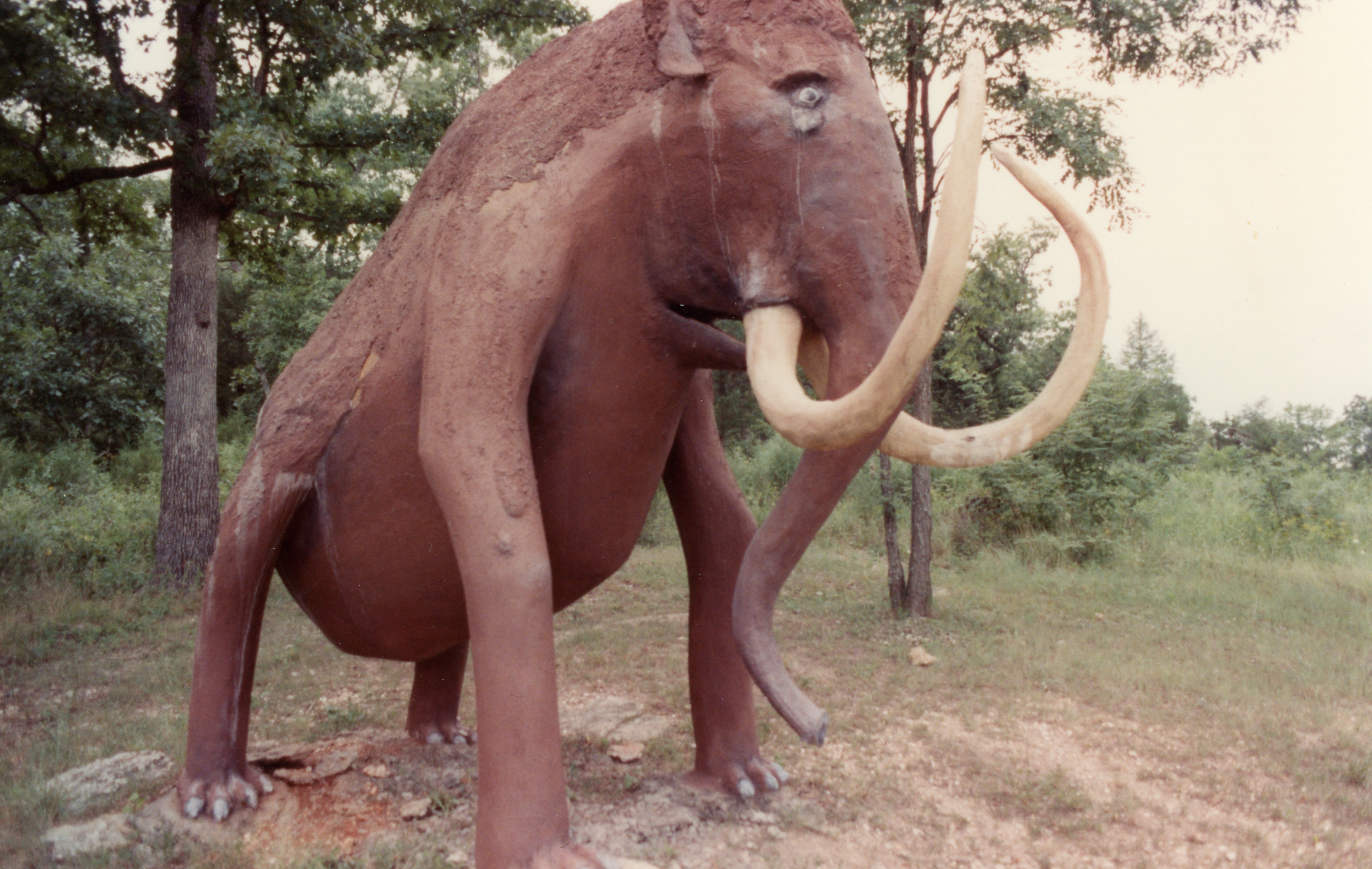
A concrete mammoth at the former Dinosaur Park in 1988 created with little grasp of anatomy; photo by Jeremy Butler
The park was filled with dozens of folk art sculptures of dinosaurs, cavemen, and the like. It began after Ola Farwell befriended Emmet Sullivan, who a year earlier had created the seven-story milk jug with arms known as the Christ of the Ozarks statue in nearby Eureka Springs. That had been created for the raving white supremacist and antisemite Gerald L. K. Smith, who retired in Eureka Springs in 1964. The statue was the first of Smith’s “Sacred Projects”, which grew to include a gallery, Bible museum, Passion Play, and a Great Wall of Jerusalem before that minister of hate expired in 1976.
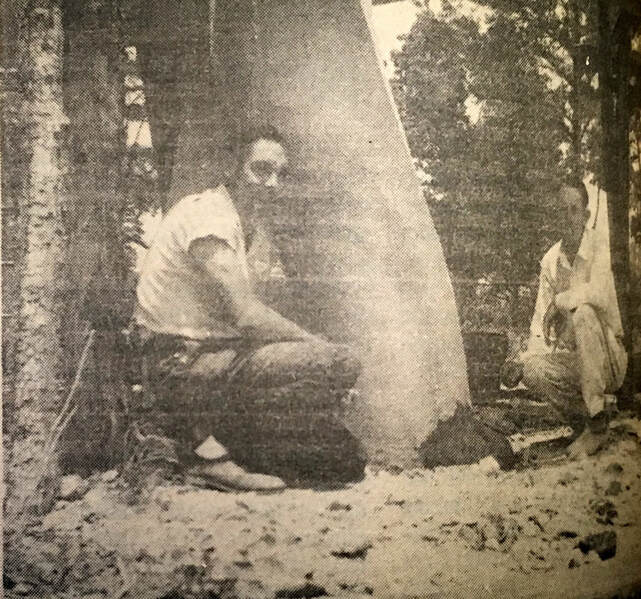
Emmet Sullivan and Ola Farwell with a 55-foot long brontosaurus in the background
Ola and Maye Farwell, who owned a grocery store in Eureka Springs, also owned 60 acres near Beaver Dam. Ola Farwell had been born in Barry County, Missouri, in 1893, so he was a contemporary of my paternal grandfather and grandmother, who were also born at that time in Barry County.
He hired Sullivan to build his Dinosaur Park, which was originally open year ’round from 7 to 7 with an admission of $1 for adults and 50 cents for children over six. Orville Farwell later said his family never lost money on the park while they owned it.
Two local men, A. C. “Mac” McBride and Orvis Parker, handled the actual construction of the dinosaurs. Mac had been the “Chief Mortar Artist” on the Christ of the Ozarks and his tombstone is adorned with an image of his handiwork. Orvis was an old-time country evangelist who lived until 2018. Abandoned Arkansas has many 2013 photos of their works.
Ola Farwell and his dinosaur in Eureka Springs
I always found the park to be a hoot. Emmet had died in 1970, but Ola Farwell kept on going. His favorite hobby was collecting rocks, and in 1972 he said he was building a large “authentic” replica of the moon to house his rock collection. What a character!
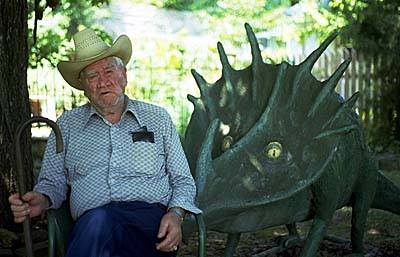
Ola even brought one of the dinosaurs home for his own yard in Eureka Springs. After he retired, he was fixture on the resort town’s Spring Street, sitting in a metal chair surrounded by concrete bunnies and his own personal Styracosaurus albertensis. He would pass out brochures about the Dinosaur Park, even though he no longer owned it.
Orvis Parker and A. C. McBride of Eureka Springs fashioned the dinosaurs
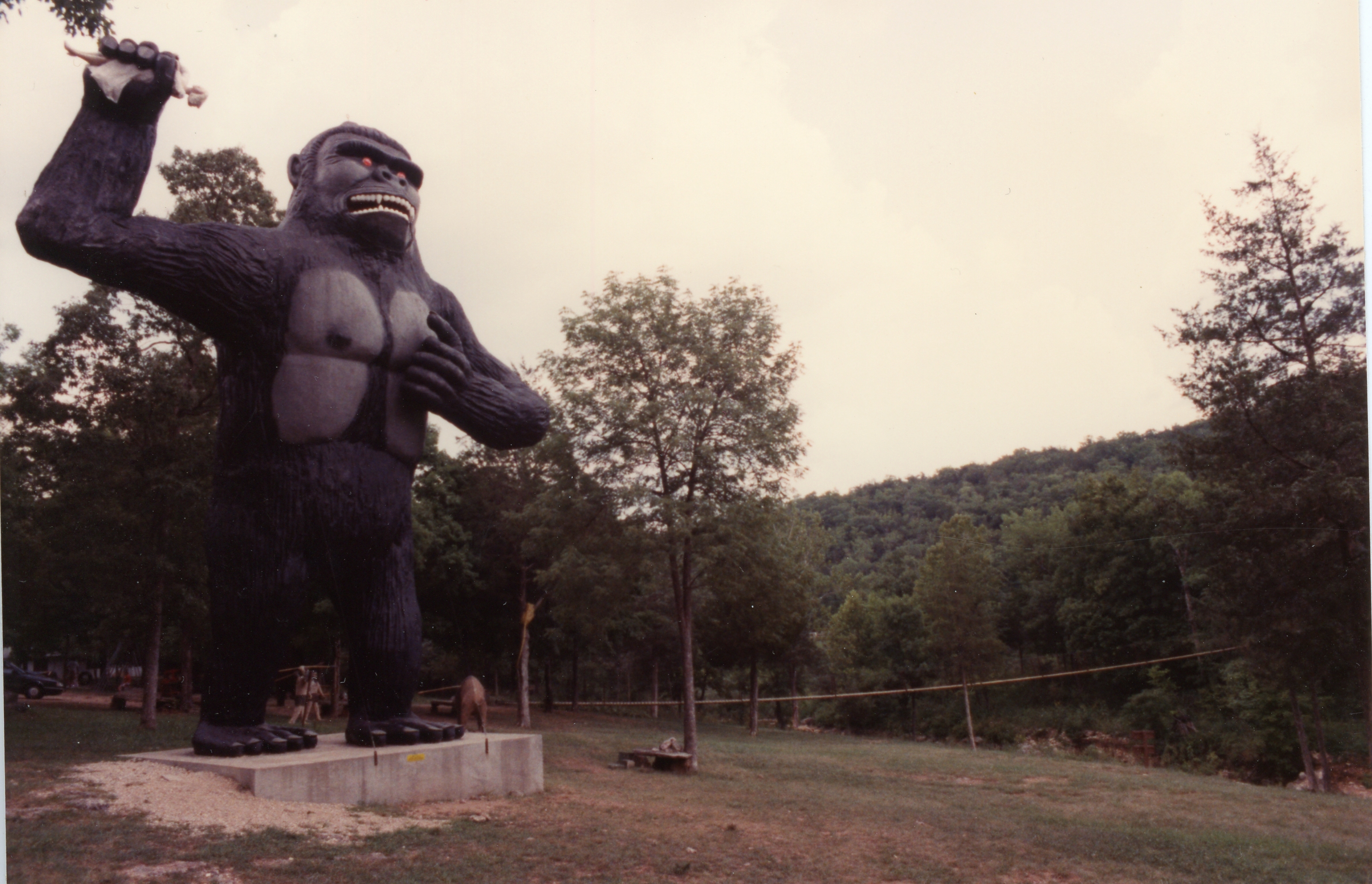
In the late 1970s, he had sold the park to Ken Childs, and Childs renamed it “John Agar’s Land of Kong” and had a 40-foot King Kong statue added. Childs was a friend of John Agar, who had a minor role as a mayor in the 1976 version of King Kong, although I remember him best as Dr. Matt Hastings in 1955’s Tarantula. Agar had famously married Shirley Temple in 1945, when she was 17 and he was 24.
Agar was an alcoholic, and his career suffered for it. He had multiple drunk driving arrests, and when he tried to explain to one judge that his troubled marriage contributed to his drinking, the judge shot back, “Don’t try to blame this on Shirley Temple!”
People presumed Agar had a financial interest in the park, but he had merely let his friend use his name.
The 40-foot King Kong statue at John Agar’s Land of Kong in 1988; photo by Jeremy Butler
In the late 1980s I treated various college friends to tours of Land of Kong, and we had great fun gawking at the ridiculous sculptures. My last visit was with some friends on spring break in 1993. The facility later became Dinosaur World, and it finally closed in 2005.
Dinosaur World a few years after closing; the spider is appropriate, as the Spider Creek Resort is just across the highway
When Wendy and I have stayed at the Sugar Ridge Resort near Beaver Dam, we have driven by the old Dinosaur Park. I respect private property, so I never trespass, but I do enjoy catching glimpses of that Ozarks Land of the Lost through the trees.
The Wandering Pigeon, like me, enjoys peering through the trees for dinosaur sightings
Social media is a mixed bag, but it can revive some decades-old memories. Today I was scrolling through my Facebook feed when this image arrested my attention, bringing back to me the sound of a fog horn, bowling balls, a horse race, and more.
My parents had that 1968 sound effects record, which I played on my mother’s Sears record player. Of course I wanted to revisit those sounds of yesteryear, and, sure enough, YouTube had them.
It was eerie to hear the bell buoy and foghorn from decades ago, with the lonely calls of seagulls. As a child living over 450 miles from the nearest ocean, those sounds fired my imagination. I wouldn’t hear a seagull in person until I was in college and flew about 1,300 miles to visit my girlfriend, who was doing a summer internship on the Atlantic coast.
Another sound effect on that record that evokes old memories of mine is Ten Pin Bowling. Both of my parents were in bowling leagues when I was little, and I remember being in the nursery at the Hilander Bowling Palace and hearing the rumble of the balls and crash of the pins. I’ve been bowling many times since, most recently in Philadelphia, but recordings of my performances would have fewer crashing pins and more sounds of the gutter.
There are sounds in the YouTube playlist, taken from a 2014 re-release, that did not appear on my parents’ record. Under the Canopy begins with elements reminiscent of Louis and Bebe Barron’s “electronic tonalities” in Forbidden Planet, shifting into jungle sounds.
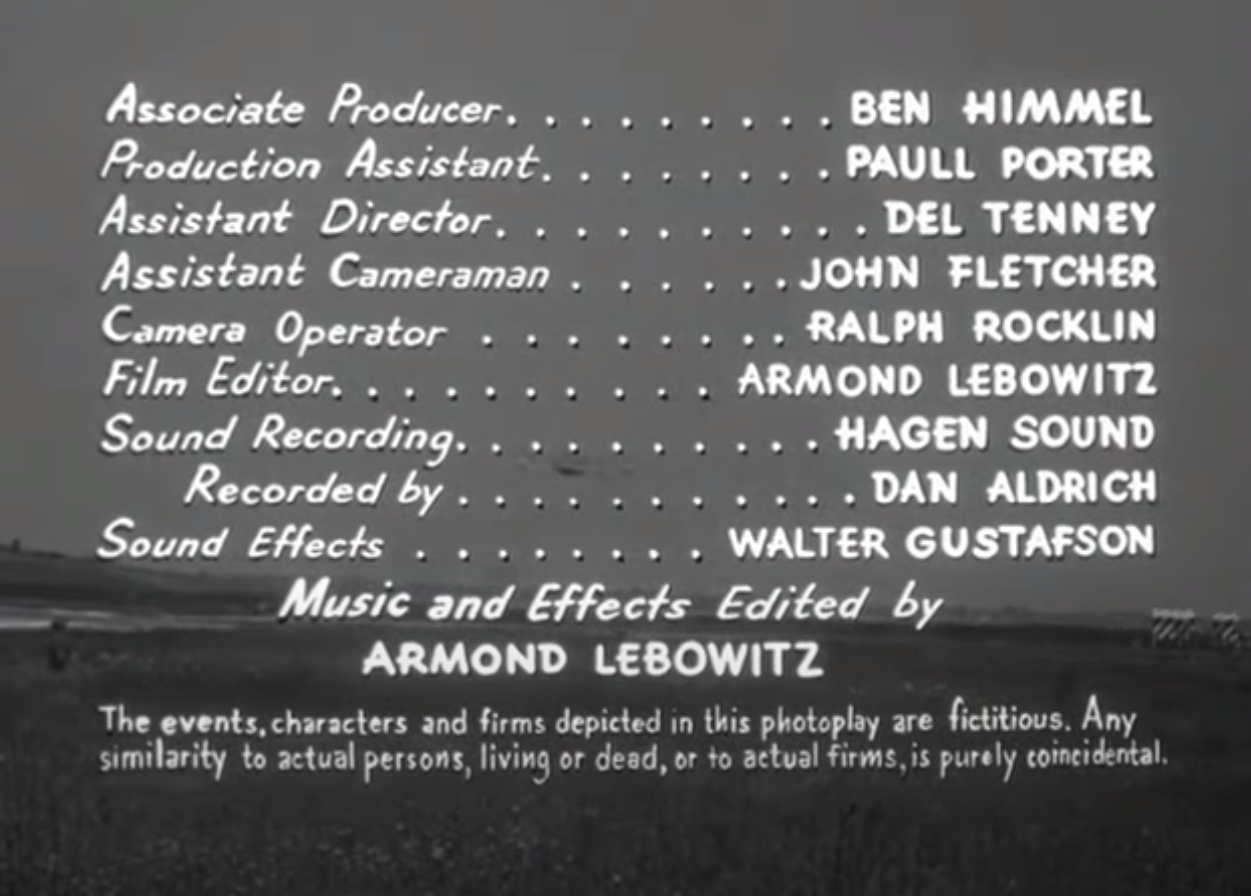
It turns out I’ve heard Walter Gustafson’s sound effects many times, as he did the ones for the Rudolph the Red-Nosed Reindeer television movie of 1964. More titillating is that two years earlier he did the sounds effects for the sexploitation film Satan in High Heels.
Walter Gustafson’s screen credit in Satan in High Heels
Oh, my. A plot synopsis is: “A carnival burlesque dancer robs her junkie ex-husband, goes to New York, gets a job at a high-class club where she becomes the mistress of the wealthy owner. She seduces his son and causes a murder.”
Grayson Hall, best known as Dr. Julia Hoffman on Dark Shadows, is striking in her role, although she later disavowed the film, which has higher production values than many sexploitation films. It notably includes an S&M production number by star Meg Myles and also has Norma Ann Sykes, known as the English bombshell Sabrina, performing for a leering audience.
Sabrina performs – I don’t know that any sound effects were needed for her scene
There is a reason Sabrina wore unfashionable long dresses: at age 11, she had contracted polio and calipers and surgery left her with a damaged right leg. That reminds me of how Cassandra Peterson, better known as Elvira, Mistress of the Dark, had extensive burn scars from an accident when she was 18 months old, and would drape her long hair over the scars on her neck and shoulders. Perfection is always an illusion.
In 1965, Walter was the sound designer for Tom Glazer’s album Noisy & Quiet/Big and Little. That children’s album started out with some recordings of household sounds. I think I’d rather listen to Meg Myles.
It took me 50 years to finish reading Pinocchio. For decades, I blamed Walt Disney and Charles Folkard for that tardiness: Disney for the false impression his 1940 film gave of the book it animated, and Folkard for a book illustration that backfired.
1971
My tale begins in 1971, when I was turning five years old. Walt Disney’s 1940 musical fantasy film based on the 1883 novel was re-released that summer. I greatly enjoyed the film, and I never forgot how Pinocchio and his friend, Lampwick, misbehaved on Pleasure Island and were turned into donkeys after making “jackasses” of themselves. I clearly remembered Pinocchio and his maker, Geppetto, being trapped inside a whale and escaping by making it sneeze. And of course I remembered Jiminy Cricket, how Pinocchio’s nose grew when he told lies, and WhenYou Wish Upon A Star.
Despite its later status as an animation classic, the film was not a box-office success when it was released in 1940. It had cost $2.6 million to create, not including promotion and distribution, and raked in less than $2 million. Walt Disney was quite depressed when both Pinocchio and Fantasia flopped in 1940, although he could take some comfort in the former winning Oscars for Best Original Score and Best Original Song.
My aborted childhood attempt to read the novel
The edition of Pinocchio given to me in childhood
I was precocious, reading 135 books in first grade. So a couple of years later my parents gave me a hardbound edition of the Pinocchio book. It had an orange cover and had been printed by Grosset & Dunlap decades earlier. I suspect my father picked it up at a garage sale.
I remember opening the 200-page book and being surprised that it was a novel, not a simple illustrated book. I was then thoroughly unnerved by the only illustration in it, which was right before the title page. It showed an owl, a crow, and a disgusting-looking anthropomorphic cricket examining a marionette lying in a bed. That marionette looked nothing like the Pinocchio I had seen in the film.
With Italy a fascist state that joined World War II as one of the Axis Powers in 1940, Disney had chosen to emphasize a Tyrolian setting in the Alps of northern Italy and western Austria for his film. His version of Pinocchio was a fat-cheeked little guy who meant well and wore a little alpine hat with a feather, a far cry from the novel’s skinny, weird-looking jerk who wore an outfit made of flowered paper, shoes made from tree bark, and a little hat from the soft part of a piece of bread.
I was particularly upset by the Talking-Cricket doctor in Folkard’s illustration. Was that hideous half-human half-insect thing supposed to be Jiminy Cricket?
Pinocchio as originally illustrated by Enrico Mazzanti
I didn’t know it, but Pinocchio had originated in 1881 as the serial La storia di un burattino in the Italian weekly children’s magazine Giornale per i bambini. Carlo Lorenzini, writing under the pen name of Collodi, stopped his first series at Chapter 15 later that year. But a few months later, popular demand convinced him to extend it to 36 chapters, and he published the complete story as a single book in 1883, with illustrations by Enrico Mazzanti.
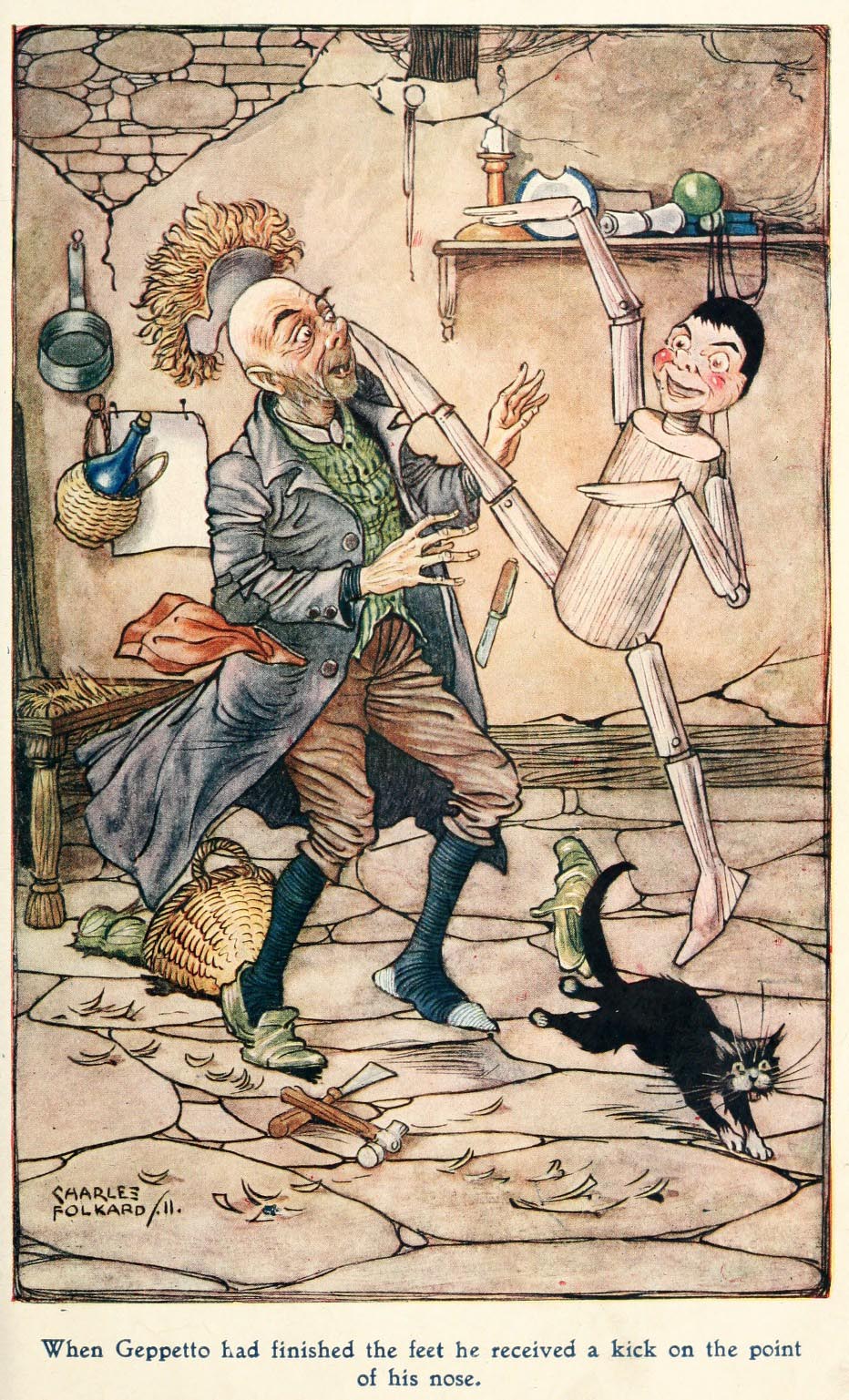
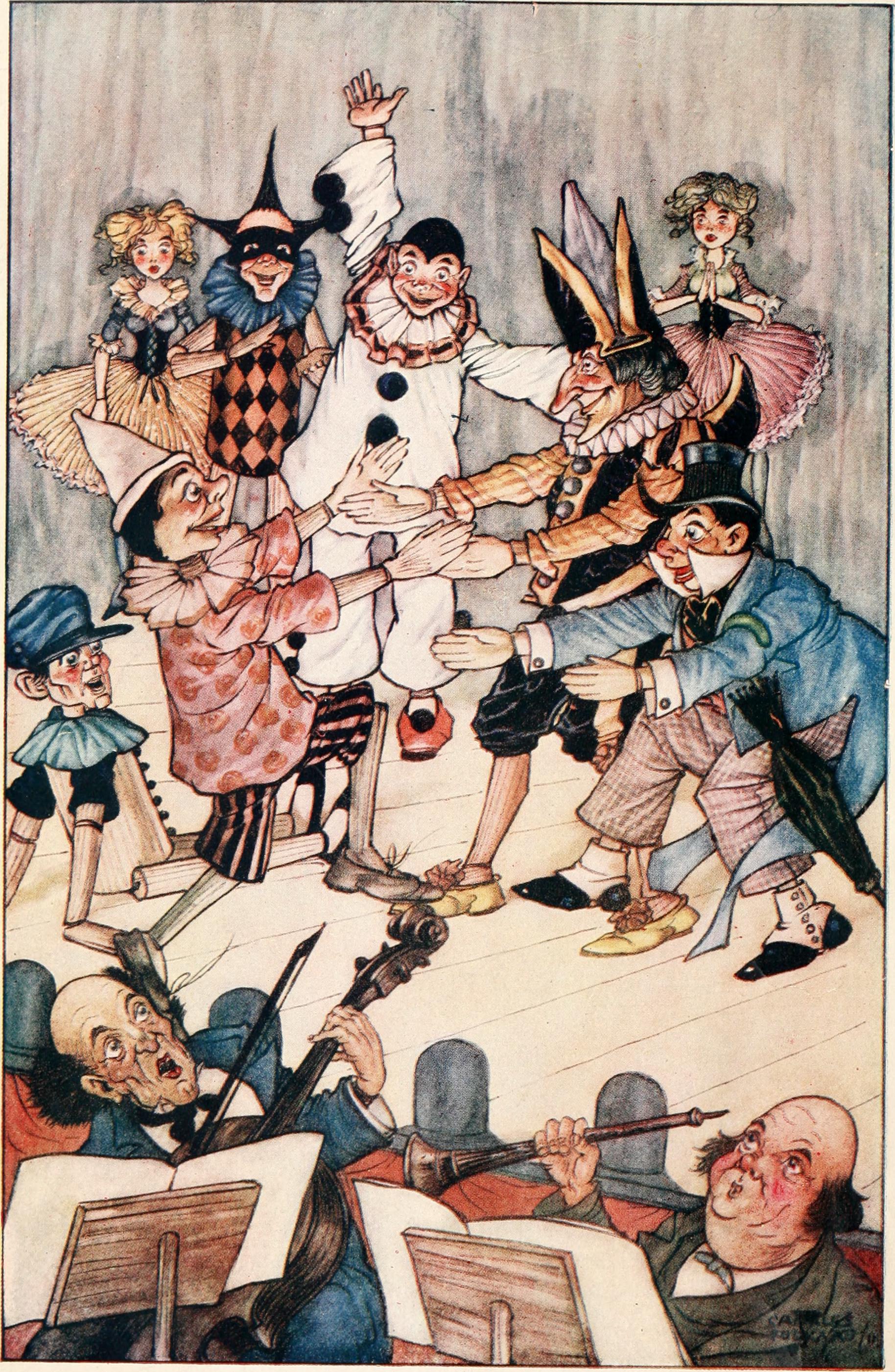
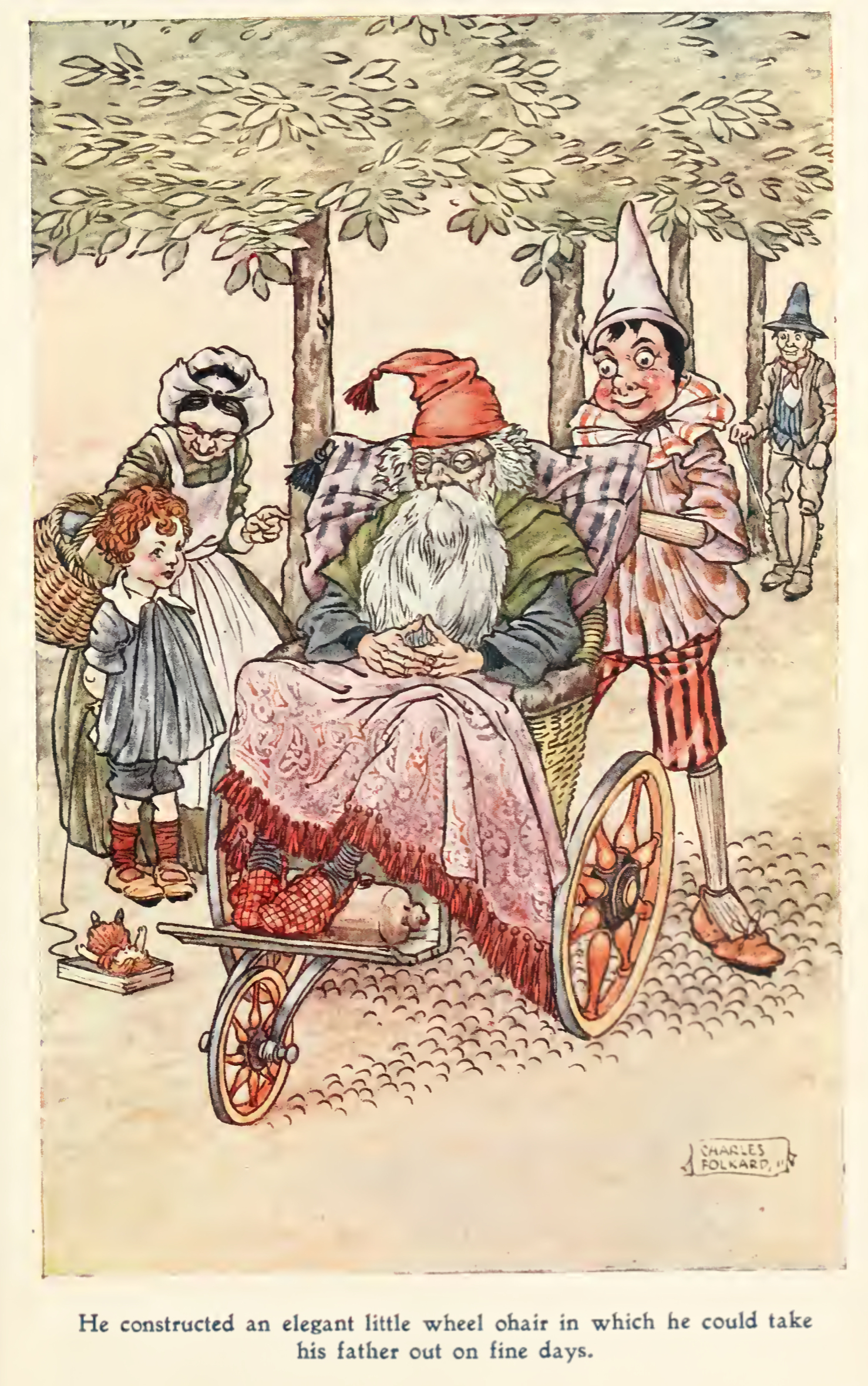
The text of my edition was the first English translation of the novel, performed by Mary Alice Murray in 1892. My cheap edition only included that single color illustration, created in 1910 by Charles Folkard for a British publisher. Decades later, I found out that Folkard had created several full-page watercolor illustrations for the novel, along with dozens of line drawings sprinkled throughout far better earlier editions.
Despite my misgivings from that single disturbing illustration, I screwed up my courage and began reading the novel. The deviations in the film were immediately apparent, throwing my young mind for a loop. The novel began with Master Cherry the carpenter, not Geppetto, cutting on a talking piece of wood. Geppetto did not appear until the second chapter, and the two characters became angry and “from words they came to blows, and flying at each other they bit, and fought, and scratched manfully.” Egad!
Geppetto and Master Cherry fight
Geppetto soon carved the “puppet” Pinocchio from the talking piece of wood, with no talk of wanting a little boy, no blue fairy, etc. Rather than living in a shop full of clever clocks, he was so poor that all his room had was a worn-out chair, a crummy bed, a derelict little table, and on the far wall a painted fire.
I remember being confused as a child when the book and the film referred to Pinocchio as a puppet, when he was obviously a marionette. The 2021 annotated translation by John Hooper and Anna Kraczyna reveals that Collodi used the word burattino throughout the novel, which was used loosely at the time to describe both puppets and marionettes. Only once did he choose to refer to Pinocchio with the actual term for marionette.
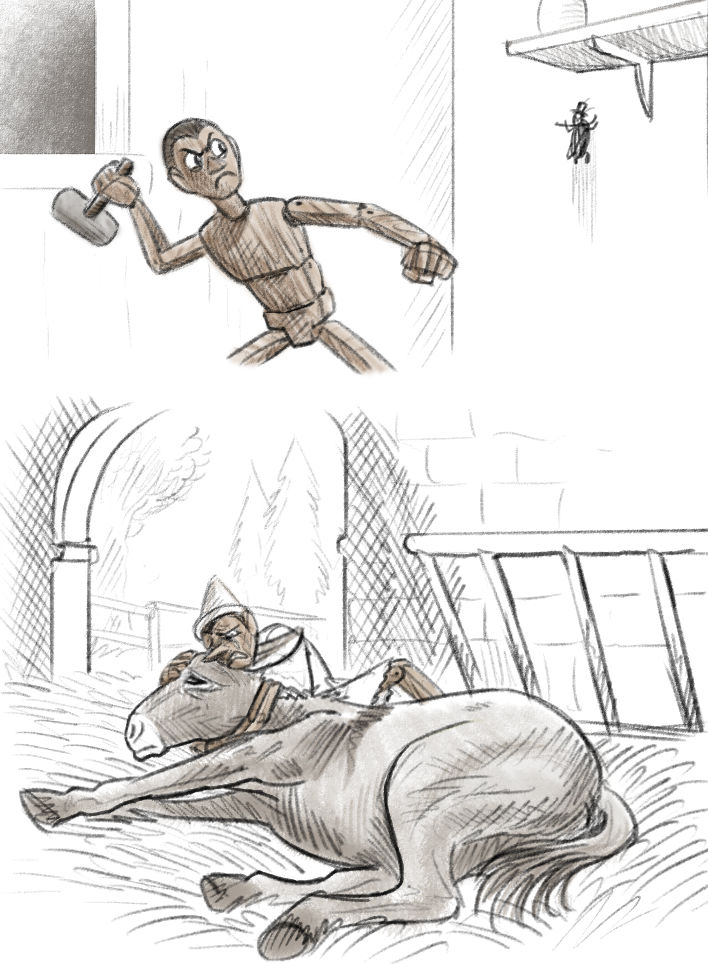
Pinocchio murders the Talking-cricket
I made it through Chapter IV, when the “Talking-cricket” appeared. But I was shocked by how it ended:
‘Poor Pinocchio! I really pity you ! . . . ‘
‘Why do you pity me?’
‘Because you are a puppet and, what is worse, because you have a wooden head.’
At these last words Pinocchio jumped up in a rage, and snatching a wooden hammer from the bench he threw it at the Talking-cricket.
Perhaps he never meant to hit him; but unfortunately it struck him exactly on the head, so that the poor Cricket had scarcely breath to cry cri-cri-cri, and then he remained dried up and flattened against the wall.
And that was where I stopped reading for 50 years: Pinocchio killing the character I knew as Jiminy Cricket.
Back in 1790, copyrights in the USA only applied to maps, charts, and books for up to 28 years. In 1831, that was lengthened to 42 years and extended to musical compositions, but not performances. In 1909, that was lengthened to 56 years and extended to motion pictures.
In 1976, copyrights were extended to the lifetime of an author plus 50 years, and to 75 years from publication for prior works-for-hire created for corporations, in keeping with the Berne Convention, an international copyright treaty. That would have finally ended the copyright on Steamboat Willie in 2003, so in 1998 Disney helped get the Sonny Bono Copyright Term Extension Act into law, which extended it to the life of the author plus 70 years and to 95 years for works created by corporations.
It was, of course, hypocritical of Disney to lobby for such extensions to protect its own works, given that many of them were based on prior works which had fallen out of copyright. If the copyright law Disney successfully promoted in 1998 had applied to the original Pinocchio novel, Walt could not have made his 1940 film without permission and licensing from the estate of Carlo Lorenzini, since the novel would have remained under copyright until at least 1960.
That was bouncing around my brain when an arctic blast had me working virtually from home for three days. That return to my work life during the early part of the COVID-19 pandemic reminded me of relaxing videos I had enjoyed during the stressful pandemic, such as Pete Beard’s videos on illustrators. One of his early videos had included Charles Folkard.
That was enough to prompt me search out Folkard’s other watercolor and gouache illustrations for Pinocchio.
I could tell some of the scenes had been adapted into the Disney film, but several had not. So I decided to finally finish reading Pinocchio. I no longer owned the old hardback copy of my youth, which was just as well given its paucity of illustrations. So I ordered two print editions: a Golden Books for Childrenedition from 1920 that included Folkard’s illustrations, and a 2004 edition with illustrations by Roberto Innocenti. I didn’t bother downloading older editions of the book with original illustrations by Mazzanti, as those did not appeal to me.
Then I decided to write this blog post about the experience, and regular readers will know that usually prompts me to do a considerable amount of research. So I purchased the Kindle edition of the splendid 2021 annotated translation by Hooper and Kraczyna. Footnotes can be a pain in a paper book or on a dedicated Kindle device, but they are quite usable in the Kindle app on an iPad. You can simply tap the footnote number to overlay it on the bottom of the page, which you can read and then tap to dismiss.
Surprises
If you are unfamiliar with the classic Disney film and/or the novel, Jon Solo to the rescue. He has made over 200 videos about the origins of children’s tales, and here is his complete summary of the plots of the 1940 Disney film and the novel:
One thing that was immediately apparent when reading the novel was what a rascal Pinocchio was. He could be mean-spirited and irresponsible, and he suffered mightily for it. His legs were burned off, and he almost burned alive as firewood.
I enjoyed him meeting the fox and the cat, with the former pretending to be lame and the latter faking blindness. They reminded me of Mark Twain’s twin grifters in Huckleberry Finn, the duke and the dauphin.
Pinocchio is shown to be truly naive, an easy mark, in contrast to how quickly Huck Finn figured out the ruses of the pair of crooks he encountered. Collodi was imparting lessons for children living in the impoverished rural areas of the recently-united Italy. Mandatory schooling was gradually being extended, and he repeatedly arranged for evil consequences when Pinocchio shirked school.
The story does not begin as a fairy tale. The famous Blue Fairy, who appears early on in the Disney film as a blonde in a blue dress and brings the marionette to life, doesn’t appear in the novel until the end of its first part, and then as the unexplained ghost of a little dead girl, waiting for her coffin to arrive.
Many translations call her the Fairy with Turquoise Hair, but Hooper and Kraczyna state that is incorrect. The novel uses the term turchino, which means dark blue, not turchese, which would be turquoise. It was believed that her later and older incarnation in the text was based on blue-eyed Giovanna Ragionieri, who was a young teenager when the book was being written. But her initial introduction is dreamlike and frightening, perhaps partly based on a memory of the author’s sister Marianna Seconda, who died at age six. Death was familiar to Lorenzini: five of his nine siblings died before reaching the age of seven.
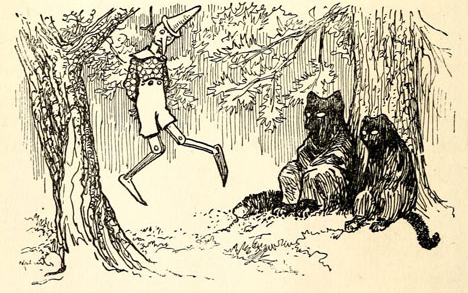
That familiarity with death and intense suffering led Collodi to pull few punches in the early chapters. The original series of stories ended tragically with Chapter XV. Here is how Mary Alice Murray translated the cruelty of the barely disguised cat and fox, who want the remaining gold coins Pinocchio has hidden in his mouth:
The grisly original end of Pinocchio
‘Let us hang him!’ repeated the other. Without loss of time they tied his arms behind him, passed a running noose round his throat, and then hung him to the branch of a tree called the Big Oak. They then sat down on the grass and waited for his last struggle. But at the end of three hours the puppet’s eyes were still open, his mouth closed, and he was kicking more than ever.
Losing patience they turned to Pinocchio and said in a bantering tone: ‘Good-bye till to-morrow. Let us hope that when we return you will be polite enough to allow yourself to be found quite dead, and with your mouth wide open.’ And they walked off.
In the meantime a tempestuous northerly wind began to blow and roar angrily, and it beat the poor puppet as he hung from side to side, making him swing violently like the clapper of a bell ringing for a wedding. And the swinging gave him atrocious spasms, and the running noose, becoming still tighter round his throat, took away his breath.
Little by little his eyes began to grow dim, but although he felt that death was near he still continued to hope that some charitable person would come to his assistance before it was too late. But when, after waiting and waiting, he found that no one came, absolutely no one, then he remembered his poor father, and thinking he was dying . . ., he stammered out: ‘Oh, papa! papa! if only you were here!’
His breath failed him and he could say no more. He shut his eyes, opened his mouth, stretched his legs, gave a long shudder, and hung stiff and insensible.
Jeepers! The influence of the Christian gospels is clear, as is the warning about boys who disobey their fathers. If the tale had ended there, as originally intended, I question if it would have become a classic.
The second part of the book has the Fairy with the Blue Hair and the nose that grows with lies
There is a clear change in the storytelling after that point. It reads much more like a fairy tale, with the dead blue-haired little girl, who occupied a small house in the woods, eventually becoming an adult fairy who lives in a mansion. She intercedes to save Pinocchio and, after many more travails and his final redemption, changes him into “a smart, lively, beautiful child with brown hair and blue eyes who was as happy and joyful as a spring lamb.”
The moralizing tone is far more noticeable in the second part of the book, which introduces Pinocchio’s most famous characteristic, a nose that grows when he lies. But he also tells at least six notable lies that have no effect on his proboscis, so it is not a consistent consequence.
Another Biblical parallel in the latter section of the book is when Pinocchio finds Geppetto inside a large sea creature. I was interested to find that Collodi did not make it a whale. He knew that most whales had large mouths but their throats were too small to swallow a person. He made the creature a shark, a pescecane, in a likely reference to loan sharks, which were described in Italy as pescecani. Collodi’s own father had fallen into the clutches of a usurer, and Collodi went into debt to assist him. So, as Hooper and Kraczyna put it, “…father and son both experienced what it was like to end up in the ‘belly of the shark.'”
Roberto Innocenti correctly portrayed Pinocchio being swallowed by a shark, not a whale or fish
While the Talking-cricket, Pinocchio, and the blue-haired girl are each reincarnated in different ways, some miscreants end badly. The cat ends up going blind for real, and the fox goes from pretending to be lame to suffering from ringworm and paralysis, forced to sell his tail to be made into a salesman’s fly whisk. Pinocchio answers his murderers’ pleas with a series of proverbs:
Stolen money never bears fruit.
The devil’s flour all turns to bran.
Those who steal their neighbor’s cape usually die without a shirt.
And then there is Lampwick, Pinocchio’s friend who lured him to abandon school to spend months of leisure at Playland. They caroused and played games until catching donkey fever, but the novel does not depict them smoking, drinking, and fighting like the Disney film has its bad boys doing on Pleasure Island. For once, Disney’s version is nastier than the novel, but the film does not depict Lampwick’s ultimate fate after his transformation into a jackass.
In Chapter XXXIII of the novel, the narrator says he does not know the fate of Lampwick. But in the final Chapter XXXVI Pinocchio finds Lampwick:
As soon as Pinocchio entered the stable, he saw a pretty little donkey lying on the straw, all skin and bones from hunger and overwork. After he had had a careful look at him, he became deeply troubled and said to himself: “But I know that little donkey! His face isn’t new to me!” And kneeling down close to him, he asked in donkey dialect: “Who are you?” In response, the little donkey opened his dying eyes and, stammering in the same dialect, answered: “I’m Lamp . . . wick . . .” Then he closed his eyes again and breathed his last.
So the novel retains some bite even with its metamorphosis into a literal fairy tale. The contrast between how Pinocchio treats the Talking-cricket early on and Lampwick at the end certainly illustrates his character growth.
The novel continued to surprise, even to its last lines. When Pinocchio finally turns into a boy, he kisses Geppetto and asks, “And where do you think the old wooden Pinocchio has gone?”
“There he is — over there!” replied Geppetto, and he motioned toward a large puppet that was propped up in a chair, his head turned to one side, his arms dangling and his legs crossed and bent at the knees. It seemed miraculous that he could stay upright.
Yikes! So the marionette wasn’t transformed into a boy. Rather the consciousness once trapped in a piece of wood was transferred into a freshly created boy. If I were Pinocchio, I’d be having quite the existential crisis at that sight.
It is that repeated disturbing strangeness, the perplexing weird nature of the novel, that makes me glad that I finally finished it after a gap of over a half-century. Was it worth the wait? Sì.