
The Lights are Out Along Hubcap Alley

One of my favorite tools is from the early 1960s: a metal roll-up yardstick that I inherited from my parents. I will delve into its design in a later post, but my preternatural curiosity has me chasing after a different rabbit.

Companies used to distribute yardsticks as free advertising. They would print their name, logo, address, and phone on them hoping that you might see it repeatedly over the years as you made use of the tool. In this case, MIDCO-Oklahoma Supply Company of Oklahoma City was the advertiser.
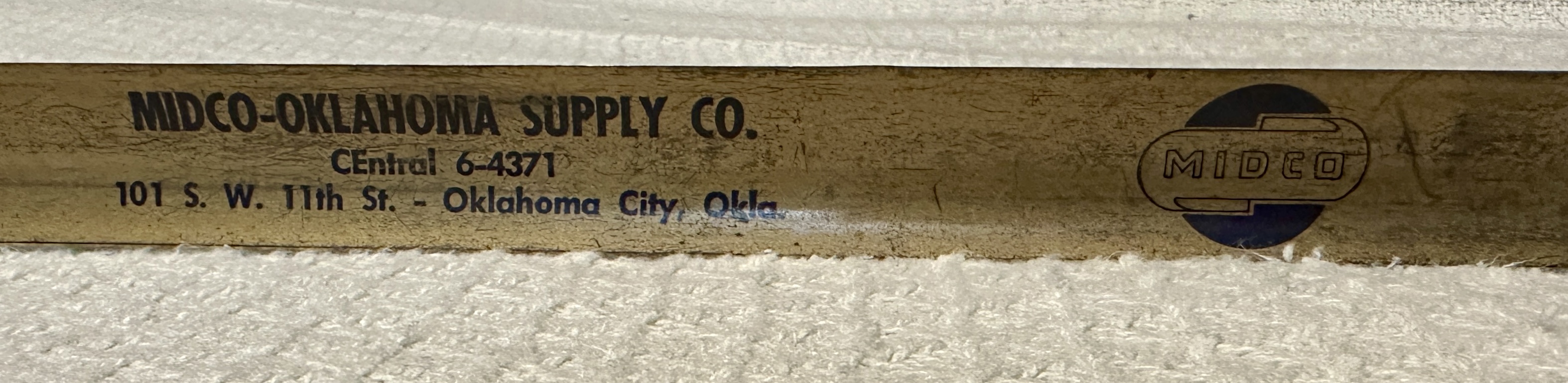
Roll-up yardstick

You can tell the yardstick is from the early 1960s since the phone number for MIDCO is in the old exchange-name 2L5N format. I couldn’t help wondering what MIDCO had been, and if it was still around. Answering that led me back to Hubcap Alley and to contemplate what my hometown gained and lost in reinventing itself.

MIDCO

MIDCO was Mid-States Supply Company, which began in 1947 in Kansas City, Missouri. It was a PVF supplier — pipes, valves, and fittings. When it opened a warehouse in Oklahoma City in 1963, it needed a cheap industrial area where its inherently ugly all-business aesthetic would fit right in. So it had a couple of obvious choices: the railroad warehouse area of Bricktown or the automobile scrapyards along Hubcap Alley.

Bricktown
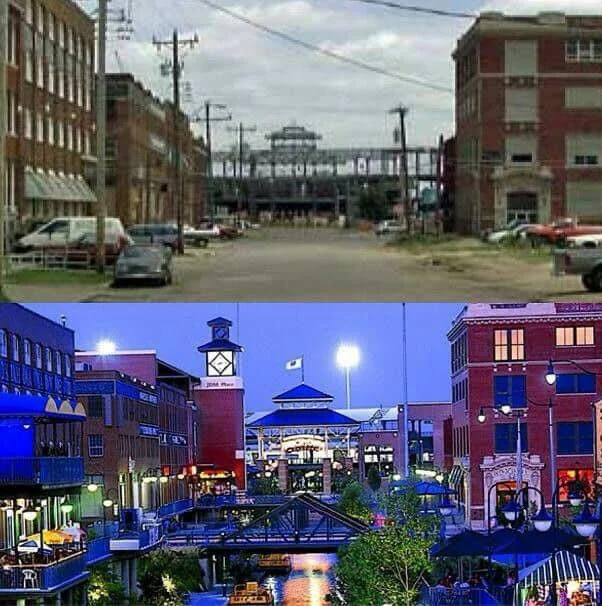
Bricktown in 1990s and 2023
Bricktown in the early 1990s and 2023

In the late 19th and early 20th century, four railroad companies had freight operations east of the tracks that ran along the eastern edge of the central business district. To avoid fires, they constructed brick warehouses from 1898 to 1930, along with working-class houses nearby. Bricktown declined in the Great Depression, and after World War II many residents left for the suburbs along subsidized highways. Railroads restructured with a lot of freight traffic shifted to highway trucks. By 1980, Bricktown was a cluster of abandoned buildings. So Bricktown was in steep decline in 1963, and MIDCO didn’t locate there.

In the 1990s, OKC residents were persuaded to invest in themselves by approving a sales tax for MAPS which renovated the Civic Center Music Hall, renovated and expanded the Myriad convention center, constructed a ballpark and sports arena, and dug the Bricktown Canal to transform that area from an abandoned warehouse district into a more lively entertainment one.

The success of the first MAPS led to three later MAPS projects. MAPS 3 would destroy Hubcap Alley.

Hubcap Alley

Almost as soon as automobiles became a part of city life, working-class families set up repair, tire, and accessory shops. There are blocks of downtown Bartlesville, where I now live, that were dotted with tire and battery companies, metal shops, and garages. Several buggy and harness firms transformed themselves to service the horseless carriages.

In Oklahoma City, the stretch of Robinson Avenue south of downtown toward the dirty ditch officially labeled as the North Canadian River became Hubcap Alley, not to be confused with Automobile Alley up north on Broadway where the car dealerships were located.
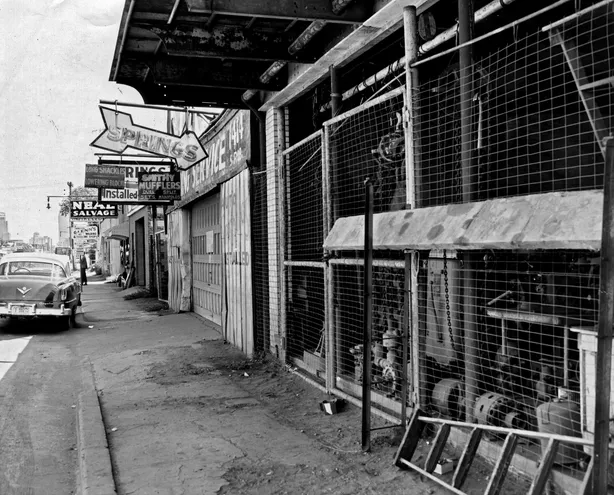
Hubcap Alley in 1956
Hubcap Alley in OKC in June 1956

Working-class families set up over two dozen repair, tire, and accessory shops along Hubcap Alley, along with big auto salvage scrapyards. If you needed a car part and couldn’t afford new, which was true for most of the folks in Oklahoma City, you would head to Hubcap Alley.

It was the birthplace of Hibdon Tires, and it was anything but pretty. So in the 1950s, it became one of the targets of the first wave of Urban Renewal. Hubcap Alley was considered an embarrassment, an ugly gauntlet for out-of-state visitors passing along US 77 on their way to downtown.

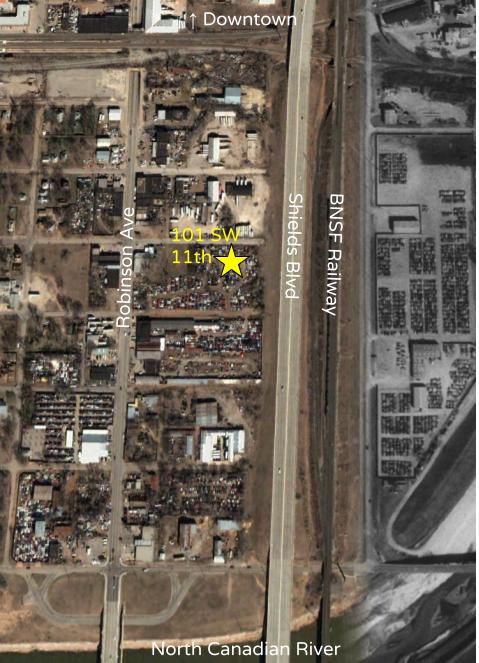
However, the businesses successfully fought back against the Urban Renewal in the 1950s, and MIDCO planted itself at 101 SW 11th in the heart of Hubcap Alley. I don’t know how long it lasted, but by 2002 that property had just become part of the auto salvage yards.

In the 1970s, Urban Renewal became stronger than ever as retail downtown collapsed. But even as it was destroying whole blocks of downtown, Urban Renewal spared Hubcap Alley by extending Shields Boulevard northward to downtown, rerouting US 77 off Robinson Avenue.
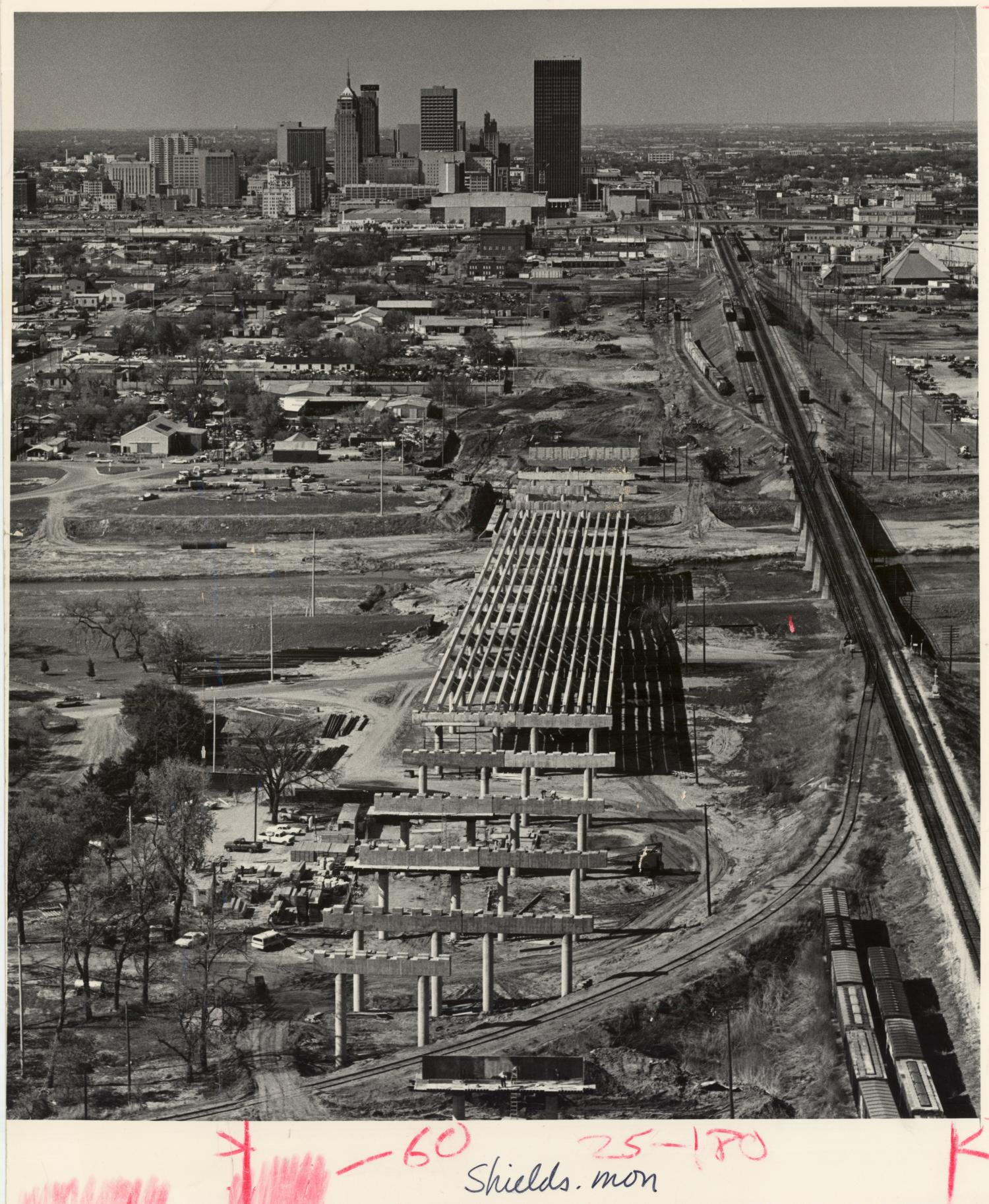
Shields extension in 1978
Extending Shields Blvd in 1978 across the North Canadian River and northward between Hubcap Alley and the BNSF tracks
Hubcap Alley aerial in 2002
Hubcap Alley in 2002

The snoots still fretted about how building the Shields extension into downtown as an elevated road, instead of at grade, would ensure no development along that stretch, and thus spare the unsightly warehouses and junkyards to the west along Hubcap Alley as Shields stabbed northward alongside the Burlington Northern Santa Fe railway tracks.

In 2009, the MAPS 3 project approved by city voters included a plan for a massive park connecting Capitol Hill, the Oklahoma River, and downtown.

By the way, lest a non-native form the wrong impression, Capitol Hill was once a small town south of the river, two miles from the actual state capitol. A newspaper man purchased the hill in 1900, hoping it might become home to the state capitol, but the capitol was instead built a mile northeast of downtown. Another scheme for a suburb location for the capitol led to the non-existent Putnam City, a story I’ve shared previously.

As for the Oklahoma River, that is a renaming of a seven-mile stretch of the North Canadian that now has several locks creating small lakes for rowing, kayaking, and canoeing regattas. You guessed it — that was another MAPS 3 project, part of the same package that dealt with Hubcap Alley.
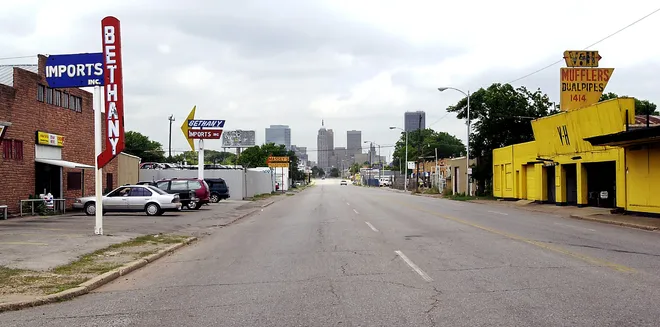
Hubcap Alley before its demise
Hubcap Alley just before its end

MAPS 3 funded the city’s acquisition of the west side of Robinson Avenue from the then-new rerouting of Interstate 40 all the way south to the river. Car shops and junkyards were transformed into the skinny lower half of Scissortail Park.
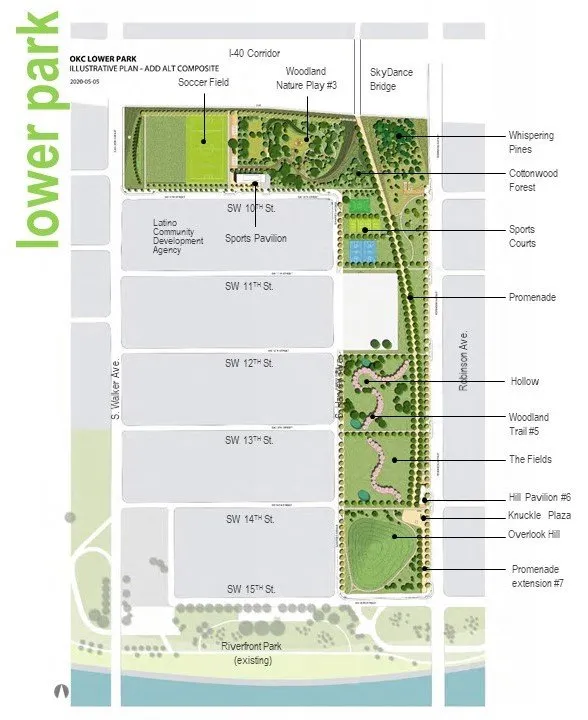
Scissortail Park South
How they destroyed Hubcap Alley

As intended, that meant that the remaining scrapyards on the east side of Robinson lost business as former customers presumed all of the junk dealers were gone. It also led hopeful developers and speculators to start buying those properties, betting on rising values near the new park. A&A Auto Parts & Salvage, the last holdout with about 400 cars on its lot, closed in 2022.
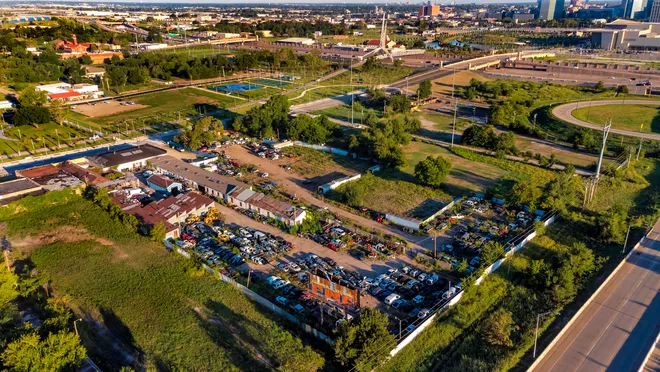
Last scrapyard at Hubcap Alley
A&A Auto Salvage, the last scrapyard along Hubcap Alley, closed in 2022

So 101 SW 11th Street is now just an empty lot east of the Scissortail Lower Park, south of the new convention center, part of the landscape that MAPS 3 denuded.
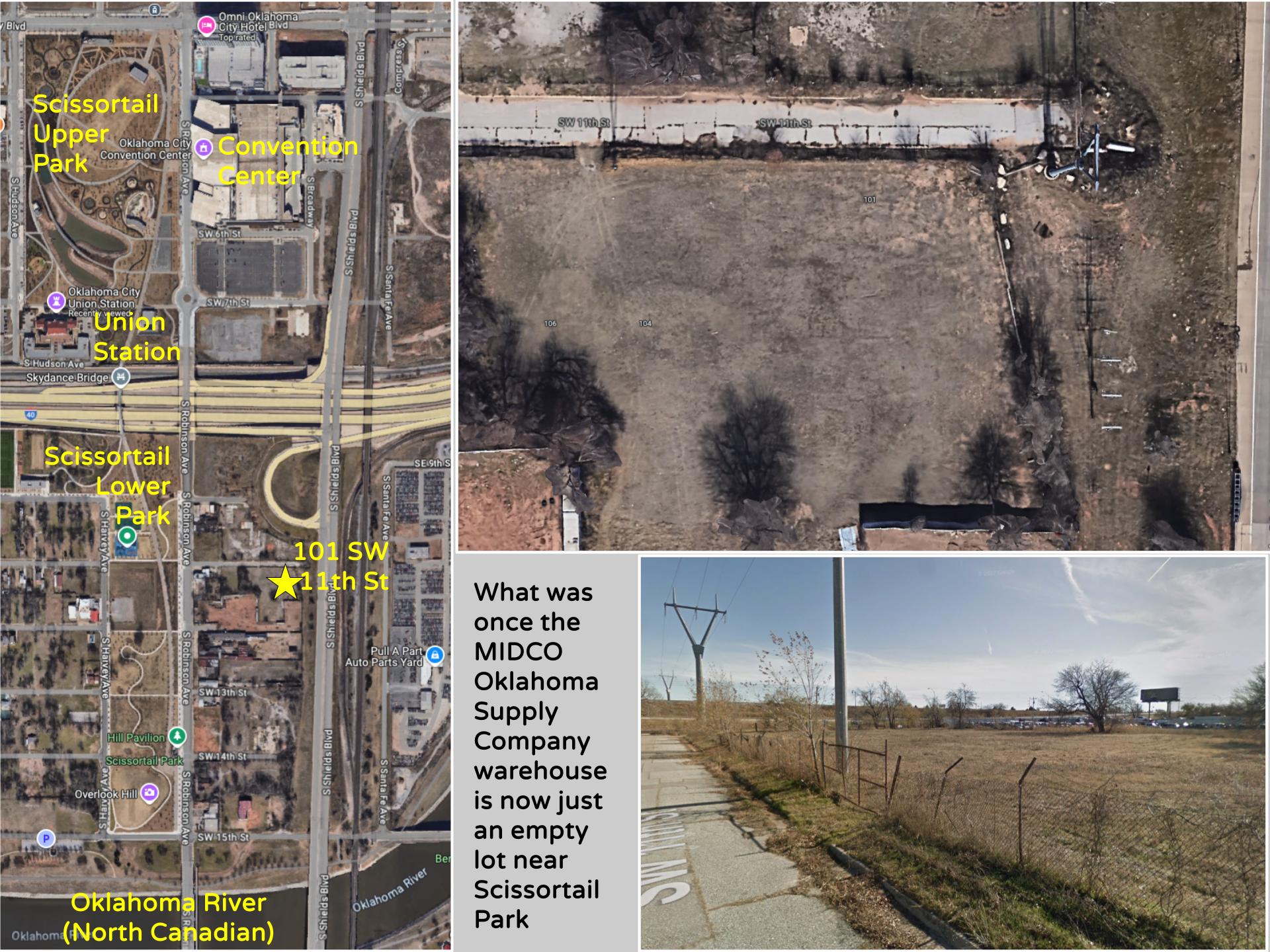
101 SW 11th vacant lot

The snobs finally won, and the lights went dark along Hubcap Alley. Below you see the fancy northern part of the park just west of the new convention center, with the distinctive spikes of the Skydance pedestrian bridge to the south across Interstate 40.

Scissortail Park North
Scissortail Park’s northern part, the distinctive bridge across I-40, and trees

I’ve yet to see Scissortail Park or the new convention center, but I’ve driven under Skydance Bridge a few times. If I were ever at the convention center, I might walk across Skydance Bridge to the lower park, which is far less compelling than the northern portion since the lower park was really just a mechanism for destroying Hubcap Alley.

A Lost World
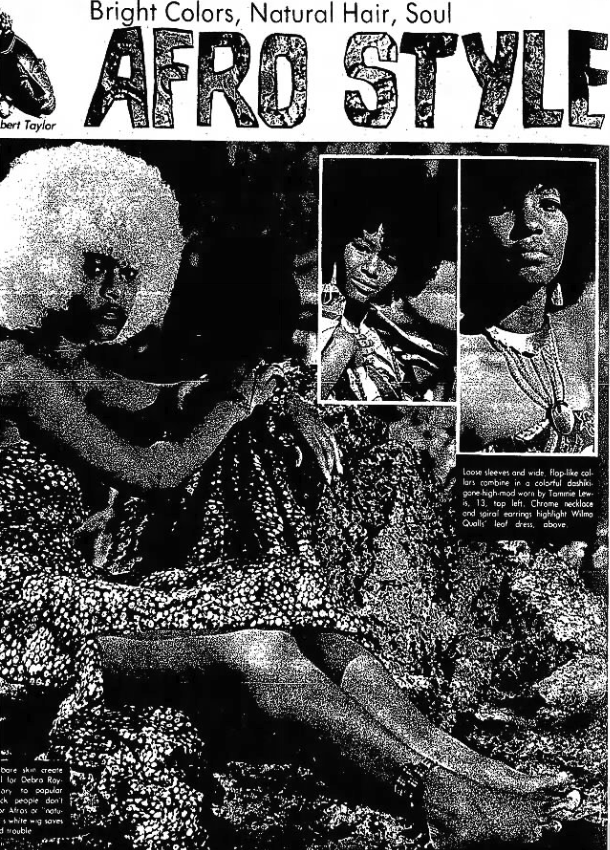
Afro style
The Soul Boutique was high-end black fashion in OKC in the 1970s

I have rather mixed feelings about it all. I grew up in Oklahoma City and knew it was not a beautiful town, but rather a flat, sprawling, and eminently practical-minded mess. I grew up in a city that sported the junkyards of Hubcap Alley, the world’s largest stockyards, and the diaspora of Deep Deuce after the Civil Rights era, when the black culture that had earlier created Ralph Ellison stretched out into a truly funky stretch of 23rd Street.

The Soul Boutique offered high-end mod and Afro fashions along an urban corridor that looked like the set of Starsky & Hutch, with big colorful Cadillacs sporting curb feelers and people strutting along in crushed velvet.

It was all rather gritty. The collapsing downtown spread urban blight and street crime. The fancy shops on the ground floors of the skyscrapers were closing, and Main Street was emptied while I explored the underground Conncourse.
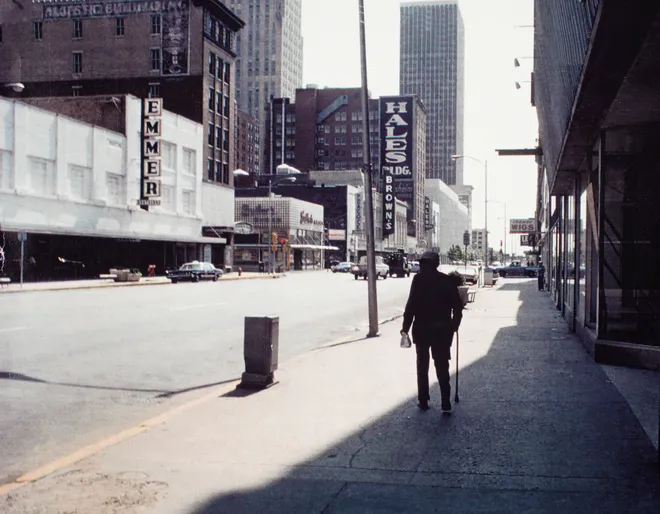
Main Street in 1974
Man Street in 1974, just before it was wiped out

The old Mayflower cinema on 23rd Street had opened in 1938 showing Bing Crosby in Pennies from Heaven. It had a nautical theme contrasting to the southwest look of its architectural twin, The Bison. While the Bison closed in 1971, the Mayflower survived…by becoming a porno house directly across the street from the famous Gold Dome of Citizens State Bank.

Mayflower adult theater
The old Mayflower became an adult-movie house

OKC knew it was in trouble by 1962, when 53 downtown retailers had closed or moved to the suburbs. City leaders Dean McGee, Stanley Draper, and E.K. Gaylord pushed for Urban Renewal, and businessmen hired architect I.M. Pei to redesign the 528 acres of the central business district.

His way of dealing with the small lots and aging structures was to demolish hundreds of buildings to form superblocks for larger-scale development. To his credit, his original plan did call for retaining notable landmarks like the Biltmore and Huckins Hotels, but that wasn’t how things went.
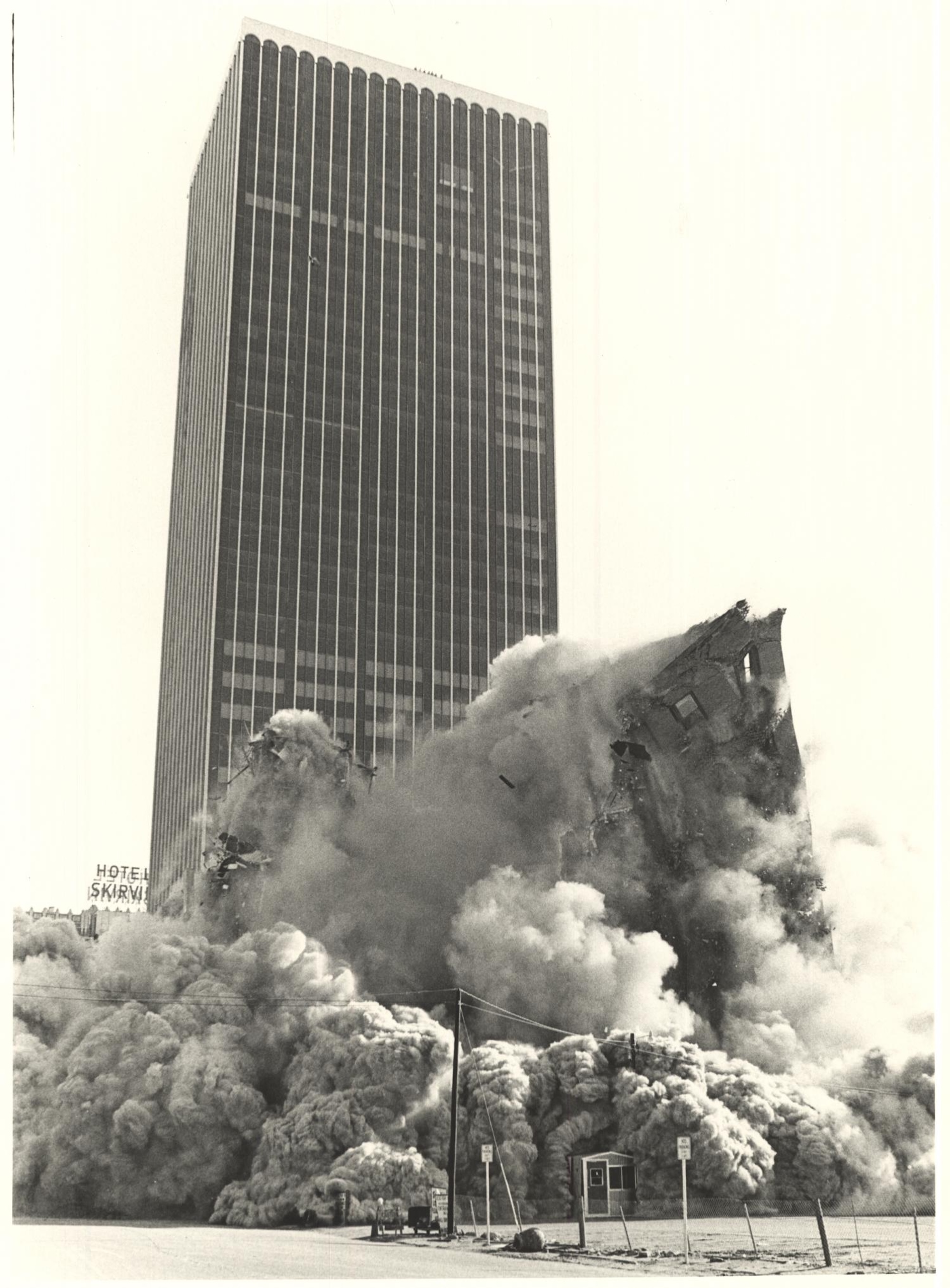
Huckins Hotel demolition
The Huckins Hotel came down in 1971

The large-scale demolitions began in 1967, but the plan ended up destroying far more than it rebuilt. In 1971, the Huckins Hotel at Broadway and Main, which had once been the temporary state capitol, was the first of the city’s buildings to be brought down with explosives.

The big John A. Brown department store was to be rebuilt, but in 1974 the out-of-state Dayton Hudson Corporation announced they would entirely abandon downtown for suburban malls. The site for a Main Street Galleria was cleared, but it just became a surface-level parking garage.

Along with Brown’s, the beautiful old Criterion Theater and the Baum Building had been torn down, but the Galleria shopping area never materialized, and the Century Center Mall ignored the street and never thrived.

My parents would sometimes take me downtown to visit my father’s office in the First National Building downtown. Eventually we parked at the new Century Center, and I was struck by the oddity of driving up and down its spiral ramps. It was strange to see so much of the city razed to make way for megastructures.

Biltmore Hotel demolition
The Biltmore was destroyed in 1977

Just across the street was the brutalist and cheaply built Myriad convention center. My high school proms and commencement were held there, and I was struck by its unadorned and grim bare concrete interiors.

In 1977, one of the last acts of destruction was blowing up the old 26-story Biltmore Hotel. The original Pei Plan called for “Tivoli Gardens” around the hotel, but the hotel was judged to no longer be economically viable. The Myriad Botanical Gardens simply grew a bit to swallow up the Biltmore plot.

The Oklahoma City Urban Renewal Authority’s contractors leveled 447 buildings, and private owners tore out another 75 between 6th and I-40, from Shartel to the Santa Fe.

The street grid and fine-grained commercial core of the early 20th century was replaced with superblocks, large public projects, parking facilities, and freeways.

OKC in 1954 and 2014
Comparing downtown OKC in 1954 and 2014

The city reeled for some time after the appalling destruction of the 1970s Urban Renewal, which had been followed by the 1980s oil bust. We should bear in mind that many of the old buildings failed to meet modern safety and accessibility codes, had antiquated heating, and could be difficult to retrofit for air conditioning. The Biltmore, for example, unlike the old Skirvin, First National, and Colcord buildings, lacked the high ceilings needed for ductwork retrofits, so it used window air units.
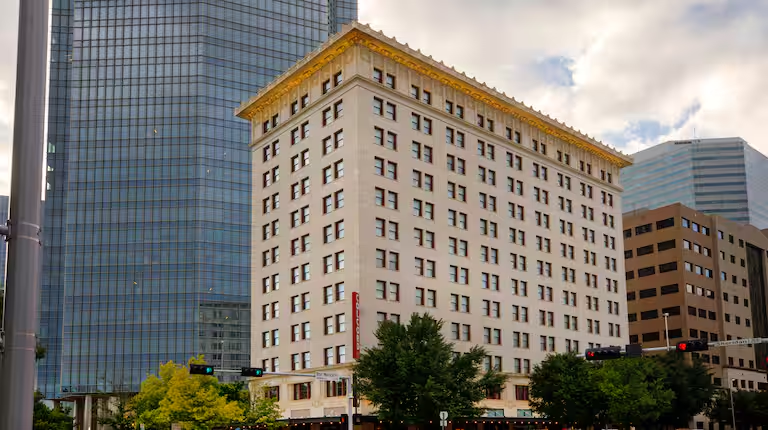
Colcord Hotel in OKC
The Colcord Hotel was spared from Urban Renewal

The Colcord Building of 1909 was the city’s first skyscraper with 14 floors stacking up to 145 feet. Charles Colcord built the office tower of steel-reinforced concrete, having seen the devastation in San Francisco from its 1906 earthquake and fires. But saving it cost $2 million in the 1970s; there simply weren’t the resources to make similar investments on a large scale. It is now a luxury hotel, and Wendy and I enjoyed a stay there. Time marches on, and now the Colcord is dwarfed by the neighboring Devon Energy Center, a ridiculous 844-foot 50-story example of corporate hubris.

Oklahoma City finally tried again at a modified form of urban renewal in the 1990s with MAPS, which at least combined some big new structures with renovations and repurposing of some of the remaining old ones. Bricktown was revived by its ballpark and big ditch.
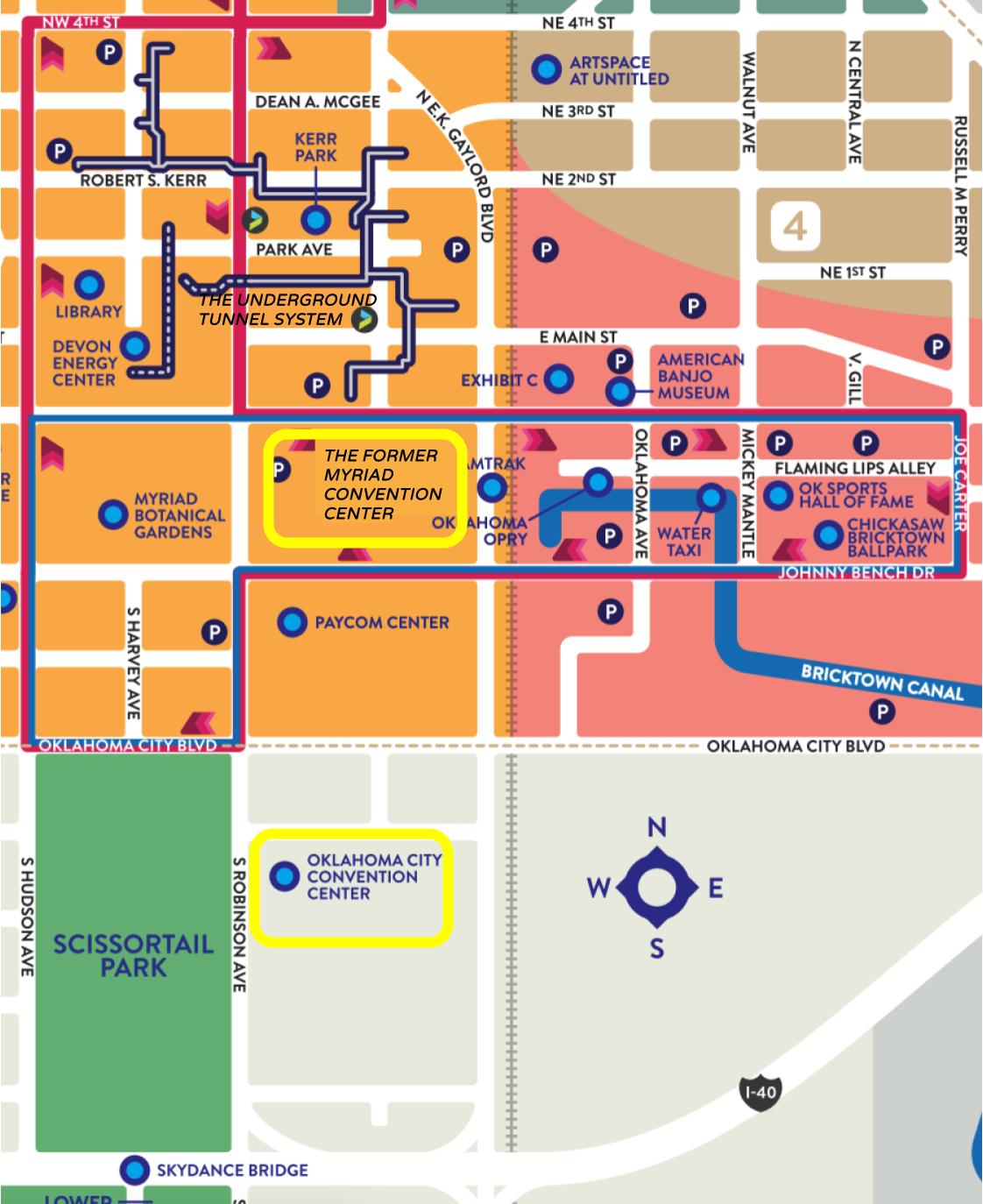
Downtown OKC Map
The new convention center is isolated from several downtown hotels and Bricktown, which is shaded red

MAPS 3 addressed the Myriad’s shortcomings by building a new convention center to the south, which struck me as counterintuitive, placing it at some distance from several major hotels and doubling the walk to Bricktown’s restaurants. Oklahoma City’s summer weather is anything but pedestrian-friendly, and I’m skeptical about the expensive new streetcar system making up for the inconvenience. The old Conncourse tunnels, now called The Underground, are now blocks away, and were never extended to Bricktown anyway.

Just as the Myriad had its gardens to the west, MAPS 3 ensured that the new convention center would have the even larger Scissortail Park. It all seems rather wasteful and duplicative, and a year ago OKC voters doubled down on that approach by approving a sales tax extension that will fund a new arena on the site of the old Myriad. That will render obsolete the intervening downtown arena built by the first MAPS project, an $89 million investment from 1999 to 2002. That first MAPS arena only had a useful life of a bit over 20 years, and the new arena will end up costing a whopping billion dollars.

I find it all a bit bewildering and alienating, but I’m not a sports fan and I haven’t lived in OKC since 1989. So I don’t pretend I know better than the people who live and play there. What I do know is that the decades of MAPS projects have allowed my hometown to sand and scrape off much of the grit that I grew up with. The city is far sleeker and more appealing these days, yet it is still busily gnawing holes in its inner core in a continuing quest for bigger and better.

What does it all mean? That what I think of as my hometown is long gone, and if I’m honest, maybe that’s for the best.


Posted in history, nostalgia | Leave a comment

2024 Reads & Watches

This is my third annual book and video report after sharing my reads in 2022 and my reads and watches in 2023. I also still have old book recommendations preserved on seven blog pages, but those haven’t been updated in years. I continue to track my reading at LibraryThing. While my reading is also logged at GoodReads, my Read list there is inaccurate, and I dislike the GoodReads interface too much to properly curate its records.

Book Tech

I read about 30 books in 2024, almost as many as I finished in 2023. 65% of those were Kindle ebooks, 25% were Audible audiobooks, and 10% were hardback books.

My Kindle eReaders over the years; some prices reflect discounts and rewards points

As I compose this post, I’ve read Kindle books for 16 weeks in a row, although I had a far longer Kindle streak of 98 weeks from November 2018 to September 2020, maintained after March 2020 by the COVID-19 pandemic. I will note that although I’ve had a Kindle since 2008, Amazon doesn’t show statistics before August 2018.

I had used seven models of Kindles over the past 16 years, and I took advantage of a Black Friday sale to purchase my eighth: a Kindle Paperwhite Signature Edition. I never liked the uneven thickness of my 2019 Kindle Oasis, although I appreciated its physical page buttons when I was reading outside on a patio swing in cold weather and wearing gloves. I usually fell back to using my 2014 Kindle Voyage, but after a decade of use the battery life on it had declined enough to annoy me.

Thus I bought the Kindle Paperwhite 6 Signature Edition, which is the 12th generation of the Amazon e-reader. Amazon no longer sells any e-ink reader with physical page buttons, but happily I find that I can still adequately advance the pages of my new Paperwhite when wearing my Sonoran Merino wool gloves with SilverSync Touch fingers — they have conductive silver fibers to allow touchscreen interactions.

One issue I faced with the upgrade, however, was getting a Kindle case. Since 2010 I had carried most of my previous Kindles in a soft case from BUILT. It was too narrow for the Oasis, but I would just take the Voyage on my escapades. However, now the Voyage was dying and both the Oasis and the new Paperwhite wouldn’t fit. I was a bit leery of purchasing an Amazon case, since their case kept crashing my Kindle 3 back in 2010. Frankly, they’ve never been particularly adept at hardware design.

I couldn’t find a wider form of the vintage BUILT case, so I reluctantly ordered a Kindle Colorsoft case. I am pleased to report that I find it comfortable to use, and I like how the Kindle sleeps and awakens when you close or open the case.

As for physical books, one was required reading for my job and was purchased for me. Another was about a photographer, and while I don’t mind reading comics with the Kindle app on an iPad, a Kindle’s e-ink is still marginal for photographs. Another book was a 1978 biography that simply was not available as an electronic book, so I ordered a used hardback for $29 with tax.

Book Reviews

Books I Read in 2024
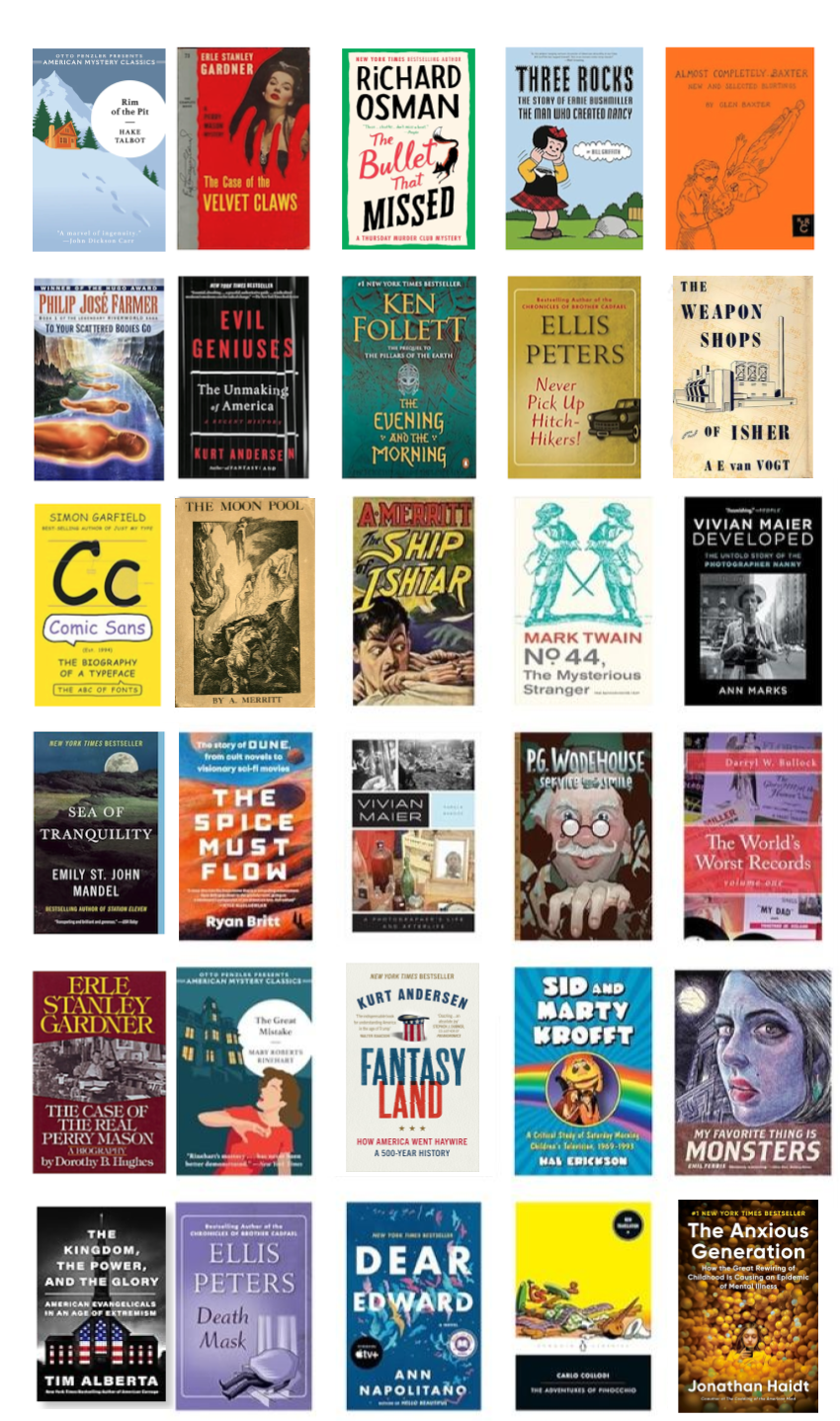
The books I read in 2024

My favorite book overall in 2024 was Vivian Maier Developed: The Untold Story of the Photographer Nanny by Ann Marks. I read it shortly after finishing Vivian Maier: A Photographer’s Life and Afterlife, which may be the first time I’ve read two biographies of the same person in succession. It was a beautifully written and well-researched look at a complicated and talented woman whose work did not find acclaim until its serendipitous discovery in a storage locker sale, and it included many of her photographs. The Finding Vivian Maier documentary is also quite good.

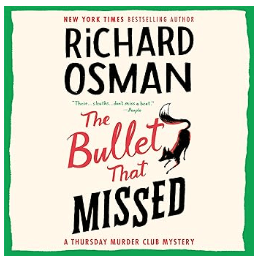
My favorite audiobook in 2024 was The Bullet That Missed, the third in Richard Osman’s Thursday Murder Club series. He has published four of them thus far, with a fifth promised for September 2025. I have loved that series so much that I deliberately save them up to enjoy one per year. Their plots are less important to me than the poignant characterizations of the aging heroes and villains.

My favorite book of 2024

I often find multiple narrators a bit gimmicky, but they were used to decent effect in Emily St. John Mandel’s Sea of Tranquility with different narrators for its timeframes of 1912, 2020, 2203, and 2401. I found the plot clumsy, but I enjoyed the book’s atmospherics.

A far more skillful and moving work was Ann Napolitano’s Dear Edward, which has melancholic existential staying power. Far more lively was Ken Follett’s lengthy The Evening and the Morning, book four in his Kingsbridge series, which offered another well-researched glimpse of long-ago life in England. That sucker was over 24 hours long, and I don’t speed-read audiobooks, but it was worth the investment.

I didn’t seek out any classics this year, other than to finally finish Pinocchio 50 years after starting it. But I did read some old works, including the final manuscript of Mark Twain’s No. 44, The Mysterious Stranger from 1908. It was a strange book and my least favorite of the ten Sam Clemens books that I’ve read. Thus far, I prefer his non-fiction travelogues and reminiscences to his fiction novels.

My favorite audiobook of 2024

Other old works I enjoyed this year were two fantasy novels by Abraham Merritt. I first read 1924’s The Ship of Ishtar, and followed that with 1919’s The Moon Pool. I liked them both, but I’d recommend the ship over the pool. I’ve downloaded a couple more of his works in my Kindle for future reading.

I listened to Mary Roberts Rinehart’s The Great Mistake from 1940, but it was far less memorable than her mysteries The After House of 1914, The Window at the White Cat of 1910, or her comedic Where There’s a Will in 1912. Another mystery author I happily returned to was Edith Pargeter, writing as Ellis Peters, with 1959’s Death Mask and Never Pick Up Hitch-Hikers! from 1976.

I decided to seek out another mystery author with a long series, so I read the first Perry Mason mystery, The Case of the Velvet Claws from 1936. I watched some of the episodes of the old television show years ago; here is a great example. While I had heard of Erle Stanley Gardner, I did not know he had been a self-proclaimed fiction factory who authored at least 140 books with about 100 million sales.

The book was not what I had expected, with a gritty tone and no court appearances. Upon discovering that Gardner had been the best-selling American author of the 20th century at the time of his death in 1970, I decided to read a biography. That meant purchasing a used hardback of Erle Stanley Gardner: The Case of the Real Perry Mason, which I found fairly interesting. I have Perry Mason #2, The Case of the Sulky Girl, downloaded into my Kindle for a future read, and I will likely sample the first in the Cool and Lam series he published using the pen name of A. A. Fair.

I also revisited another favorite author, who helped me endure the darkest days of COVID-19: P.G. Wodehouse. Service with a Smile was the eighth full-length novel set at Blandings Castle. I’m parceling those books out as well, with only two finished novels left to go, plus one unfinished work. I plan to finish that series before sampling a Jeeves and Wooster novel.

I’m finishing 2024 with this one

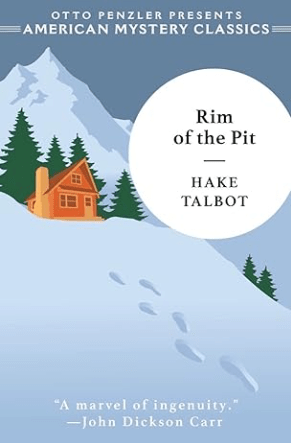
I’m currently reading 1944’s Rim of the Pit, one of only two published novels by Henning Nelms, writing as Hake Talbot. It is lauded as the second-best locked room mystery of all time, after John Dickson Carr’s The Hollow Man. TomCat wrote a great review of the Talbot book, and Curtis Evans provided a nice biographical article on Nelms. I especially enjoyed how Hake Talbot introduced one of the characters in Rim of the Pit:

Her face still showed traces of a beauty which must have been flamboyant in her youth, but she had fought age with the wrong weapons. The implausible black of her hair made her look five years older than she was.

I’m generally unimpressed by depictions of the supernatural, but the hysterics of a spirit supposedly contacted via a dark séance were striking:

Imbecile!” Désanat’s voice rose to a shriek. “You dabble in mysteries you are not able to comprehend, like a child playing on the rim of a volcano. Imbecile, like the child, to think that which lies dormant cannot engulf you.”

My most disappointing read of 2024 was my attempt at Philip José Farmer’s Riverworld Saga. I finished To Your Scattered Bodies Go, which had a fascinating premise but uneven execution, but I abandoned The Fabulous Riverboat mid-stream. I read about half of The Kingdom, the Power, and the Glory: American Evangelicals in an Age of Extremism, and I listened to Kurt Andersen’s Evil Geniuses: The Unmaking of America and Fantasyland: How America Went Haywire, which helped delineate the origins of some of our problems, which seem unlikely to be solved anytime soon.

I don’t read many comic books, but I enjoyed Three Rocks: The Story of Ernie Bushmiller: The Man Who Created Nancy by Bill Griffith, although it would have benefited from a harsher edit. I got a kick out of the 12-part Batman ’66 Meets the Green Hornet series by Kevin Smith, Ralph Garman, and Ty Templeton. I particularly enjoyed the dark and deep My Favorite Thing Is Monsters by Emil Ferris, with Part 2 finally released seven years after Part 1. Almost Completely Baxter: New and Selected Blurtings was a bizarre work.

Videos

I’m currently supporting eight creators via Patreon, having dropped three of my 2023 memberships and added Asianometry. You can see my 2023 post for links to my favorite video creators; I’ll just highlight a new discovery here.

Perf Damage is great

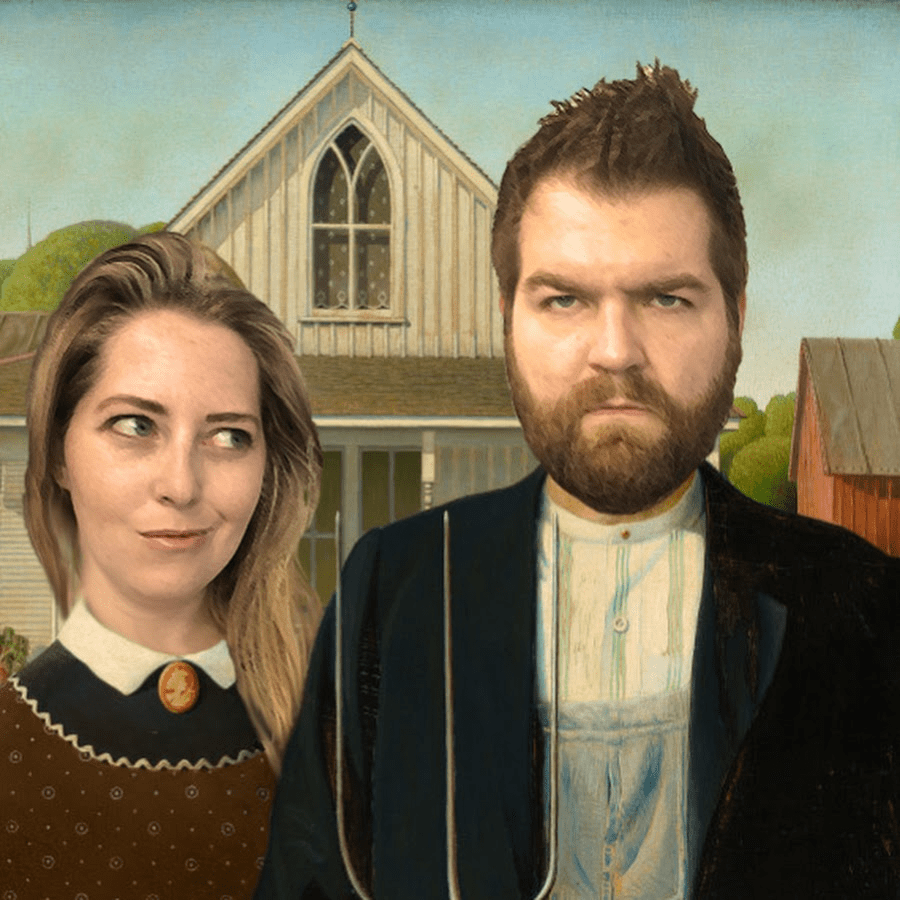
Recently I stumbled onto Perf Damage, with the wife-and-husband team Charlotte and Adam Barker. She is the Director of Film Preservation for Paramount, and he is a camera utility for the Jimmy Kimmel show. They are movie fanatics who watch double features all the time. I loved their look back at The Lydeckers, who did practical effects for the old Republic pictures, and Natalie Kalmus, the infamous Technicolor consultant.

Their videos were so good that I wanted to listen to several of their older podcasts, but I found that most of the links were broken. Happily, the ones at Spotify still work, which was the first time I’ve ever used that service. I especially enjoyed their two episodes on William Castle: his early years from 1914-1958 and his later years from 1959-1977. I also recommend H for Horrific. If you get interested in their work, there is a great interview with Charlotte by Cereal at Midnight.

That is part of the beauty of all literature. You discover that your longings are universal longings, that you’re not lonely and isolated from anyone. You belong.

F. Scott Fitzgerald
Posted in books, video | Leave a comment

Switches Old and New

In 1972, my parents moved us to Bethany, Oklahoma after I graduated from kindergarten. I was excited to explore our new home, which consisted of a 1949 house with a large addition constructed sometime in the 1960s. My bedroom was in the 1949 part of the home, which had the standard toggle light switches that were invented in 1916. The new addition, however, had different switches that are quite uncommon these days.

Low-Voltage Sierra Despard Switches

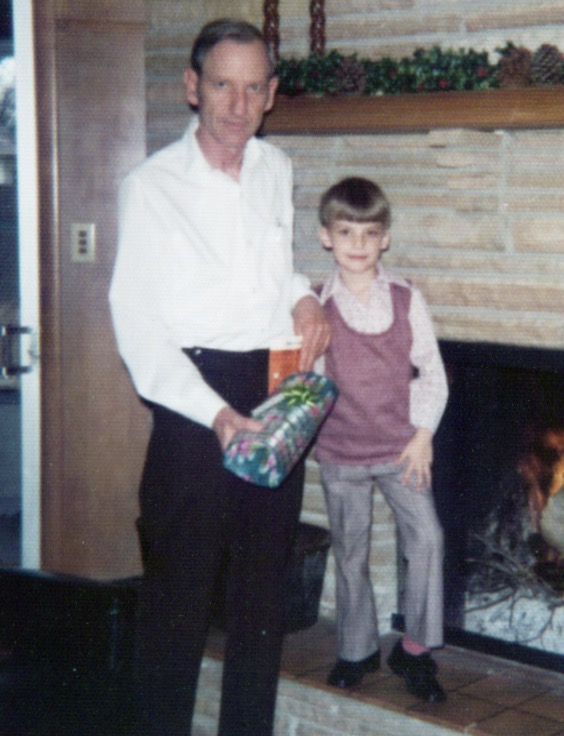
Christmas 1972 with my father at our new home; behind him is one of the low-voltage switch sets

The addition was wired with low-voltage light switches, which first came on the market in the late 1950s and were discontinued in the 1980s. You can see a gang of three on the wall plate behind my father in the photo from Christmas 1972.

They were 24-volt momentary switches. You briefly pressed a tab upward to turn on a circuit or briefly pressed it downward to turn it off, and a spring always returned the tab to the central position.

Pressing the tab one way or the other briefly energized a 24-volt line leading to one of several latching relays on regular 120-volt circuits for the various lights. The set of relays were all mounted together in a panel in the garage. The relays were what opened or closed the actual lighting circuits, themselves being triggered by thin 24-volt lines leading off to the various switches.

A set of relays in an old low-voltage lighting system

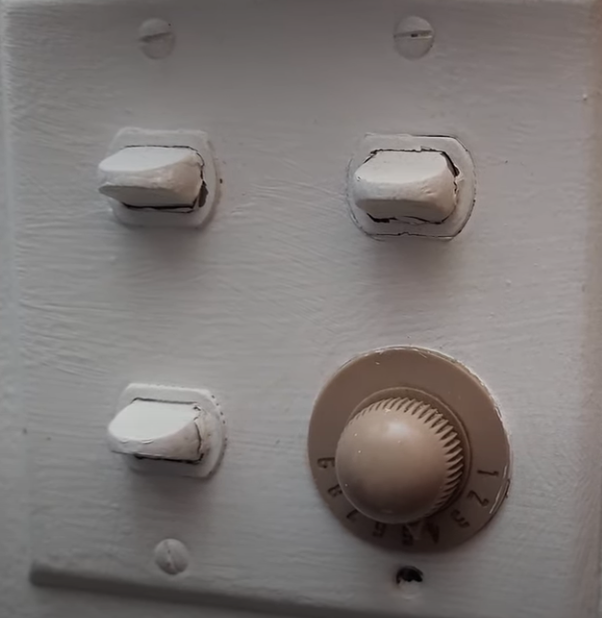
This odd approach to wiring meant you could have any number of switches for a given circuit without complicated wiring paths. It was also used in some high-end housing because it could be used to control multiple areas or zones. Smarter Circuits showed how his home has a rotating switch in the master bedroom that once could be used to control up to nine different circuits scattered around his home.

The rotating switch allows one to control different lights throughout the home

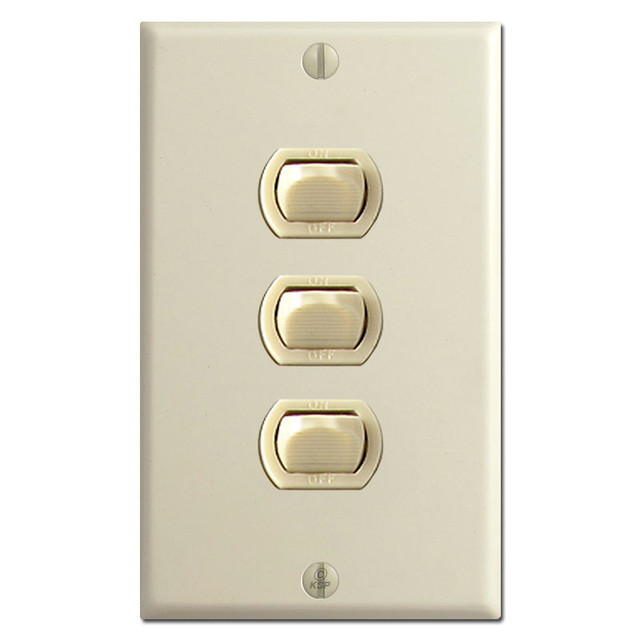
Our home didn’t have anything that fancy, but it did have panels with little Sierra despard switches. If you removed the cover plate, you found units like the one shown below.

Despard switches and outlets are compact units that allow you to cram more components onto a plate when wall space is limited.

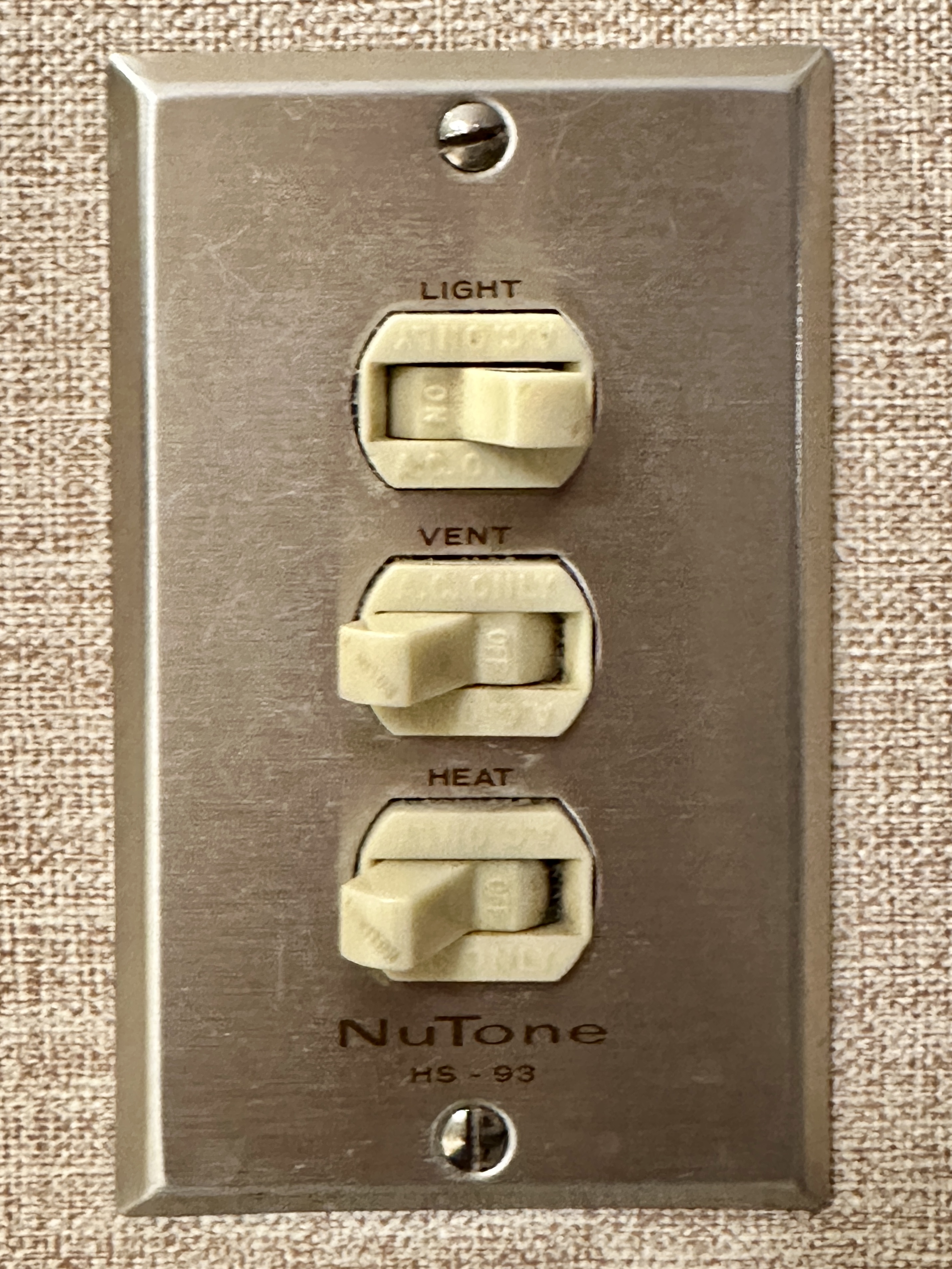
My current home, constructed in 1981, has a set of three despard switches in each bathroom that operate the light, vent, and heat in NuTone units in their ceilings. However, they are typical full-voltage switches, not low-voltage momentary switches connected to hidden relays.

Low-voltage switching didn’t catch on. Sierra Electric went out of business in the early 1980s, and my impression is that most low-voltage switch-relay systems have been abandoned.

20th Century Evolution

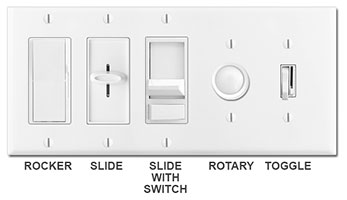
Several different light switch types came and went in the 20th century, and Nils Rasmusson did a nice job illustrating them, although he omitted the variants using low-voltage momentary switches and relays.

We had one of those old mercury silent light switches in one of our houses, and it was also outfitted with a tiny internal neon lamp that made the switch glow. I didn’t care for it, however, as I preferred to give a toggle switch a quick snap on or off as I walked by.

Eventually I replaced the Audio Lite with a simple Decora switch
I installed one of these in my bedroom when I was a teenager

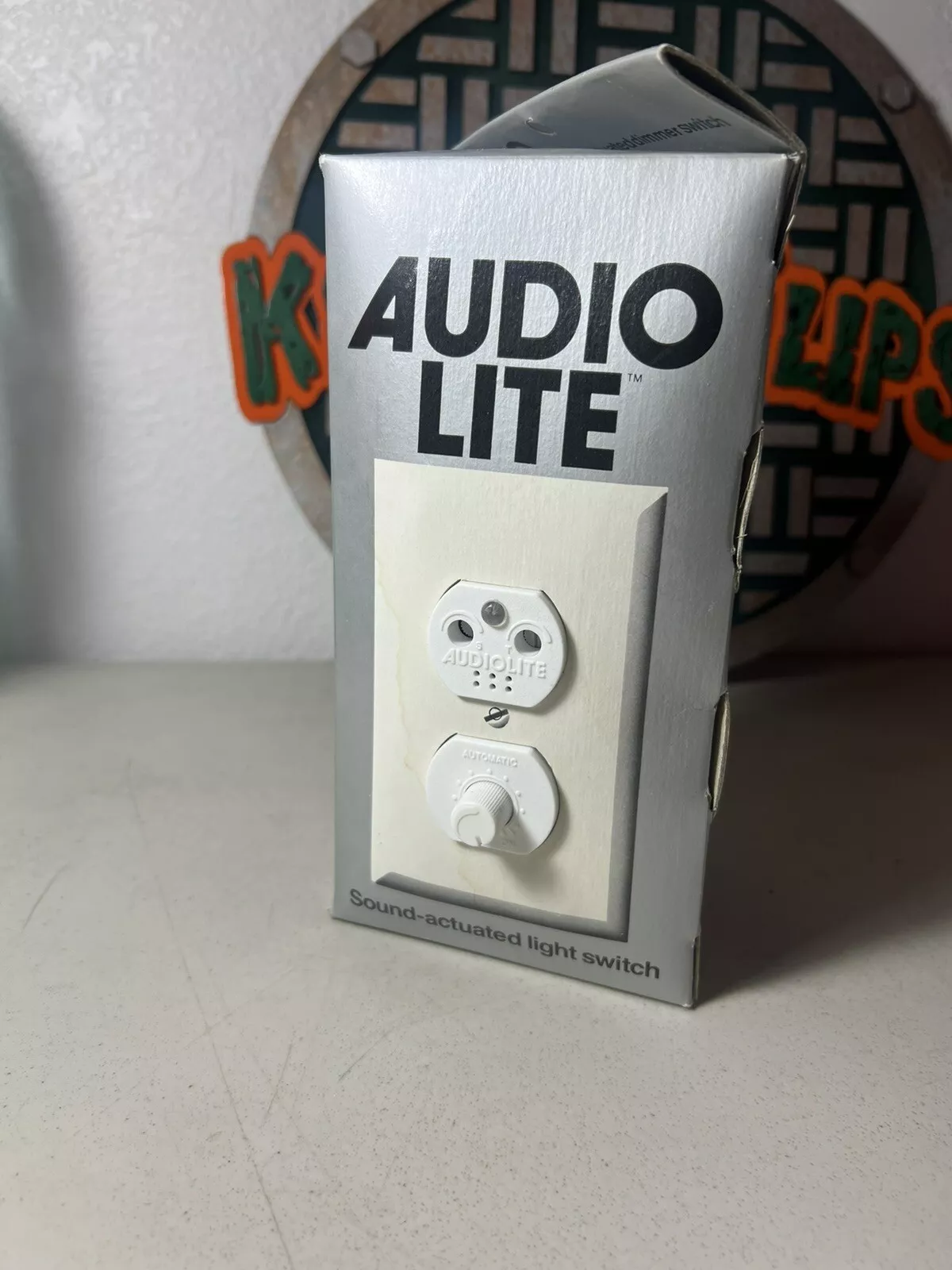
Later I was a teenager fascinated with gadgets, and in our next home I swapped a toggle switch in my bedroom for an Audio Lite. It turned on the light if it detected sound and had a dimming function. The novelty wore off quickly, and eventually I replaced it with a simple Decora switch.

Leviton introduced those rocker switches in the 1970s, and they were popular enough that the Decora brand has morphed into a generic name for rocker switches, just as Kleenex became a generic term for facial tissues. When my mother sold the home forty years later, that bedroom still had its oddball Decora light switch.

At work, I encounter some motion sensor light switches. Technology Connections explained how passive infrared motion sensors work. I understand their utility in turning the lights off in unoccupied rooms, but they are endlessly annoying, and I would never consider having them at home.

Pet Peeve

Another light switch type that I’ve never liked is the rotary dimmer that you push to turn on and off and rotate to adjust the brightness. I don’t like their look and feel and how easily the dial can turn when you push them on or off.

My 1981 home came with five of the damnable things in the living room. A gang of three in one corner operates some little-used ceiling can lights, and those have survived my wrath. However, two near the kitchen were used constantly for some switched outlets for living room lamps and for the dining area chandelier.

So soon after I moved into the house 30 years ago, I replaced those two rotary dimmers with toggle ones. They have a thinner toggle switch with a dimmer slider alongside. That lets us flip a switch on or off without inadvertently affecting the amount of dimming, while still providing full dimming control.

Various types of dimmer switches are available, including expensive fancy ones with online access, but eventually I’ll just replace our three surviving rotary dimmers with toggle switches and slide dimmers.

Smart Lights

The Nest Hub and lamp on my nightstand

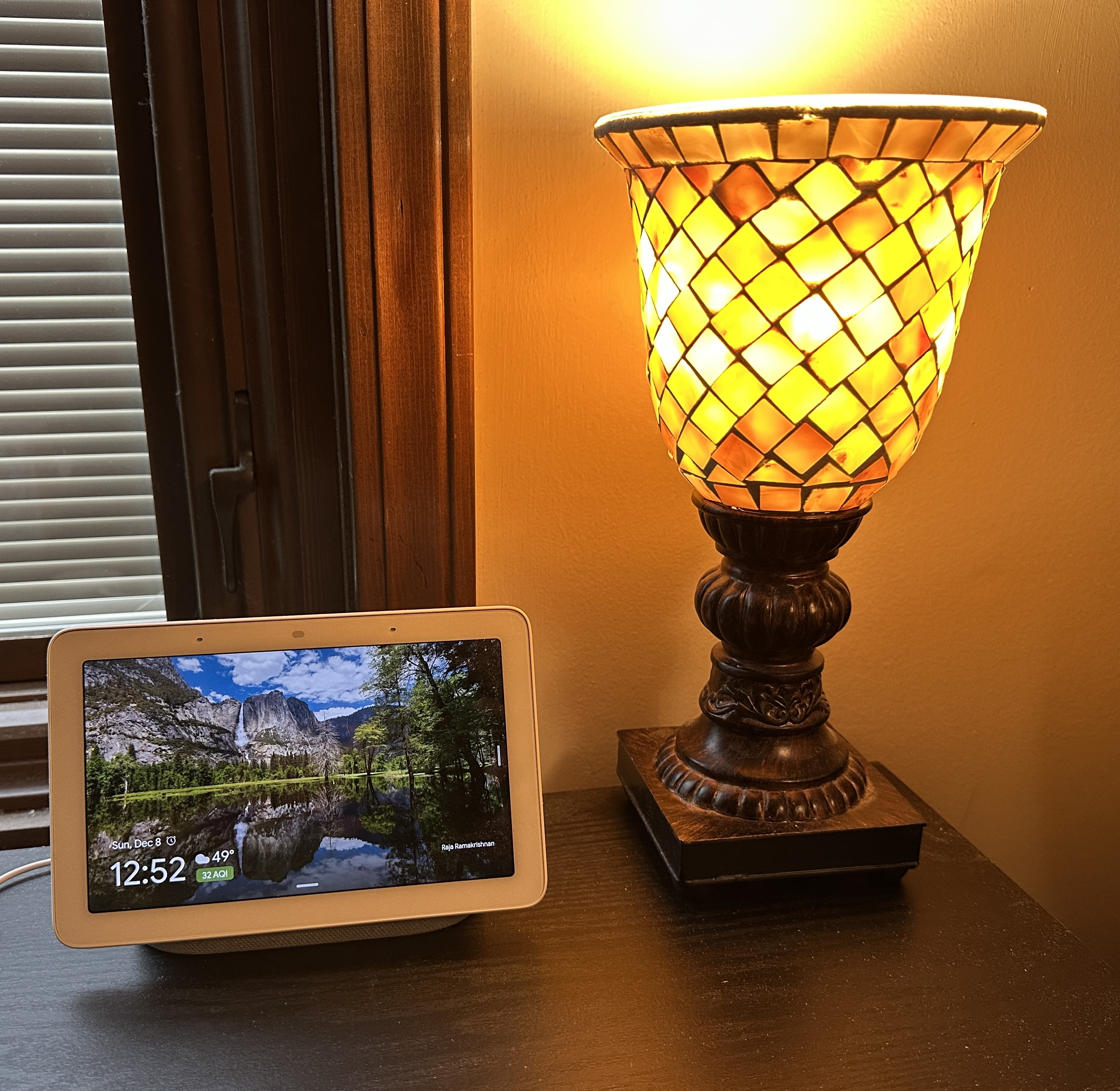
As a lifelong technology and gadgets guy, years ago I bought some of the Philips Hue smart light bulbs, which can be dimmed and set to various colors, and they are programmed into our Google Home system. But the only one I ever use for its smart features is in a bedside table lamp. Instead of messing about with the lamp’s clumsy inline power switch, I just tell the Nest Hub on my nightstand to turn the light on or off, adjust its brightness, etc. Plus I have preprogrammed bedtime and wake-up routines on the Nest Hub that involve that lamp.

Wendy and I also use smart switches linked to our Google Home system for a few other lights that otherwise would be awkward to control. Otherwise, we have stuck with dumb switches.

Modern Bulbs

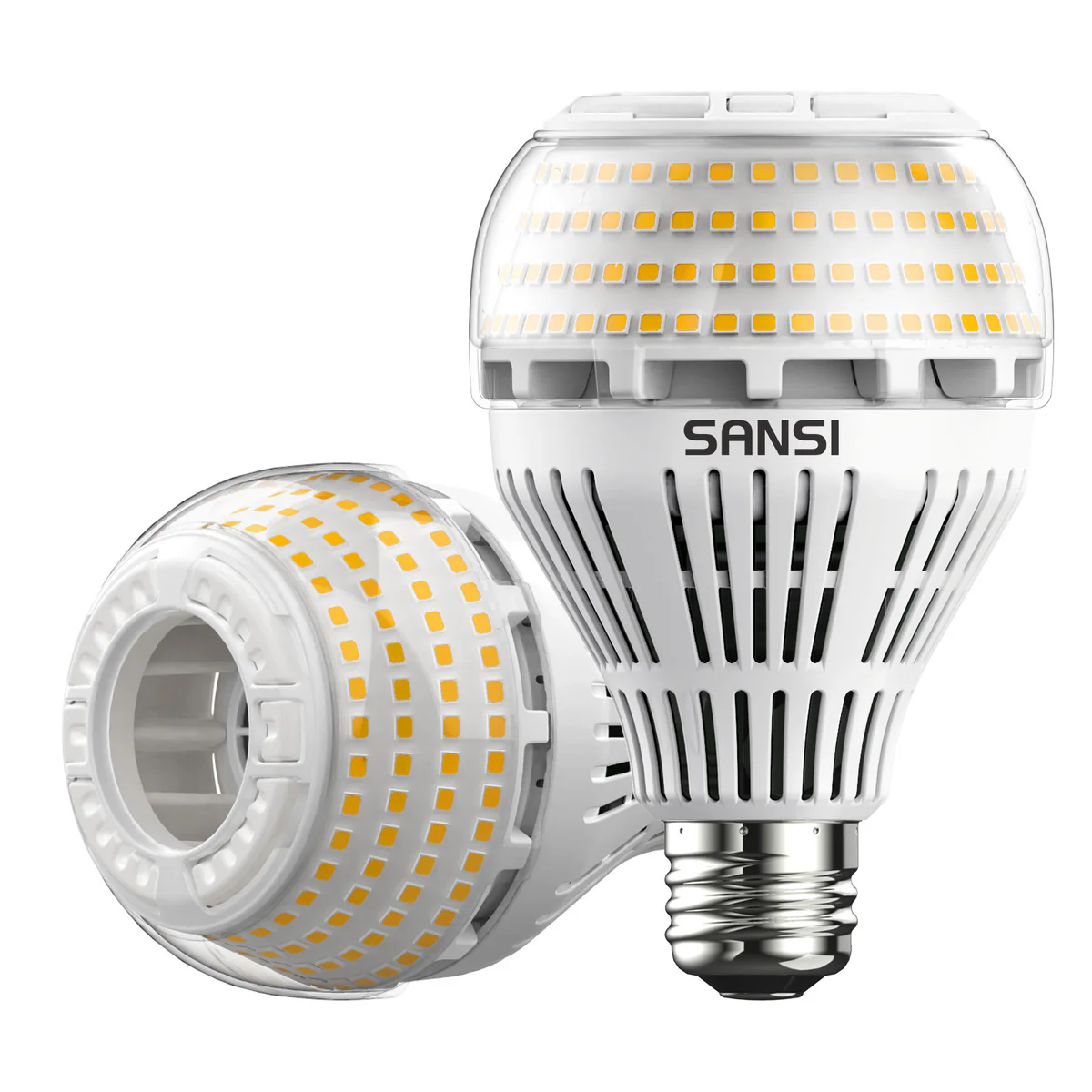
This crazy bulb is in our main living room torchiere lamp

I switched to LED bulbs over a decade ago, and Wendy has installed LED strips in a few spots around the house. However, our main living room light is a torchiere lamp hooked into a wall outlet controlled by one of the dimmer switches. Until 2022, I still had to regularly replace its 50/200/250 watt bulb since the 200 watt tungsten filament had a limited life but there were no LED bulbs capable of rivaling its 4000-lumen output that were dimmable and had the 3000 Kelvin warm white color I prefer.

I finally was able to order a bulb from SANSI meeting my specifications. It has 156 LED chips that collectively only consume 27 watts. That means the only incandescent bulb I still have to regularly replace is the 40-watt appliance bulb in our 1981 JennAir oven.

LEDs and their associated circuitry remain vulnerable to heat. Over the past decade I have replaced almost all of the LED bulbs at least once, some multiple times, particularly in enclosed or tight fixtures.

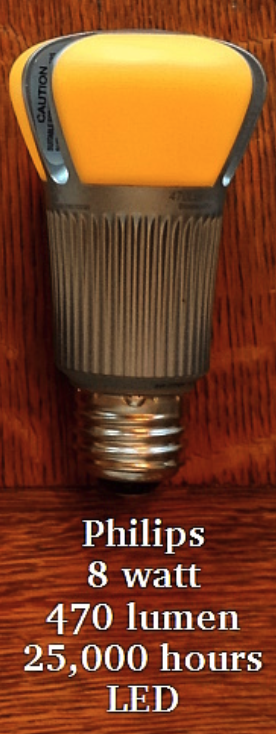
However, my two oldest LED bulbs are still going. Back in 2011 or so, I purchased those Philips Ambient bulbs. They were primitive by today’s standards, with a light output equivalent to only a 40-watt incandescent bulb, huge heat sinks, and yellow-orange covers for the LEDs to produce a warm white.

I put them in a table lamp beside my recliner in the same circuit as the big living room torchiere, so those lights are used every day. But, with those huge heat sinks, their relatively low power, and placement in a lamp with adequate ventilation, they have endured. I’ve grown fond of them, and I am glad that they weren’t recalled like some of their 12.5-watt brethren. I’ll be sad when they finally expire.

This year I also replaced the only remaining fluorescent light in our home when a 1981 fixture for a 24″ T12 bulb above our kitchen stove finally gave out. I had known for years that it was difficult to get started, so the old ballast was shot, but that didn’t matter since we left the light on continuously. Finally it went out and wouldn’t restart, even with a new bulb.

Rather than mess with the ballast in a cheap 43-year-old fixture, I wired in a new LED light, wedging the old light cover over it to reduce its glare. That wrapped up the modernization of the lighting in our home for the foreseeable future.

Posted in home repair, technology | Leave a comment

Getting my shots

I deliberately sickened myself multiple times in 2023 and 2024, and I’m glad that I did. I opted to take fourth and fifth booster doses of COVID-19 vaccine. I also took two doses of the Shingrix vaccine against shingles, a disease which has afflicted some of my colleagues and acquaintances over the years. Each time, I had immune system reactions that subsided after 36 hours.

After you recover from chickenpox, the varicella virus stays dormant in your body and can reactivate years later, causing shingles. That can mean a painful rash of blisters with an intense burning sensation, and the possibility of long-lasting pain from postherpetic neuralgia, as well as the risk of vision loss or blindness if the virus attacks an eye.

A varicella vaccine became available in 1995, and by 2014 that had reduced the incidence of chickenpox in the USA by over 90%. But of course I’m far too old to have been vaccinated as a child against chickenpox, and I contracted a severe case of it back in 1972 when I was six. I remember how my body was covered in blisters, and my mother having me wear mittens and plastic Baggies to ensure I wouldn’t pick at them.

Those memories were vivid enough for me to accept some mild and temporary discomfort to reduce my likelihood of shingles by well over 90%. A Zostavax shingles vaccine was approved in the USA in 2006, but it has been supplanted by Shingrix, which provides strong protection against both shingles and postherpetic neuralgia. Shingrix was approved in 2017, and the CDC recommends that healthy adults 50 years and older get two doses separated by two to six months, whether or not they previously had chickenpox.

I knew in advance that it would likely have some temporary side effects. I had my first dose of Shingrix in one arm, and my fourth COVID booster in the other. My arms were sore for a couple of days, and I had body aches and fatigue that began about 6 hours after the shots and lasted another 24 hours.

The Shingrix vaccine requires a second dose two to six months after the first. So I scheduled my second dose on a Friday afternoon four months after my initial dose. Sure enough, my arm was again sore and I began to have body aches by the time I went to bed. I had a slight fever, body aches, and headache that Saturday. Taking ibuprofen helped a bit, and I was actually fairly happy to have such symptoms, since they meant that my immune system was responding as intended. When I woke up on Sunday, I felt fine, other than a sore spot on my upper arm.
I went through a similar process recently, getting my fifth COVID booster and a Tdap booster against tetanus, diphtheria, and pertussis on a Friday afternoon. I again was sore and fatigued on Saturday and woke up on Sunday feeling fine. It had been nine years since my previous Tdap booster, and they recommend a booster every ten years. I advanced mine since our school district had numerous cases of pertussis this fall, so it is going around.

While my immune system ramped up, I thought back to my previous diseases and vaccinations. As a child, I contracted mumps, chickenpox, rubella, and scarlet fever, and later endured influenza and mononucleosis. But I was vaccinated against poliomyelitis, smallpox, measles, pertussis, diphtheria, and tetanus, so I avoided them.

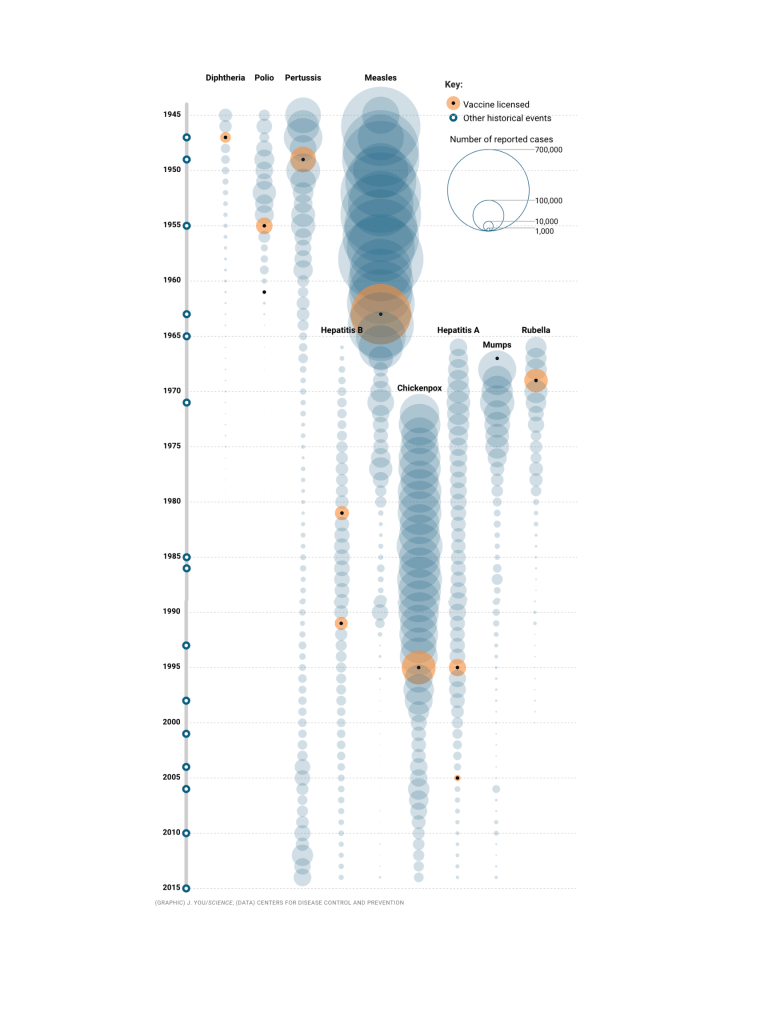
Vaccinations are in the news because of vaccine skepticism and misinformation, so I decided to delve into diseases in this post, with some illustrations. I’m motivated because many younger people lack direct experience with a variety of diseases which have been largely vanquished by vaccines. Consider the following chart, which you can also view online in an interactive:

Vaccines have beat back many infectious diseases, as shown in the above timeline chart [Source]

So I’m going to provide you with a glimpse of various infectious diseases, including my own experiences with some of them.

Poliomyelitis

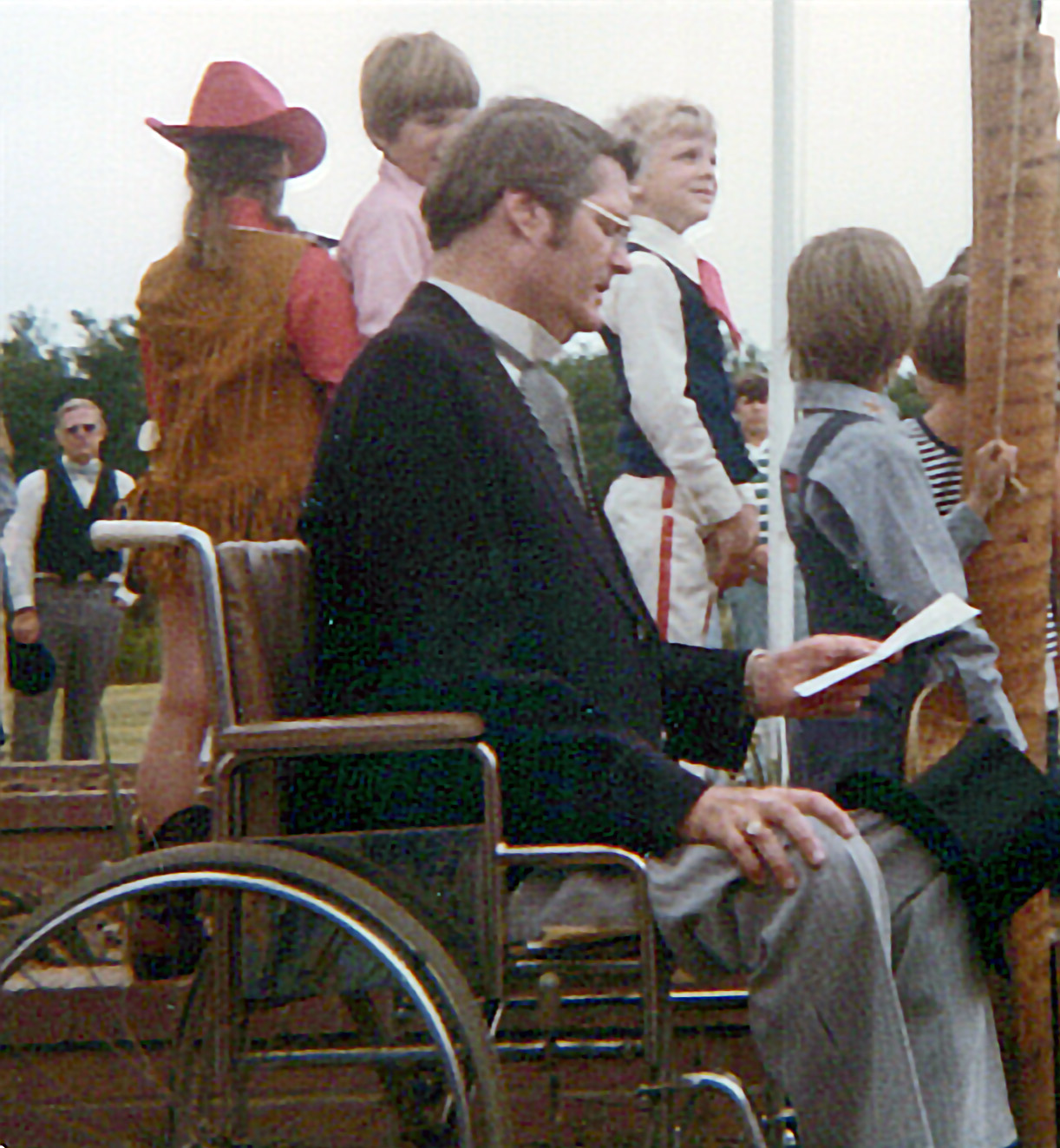
Our minister was paralyzed by polio; that’s me in the blue shirt and overalls looking away from the camera

Poliomyelitis was a scary disease for previous generations. My childhood minister and one of his brothers had been paralyzed by it, so while I was growing up I saw firsthand every Sunday how it could change lives.

My parents had witnessed the polio epidemic of 1952, with 58,000 cases in the USA which killed over 3,000 and left over 21,000 with mild to disabling paralysis. Those who were spared lasting paralysis could still suffer post-polio syndrome 15-30 years after an acute attack, with decreased muscular function or weakness with pain and fatigue. That is analogous to shingles: the polio virus lies dormant in the body for many years, but it can eventually reactivate.

Thankfully, the Salk vaccine became available in 1955, and the Sabin oral vaccine in 1961. So my parents ensured that from 1966-1971 I had three doses and a booster of the Salk vaccine, as well as three types of Sabin oral vaccine with a trivalent booster.

However, the scourge of polio didn’t disappear in 1955. The three Johnson brothers and their wives were together for Labor Day weekend in 1956. A few days later, all three of the brothers came down with polio. Our minister, Jerry, and his brother Tommy were paralyzed, while their brother Dale recovered with no long-term effects.

I vividly recall how every breath was a struggle for Tommy, a retired military veteran. He was so afflicted that he couldn’t work for a living, so he devoted himself to volunteer work, and he always sat behind his brother’s pulpit at church. That pulpit had a steep ramp that Jerry would be wheeled up, locking his wheelchair into place for most of the service.

Yet Jerry never dwelled on their disabilities. I only recall one sermon in which Jerry spoke of his own struggles with being confined to a wheelchair because a scarce vaccine had been prioritized for others. He never doubted the importance or efficacy of vaccination, as he and his brother were living proof of the consequences of not being protected by modern science.

Smallpox

Smallpox was a terrible disease

Variola virus emerged thousands of years ago and killed 30% of its victims, leaving the rest with scars. My smallpox vaccination spared me from that scourge, which wiped out 50% of the First Peoples in America after Europeans brought it to these shores. The last outbreak in the USA was in 1949, and a concerted worldwide vaccination campaign led to the eradication of the disease by 1980.

That was the greatest victory of vaccinations, but smallpox and rinderpest are the only infectious diseases we have thus far managed to fully eliminate. Vaccinations can keep many, but not all, of the others at bay. For example, thanks to vaccinations, there were only 30 confirmed cases of polio worldwide in 2022.

Measles, Mumps, and Rubella

Measles is now rarely seen in the USA

Measles is an airborne disease that is extremely contagious and with no specific treatment. A measles outbreak at a boarding school outside Boston in 1954 provided an opportunity for the rubeola virus to be isolated and cultivated, leading to the first vaccine trials from 1958 to 1960 and licensing for public use in 1963. I had two shots of inactivated rubeola virus and an attenuated live rubeola virus vaccine in 1967, so I never had the measles.

Dr. Maurice Hilleman developed an improved measles vaccine with fewer side effects in 1968, and he combined vaccines against measles, mumps, and rubella into the MMR vaccine in 1971. It is estimated to be 97% to 99% effective in preventing measles after a second vaccination, and measles was declared eliminated in the USA in 2000. However, travelers continue to bring it into the country, and there can still be outbreaks among the unvaccinated, so children should still receive the MMR vaccine.

Vaccines have also virtually eliminated rubella here

Dr. Hilleman’s work came too late for me, and I had rubella in 1967 and mumps in 1970.

Rubella is sometimes called 3-day measles or German measles, but it is actually caused by a separate virus, against which the MMR vaccine is 89% effective. The MMR vaccine has virtually eliminated it in the USA, with less than 10 people contracting it each year.

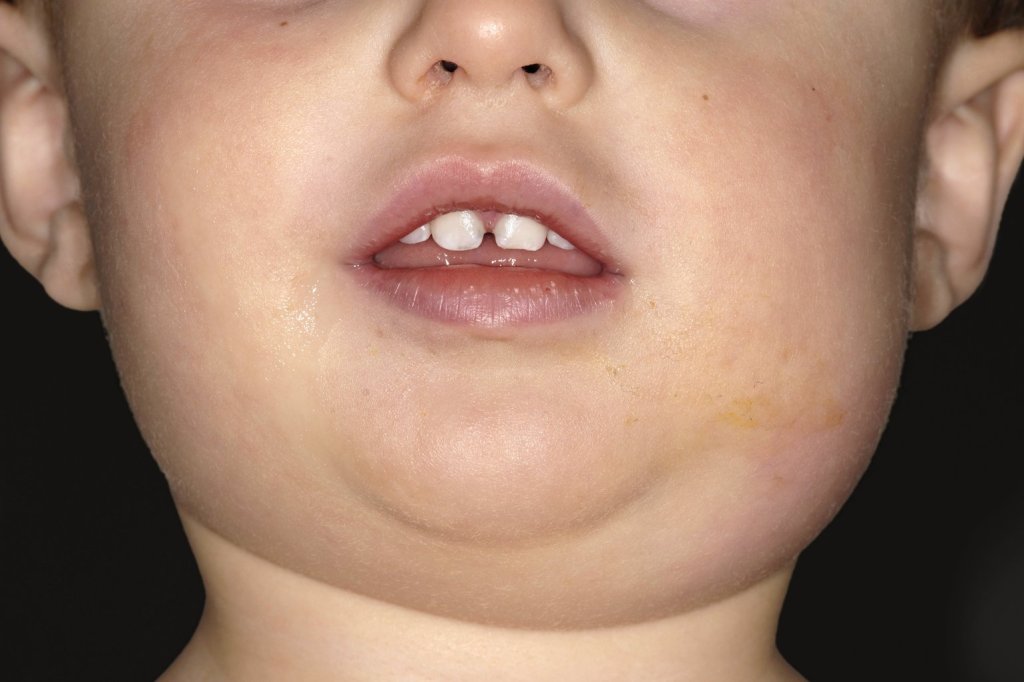
Mumps causes a swollen jaw

Mumps is caused by a third virus, and it doesn’t cause a rash. Instead, it makes the salivary glands swell, causing puffy cheeks and a tender, swollen jaw. Back when I got it, there were over 150,000 cases each year in the USA. The MMR vaccine is 86% effective against it, and now there are only a couple hundred to a couple thousand cases of it in the USA each year.

Chickenpox

Chickenpox blisters; photo source

While my rubella and mumps infections were mild, I was not so lucky when I contracted chickenpox in 1972. I was six years old, so I can remember the experience. Dr. Sam Sepkowitz had my mother apply Caladryl lotion to my skin and had me take Benadryl by mouth. The stratagem of mittens and Baggies to control my scratching and prevent picking did help me avoid having any of the telltale round, depressed marks on my skin caused by the varicella zoster virus which I noticed on several of my childhood friends.

Scarlet Fever

Scarlatina

Many a sore throat has been caused by an infection of the bacterium Streptococcus pyogenes; there are several million cases in the USA each year. When it causes scarlatina, or scarlet fever, a rash begins on your trunk and then quickly spreads outward, usually sparing your palms and soles. I contracted it in 1975, and that kept me out of school for several days.

My pediatrician, Dr. Eric Meador (no relation), was concerned that a future infection of Streptococcus pyogenes might lead to rheumatic fever, which could damage my heart. So from then on, he wanted to see me whenever I had a sore throat. He would culture my infection and, if it was caused by strep, he would prescribe an antibiotic.

Mononucleosis

Mononucleosis is often accompanied by exudative pharyngitis

In college, I contracted mononucleosis, probably from the Epstein-Barr virus. About 10% of college students develop it. I had the typical fever, sore throat, and swollen glands. Even after those symptoms resolved, I had chronic fatigue for weeks, so when I returned to my classes, I sat far from everyone else. That precaution wasn’t necessary to prevent contagion, since mono is contracted through direct contact with infected body fluids, but I was so exhausted that I wanted to avoid interacting with my fellow students. There is still no vaccine for mono, and nearly 95% of people have had an Epstein-Barr viral infection by the time they are adults.

That experience gave me empathy for those afflicted with chronic fatigue; those were the most depressing weeks of my time in college. When I finally began to recover, my parents came to Norman to help me launder weeks of dirty clothes at a laundromat.

Influenza

As an adult, I didn’t think much about vaccinations, having no memory of the shots and oral doses of early childhood, until I contracted a severe case of influenza in 1989. I was moving into my first apartment after graduating from college, and I felt miserable for two weeks. Tamiflu had not been developed, and fever-reducing medications could only get my fever down to 103 degrees Fahrenheit.

After that, I made sure to get a flu shot every year. Influenza mutates so much that over the last 20 years the vaccines’ efficacy ranged from 10-60%, averaging at a bit over 40%. But I haven’t had the flu since 1989, and I hope to never experience it again.

By the way, when people say they had the stomach flu, that means it wasn’t actually influenza, but rather a bacterial infection or infection by noroviruses or rotavirus.

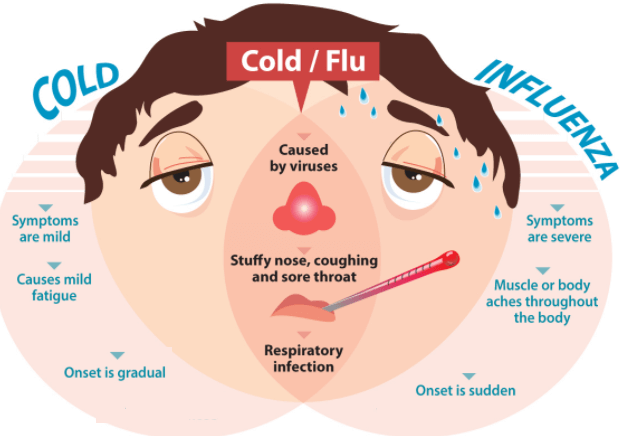
About 8% of the USA population contracts influenza each year, while about 7% are infected by a norovirus. You can get vaccinated against the flu, but currently there is no available vaccine for norovirus. Children are especially susceptible to rotavirus, which infects 95% of them by 5 years of age, with about 2.7 million cases per year, although vaccines are now available.

Respiratory Syncytial Virus

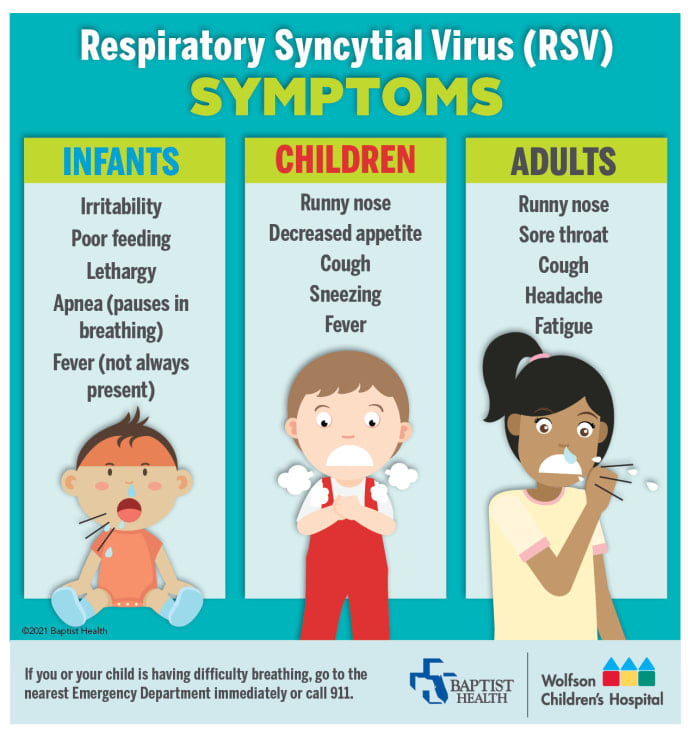
Respiratory syncytial virus (RSV) infects nearly all children by age two, hospitalizing about 58,000 of them annually in the USA. It also hospitalizes about 177,000 older adults each year, killing about 14,000 of them. It was first identified in humans in the late 1950s, but a vaccine candidate in the mid-1960s was not effective and dozens of later attempts also failed.

In the 2000s, the structure of its proteins was determined, allowing an 80% effective vaccine to be developed for older adults. As of this writing, 22% of adults age 60+ get vaccinated for RSV. There is an RSV vaccine available for pregnant mothers, which protects infants from birth through 6 months of age, as well as an antibody product for infants.

The work analyzing the protein structure of RSV paved the way for determining the spike protein structure of SARS-CoV-2, the virus that causes COVID, allowing for the famous COVID vaccines to be developed in record time.

COVID

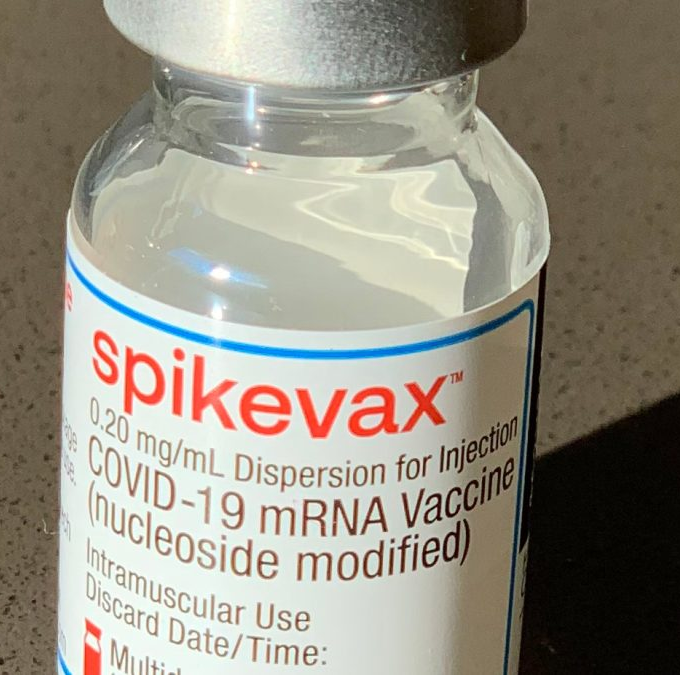
I’ve written previously about my personal and professional experiences with COVID. I have been grateful for every COVID shot I could get. I had two doses of the first Pfizer vaccine in February and March of 2021, a Pfizer booster in October 2021, a Moderna booster in April 2022, and another Moderna booster in October 2022.

Unfortunately, I still contracted COVID in November 2022 and again in June 2024; the vaccines have proven to be highly effective at preventing hospitalization and death, but they are no guarantee against infection. My first bout with COVID included a chronic cough for several days, nasal congestion and a runny nose, fitful sleep, and chills but no fever. I began testing positive five days after my first symptoms, and didn’t get a negative rapid test until 14 days after I first suspected I might have the virus.

I contracted COVID again in June 2024 during a vacation to the California redwoods. That round brought congestion, fever, headache, body aches, fatigue, and chills and eventually a cough. No doubt all of that would have been much worse if I hadn’t been vaccinated.

Vaccinations and immunity via infection helped lower COVID from the third leading cause of death in these United States in 2020 and 2021 to fourth place in 2022 and tenth in 2023. I’ll gladly do whatever I can to keep improving that statistic.

Tetanus, Diphtheria, and Pertussis

Influenza and COVID mutate so rapidly that the smart money is on getting an annual dose of the latest tailored vaccine. Another vaccine that needs an occasional booster is the Tdap, which protects against the tetanus, diphtheria, and pertussis bacterial diseases.

Tetanus or lockjaw is caused by the bacteria Clostridium tetani. It causes painful stiffening of the muscles, which can lead to trouble opening the mouth, swallowing, and breathing, so it can be fatal. Vaccinations reduced it from 500-600 cases each year in the USA to only a few dozen.

Diphtheria is caused by the bacteria Corynebacterium diphtheriae, which product a toxin can lead to difficulty breathing, heart failure, paralysis, or death. Before vaccination, there were at least 200,000 cases each year in the USA, but now the average is less than one per year.

Pertussis or whooping cough, which is caused by Bordetella pertussis bacteria, is tougher to beat. It can cause uncontrollable, violent coughing making it hard to breathe, eat, or drink. It is especially dangerous for babies and young children. Babies and children younger than seven receive DTaP vaccines, while older children and adults receive Tdap.

Pertussis waxes and wanes. There were over a quarter-million cases in the USA back in 1934. The first triple-vaccines were licensed in 1949, and that dramatically reduced the cases to below 10,000 from 1964 to 2002. But it surged back to almost 50,000 in 2012, thanks to misinformation that led some parents to decline to vaccinate against it. As of this writing, the old epidemic cycle of pertussis peaking every two to five years has been re-established.

I’ve experienced paroxysmal coughing from pneumonia, so I am grateful that I’ve never had pertussis. Tdap is a little over 50% effective against pertussis, which beats the average efficacy of flu vaccines. Adults should get a Tdap booster every 10 years, and we had a significant number of pertussis cases in all of our local schools this fall, so I went ahead and got my booster a year early.

Get your shots!

I hope you found that informative and interesting. Don’t let news coverage of attention-seeking crackpots mislead you. The vast majority of people trust and support vaccination. 93% of kindergartners in the USA are up-to-date on their vaccinations, 88% of parents believe the MMR vaccine is important for their children, and over 90% of children are vaccinated against polio.

I am certainly grateful that modern medicine has protected me against many terrible diseases, and helped me battle through the ones I could not avoid. In the coming years, it is important that pediatricians, family doctors, community leaders, and friends and family leverage their relationships to promote accurate, evidence-based information. Recent events reinforce how useless it is to belittle or insult the ignorant or misled among us. Be kind and patient while holding firm. Don’t preach; educate…and get your shots!

Posted in history, pandemic | Leave a comment

The M4 Pro

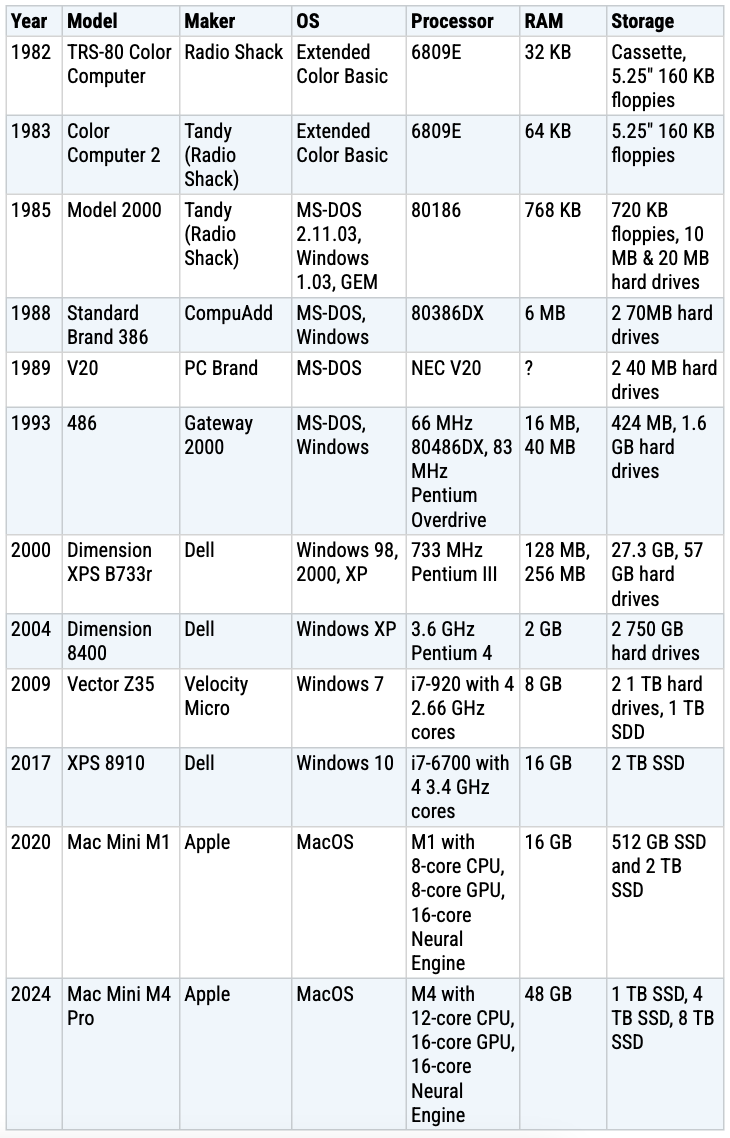
This week I set up the twelfth desktop personal computer for my use at home over the past 42 years. A new machine typically offers improvements in processing power, RAM, and storage size, and that is certainly true for my new Mac Mini M4 Pro, which replaced a Mac Mini M1 I purchased back in 2020 and had briefly experimented with when I was unable to travel due to the COVID-19 pandemic.

I didn’t actually use the M1 as my primary desktop machine until April 2024. Before that, I had used computers running Windows as my primary home platform for 30 years, and I had used MS-DOS machines for a decade before that.

A Mac Mini M4 atop a Mac Mini M1

My first computers were Color Computers I bought from Radio Shack in high school that used one of the most advanced of the various 8-bit microprocessors: the Motorola 6809E.

In college, I spent an amazing amount of money on an advanced Tandy Model 2000, which used the oddball 16-bit 80186 microprocessor and had much sharper graphics than the IBM PCs of that time. However, it wasn’t long until full compatibility with IBM PCs became a priority, and the Tandy 2000 was only semi-compatible. WordPerfect 4.2 worked fine for word processing, but I had to invest in a specific version of Lotus Symphony, as the IBM PC version of the Lotus 1-2-3 spreadsheet software was incompatible. So as I graduated from college in 1988, I invested in a PC clone with a 32-bit 80386DX microprocessor.

The only time I bought a desktop machine that was slower with less memory and storage than its predecessor was in 1989, when a friend and I bought a cheap desktop machine to run a bulletin board system (BBS) in Oklahoma City, which I soon transplanted to Bartlesville. That one used an NEC V20 microprocessor, which was a clone of the 16-bit 8088.

In Star Trek, M4 was a robot butler, housekeeper, gardener, and guardian for Flint, while the M-4 multitronic unit was an unseen failed computer designed by Dr. Richard Daystrom

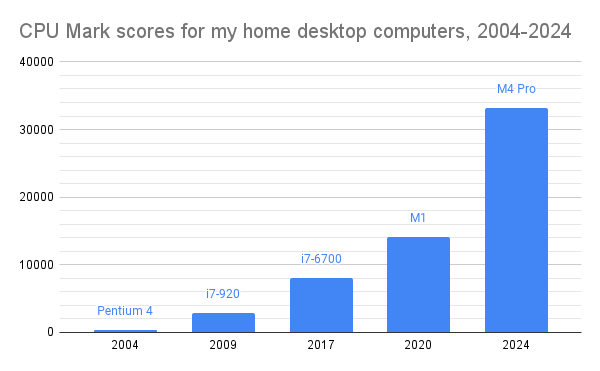
I had a couple of other 32-bit machines after that, with a Pentium 4 being my first computer with a 64-bit microprocessor back in 2004. Twenty years later, my new computer’s processor cores still process data and instructions in 64-bit chunks, and the clock speed of my 2004 single-core machine was 3.7 gigahertz, not that much slower than the 4.5 gigahertz for my latest computer.

As heat generation and power consumption limited how much chip makers could boost clock speed, they started adding more computing cores and software incorporated multithreading to divide workloads across multiple cores working in parallel. Thus, instead of a single core like in 2004, my latest machine’s microprocessor has 12 cores plus a 16-core graphics processing unit and 16-core Neural Engine to speed up machine learning models.

That allows my 2024 M4 Pro to score 86 times higher on CPU Mark than my 2004 Pentium 4 computer. The chart shows how computational power has improved for me at home over the past 20 years.

Source

Apple says that my new M4 Pro has up to 1.8x faster CPU performance and 2.2x faster GPU performance than my M1 Mac Mini of 2020, and I’ve configured it with quadruple the amount of RAM and about triple the available non-backup storage. Those specs should meet my needs for many years. Nevertheless, the M1 is no slouch, and I’m hanging onto it as a fallback machine should the M4 ever go down for awhile.

I couldn’t resist calculating some comparisons of my new desktop to my first computer over 40 years ago. My new desktop has 1.5 million times as much RAM, and immediate access to over 15 million times more storage. The M4’s internal 1 TB drive writes at about 6,300 MB/s and reads at about 5,100 MB/s, while the external 4 TB drive reads and writes at about 3,400 MB/s. Both are multiple times faster than the M1’s internal and external drives, and their data transfer rates are 100,000 to 200,000 times faster than the 156-kilobyte 5.25″ floppy disk drives on my first TRS-80 desktop computer.

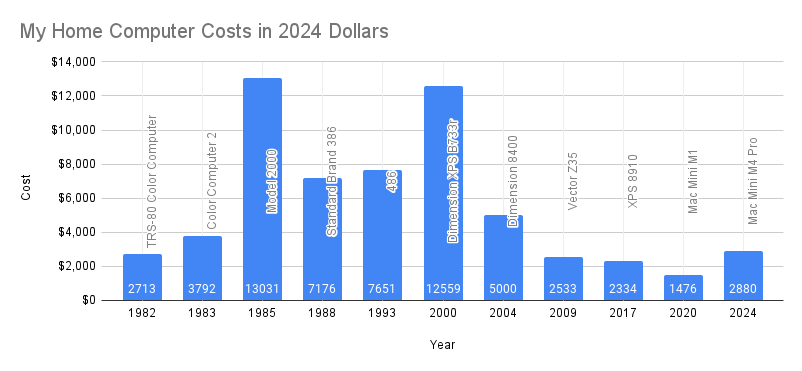
Of course, all of that progress came at some fiscal cost. Below I’ve charted the inflation-adjusted costs for my systems. (I don’t have the costs for the BBS system my friend and I purchased in 1989, so I’ve omitted it.)

My first 16-bit computer, the Tandy Model 2000 in 1985, was the most expensive system with my first Dell computer, a Pentium 4 in 2000, coming in close behind. I spent more on my latest system than I’ve spent on one since 2004, but it is still considerably below the average and the median costs over my past 42 years of buying home computer systems. Its power and capacity make it a bargain if I take the long view.

The new system will certainly suffice for the projects I have in mind for my last 18 months of gainful employment and the first years of my retirement. I consider myself quite lucky to have used personal computers since I was ten years old and to have owned them since I was fifteen. They were of immense benefit to my higher education and working life.

My grade school years were low-tech, and I certainly didn’t suffer with the issues that have led to recent recommendations that children not be given smartphones or allowed to use social media until they are 16: I didn’t have a cell phone until I was in my 30s, and I didn’t have a smartphone until I was in my 40s. That means I recognize the amazing benefits of the various technologies and services while knowing how to survive without them. That’s a sweet spot I can appreciate.

Posted in Mac, technology | Leave a comment