Honeymoon, Day 10: Ruby Beach

TRIP DATE: July 11, 2016 | SLIDESHOW | PHOTO ALBUM | Other Honeymoon Posts

We spent two nights at the Kalaloch Lodge on the shore of the Pacific Ocean in Olympic National Park. I’d been out on the Olympic Peninsula of Washington State before, but only to visit Hurricane Ridge and take the ferry across the Strait of Juan de Fuca from Port Angeles to Victoria, British Columbia. This time I opted for us to drive over to the Pacific shore because our friend and colleague Gary Layman had recommended that we visit Ruby Beach.

Kalaloch Lodge

In planning the honeymoon trip, I had been looking for fancy accommodations and hit upon Kalaloch Lodge. I booked its largest room, the Kalaloch Room, which was originally a bar and is now a very spacious room with a panoramic view of Kalaloch Creek winding its way to join with the Pacific.

View from our room at Kalaloch Lodge

One thing we learned when we reached the lodge was how to pronounce the name: CLAY-lock. The Quinault native Americans named the area, which translates to “good place to land” as it was a safe place to land between the Quinault and Hoh Rivers.

Another thing we learned is that the fanciest rooms can have their shortcomings. The room was indeed very large with a great view. I loved gazing out at three windblown cedars near the Pacific. The room had its own wrap-around balcony and dedicated interior and exterior stairs. But the bathroom was another matter.

An elevated area that was once a stage now had a whirlpool tub, shower, sink, and cramped toilet room. The toilet room was the problem…it stank! The longer you were in there with the door shut, the more your nose itched with the unwelcome smell of old urine. Our attempts to clean the area did not help. I should have raised more of a stink about it, haha, but we just held our noses. First the smelly carpet in Astoria and now this. Thankfully that was the last issue we encountered with our honeymoon accommodations, and things would improve a lot when we arrived in Canada a couple of days later.

Coffee Time

One thing Wendy is adamant about is having coffee to start and end her day. Travel complicates that, and here is her take on the struggle for a good cup of coffee moving from one hotel to another.


Wendy's Post
Wendy on Hotel Coffee

The types of coffee machines varied as we hopped from hotel to hotel on this trip. Many hotels like Best Western have the one or two cup drip machines. You get a tea-bag-like packet with coffee in it and pop it into the tray, add water, and let it drip. That’s the norm. At home I use a drip coffee maker, so that is fine by me.
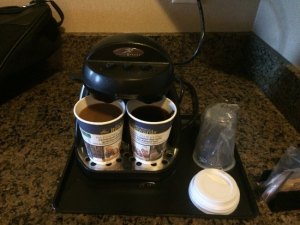
Best Western coffee maker

At some of the hotels, they have those Keurig coffee makers. They make good coffee, a little strong, but still good. Instead of a filter or tea-bag-like packet, you get a plastic cup full of ground coffee with foil covering the top. Pop it into the Keurig (which punctures the plastic cup), and add water. Then wait. Forever.
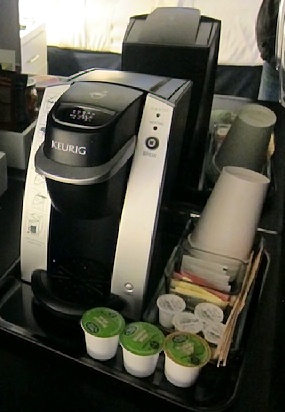
keurig
Keurig Coffee Maker

At Kalaloch Lodge, we had a regular drip coffee maker. Relieved, I got out my filters and little sandwich bags full of the “good stuff” (½ Walmart decaf and ½ Dunkin Donuts regular). When I opened up the coffee maker to put in a filter, the filter basket was CAKED in brown coffee gunk. It appeared it had never been cleaned. So I worked with my Q-Tips to clean out every single crevice. When that was all clean, I pondered what kind of microorganisms might be growing in the water reservoir, which I could not readily get to. Completely disgusted, I decided not to use the coffee maker.

Usually I am prepared for a situation like that. Granger’s father gave me a portable coffee kit with an electric percolator and all of the accoutrements. That kit is usually my backup on every trip. Unfortunately, due to airplane weight restrictions, I wasn’t able to bring it on the honeymoon. But I couldn’t just go without my coffee!
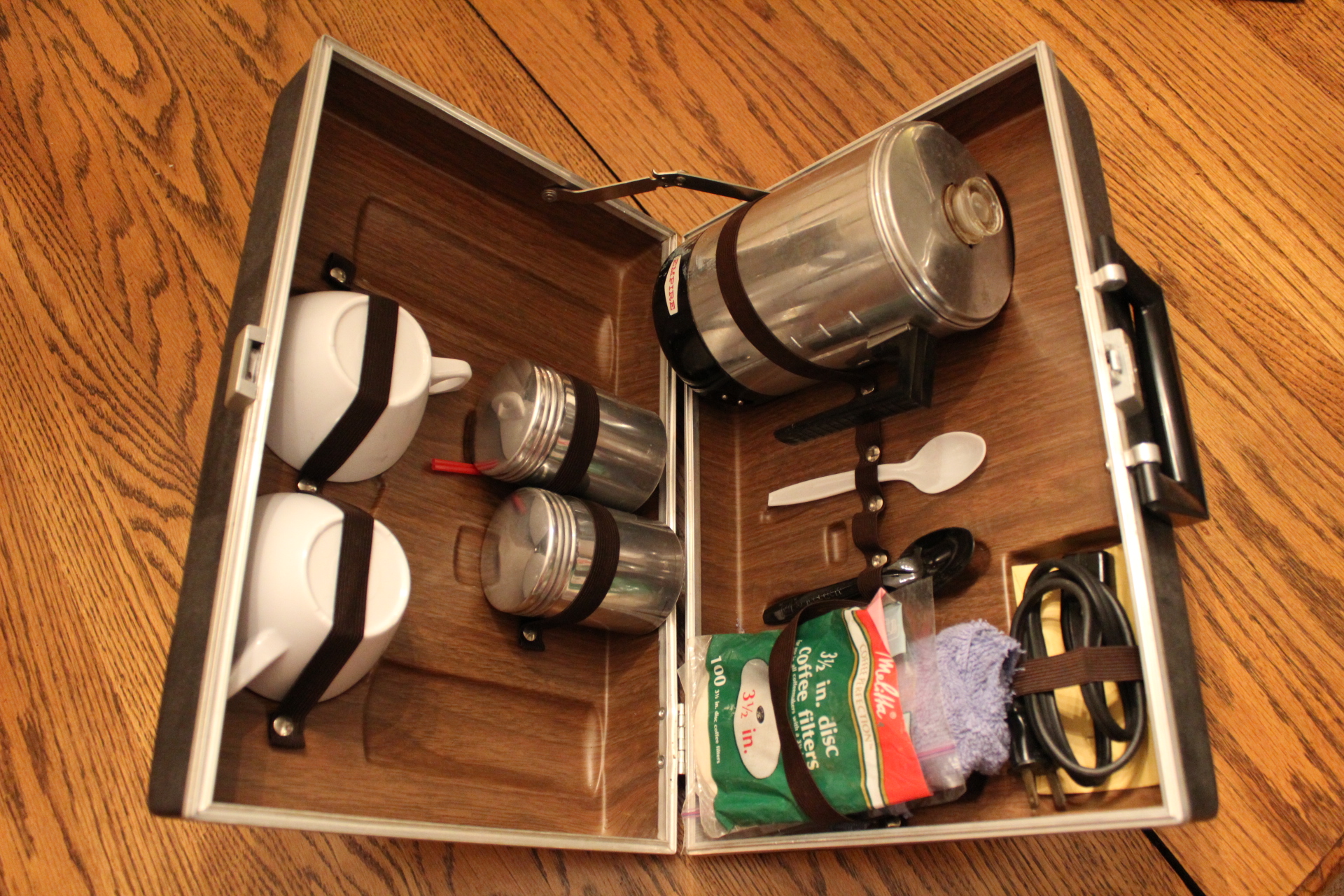
The Backup Coffee Kit

Since I was raised to “rig” things up when they don’t work, I came up with a solution. I took a filter, filled it with coffee, and then tied it up tea-bag fashion with the tie from a trash bag. I boiled a cup of water in the microwave and then dipped the bag into the boiling water. Voilà! Coffee time!

Later, once we got to Canada, I would discover yet another coffee making device – Nespresso. It’s pretty fancy and high-tech.  Coffee delivery systems are evolving, but just give me a drip coffee maker any day. Keep it simple.


Meador Post

The room certainly had its shortcomings on cleanliness, but the lodge’s Creekside Restaurant was splendid. We ate there for all of our meals. It had an attractive seating area indoors (we avoided the patio, although it looked pleasant), and the food was great. All of our servers were interesting, helpful, and friendly.

Ruby Beach

The whole point of our stay at Kalaloch, however, was to visit Ruby Beach. Named after the ruby-like crystals in its sand, the beach was a 7.5 mile drive north on 101 to a lot filled with cars and a trail winding its way down to the ocean. A panoramic view through the last stand of trees revealed an initial beach area covered in driftwood, with a group of sea stacks.

Ruby Beach Map

A closer look revealed people roaming amidst sea stacks three or four times their height, with Abbey Island looming in the background with its steep rocky cliffs. We would eventually roam over to it during our exploration of the beach.

Sea Stacks and Abbey Island

Upon reaching the shore, we had to clamber over driftwood and made our way northward toward Cedar Creek, which was flowing strongly across the rocky beach and into the ocean. I led us away from land to what seemed the easiest place to ford the creek, where we rolled up our jeans and carefully made our way across. Wendy delighted in scouring the rocky beach for finds while I headed toward a large sea stack to explore its nooks and crannies.

Sea Stacks
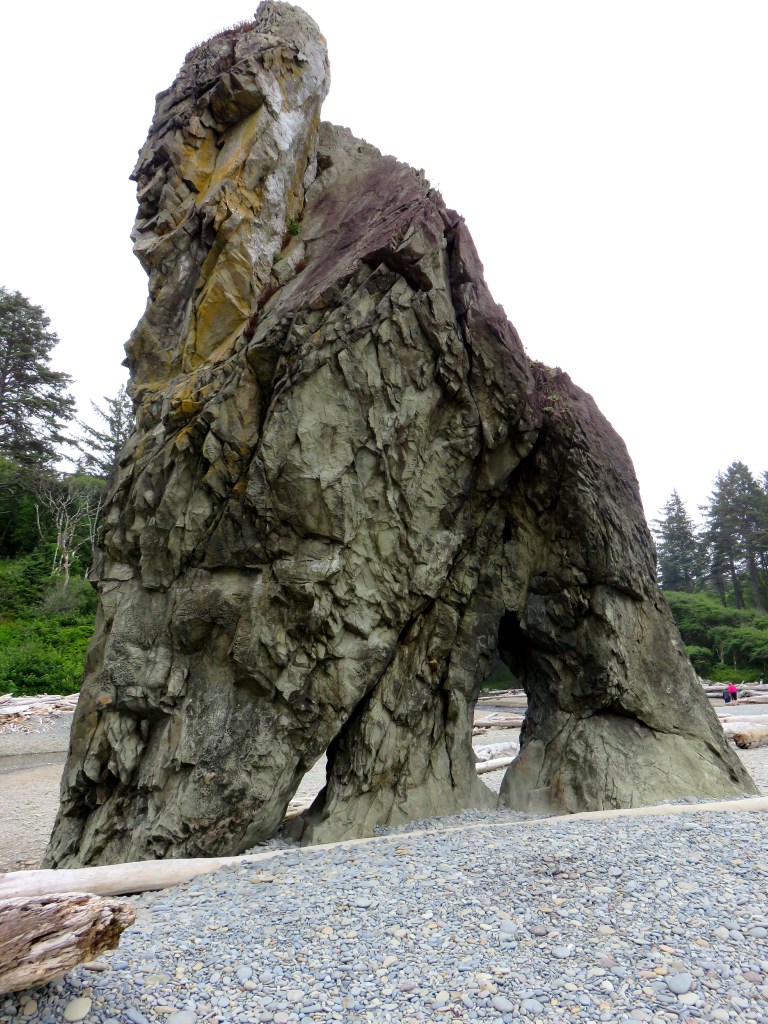
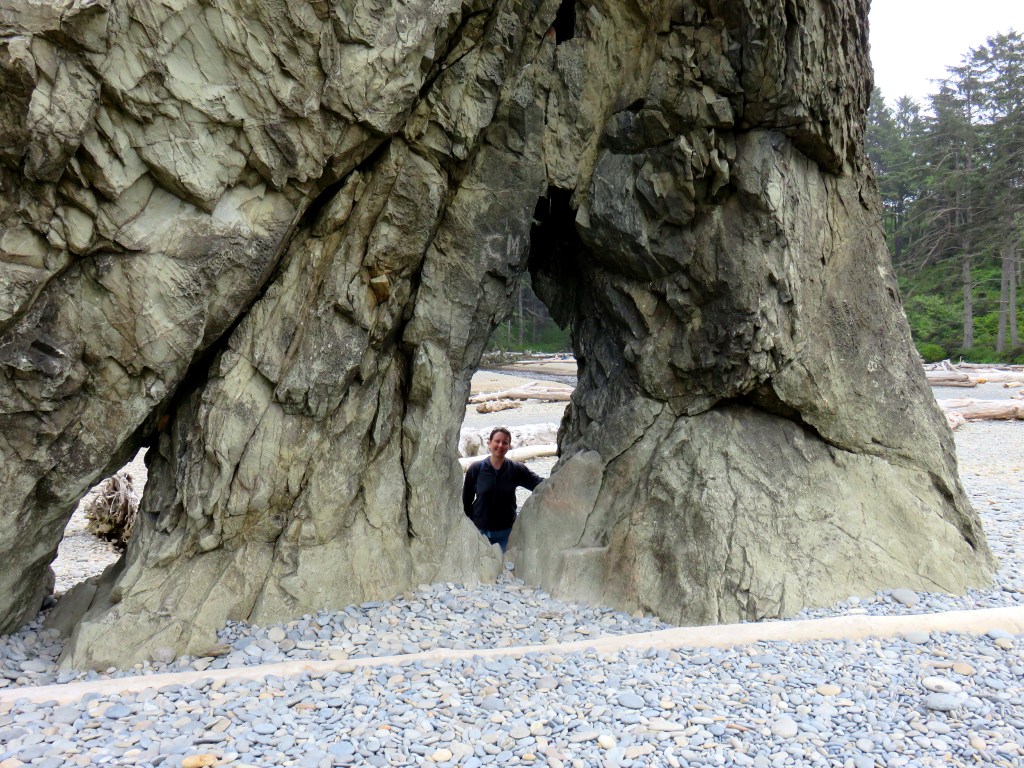
Some of the sea stacks were quite striking, and Wendy posed in an archway of one to provide scale.

An Okie at the Pacific shore

Finding me out in the sea stack, Wendy took a shot of me below a rock archway and in a narrow channel between walls of volcanic breccia covered in mussels embedded in barnacles. I held my thumb up to some gooseneck barnacles for scale. A dead tree leaned up against the same volcanic rock underlying the shore forest.

Wendy at the sea stacks

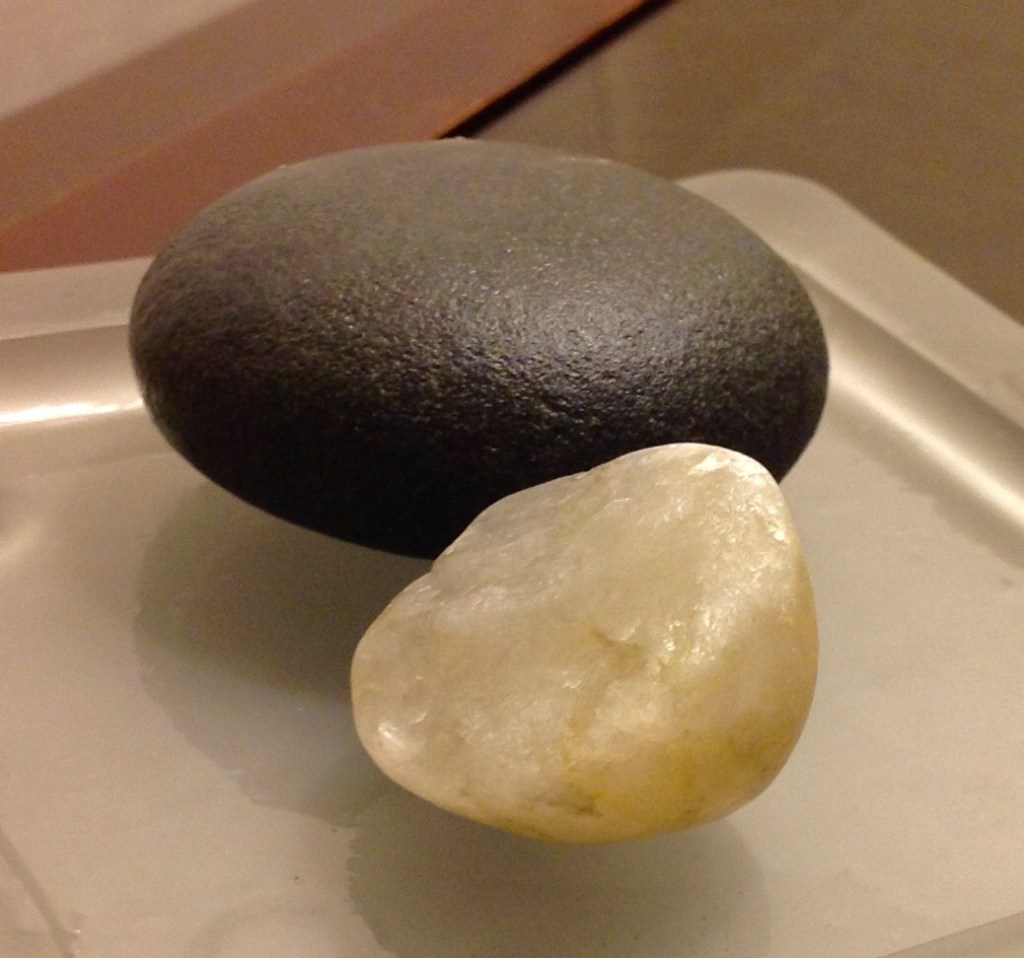
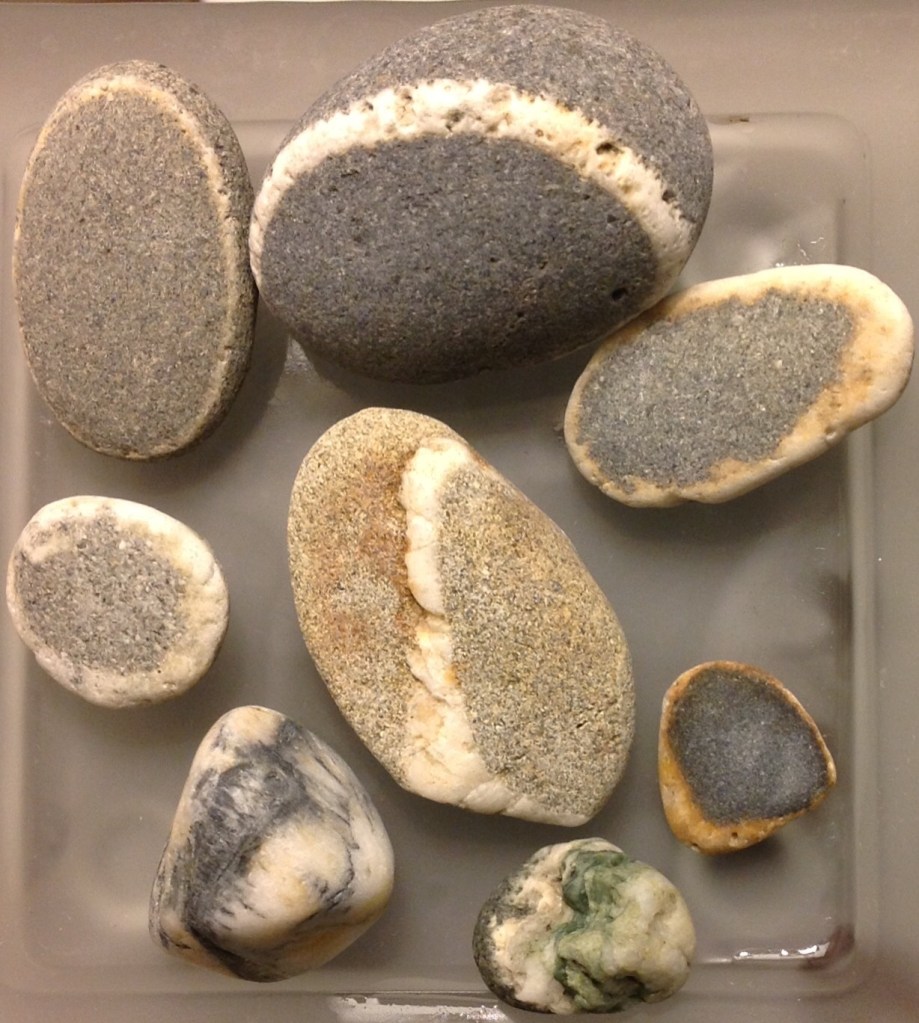
While I took photographs and shot a video through the rocks of the ocean waves, Wendy posed for me briefly before returning to scouring for agates. Hearing her speak of green stones, I collected as many as I could find in the area for her to sort through.

Happy Rock Hound

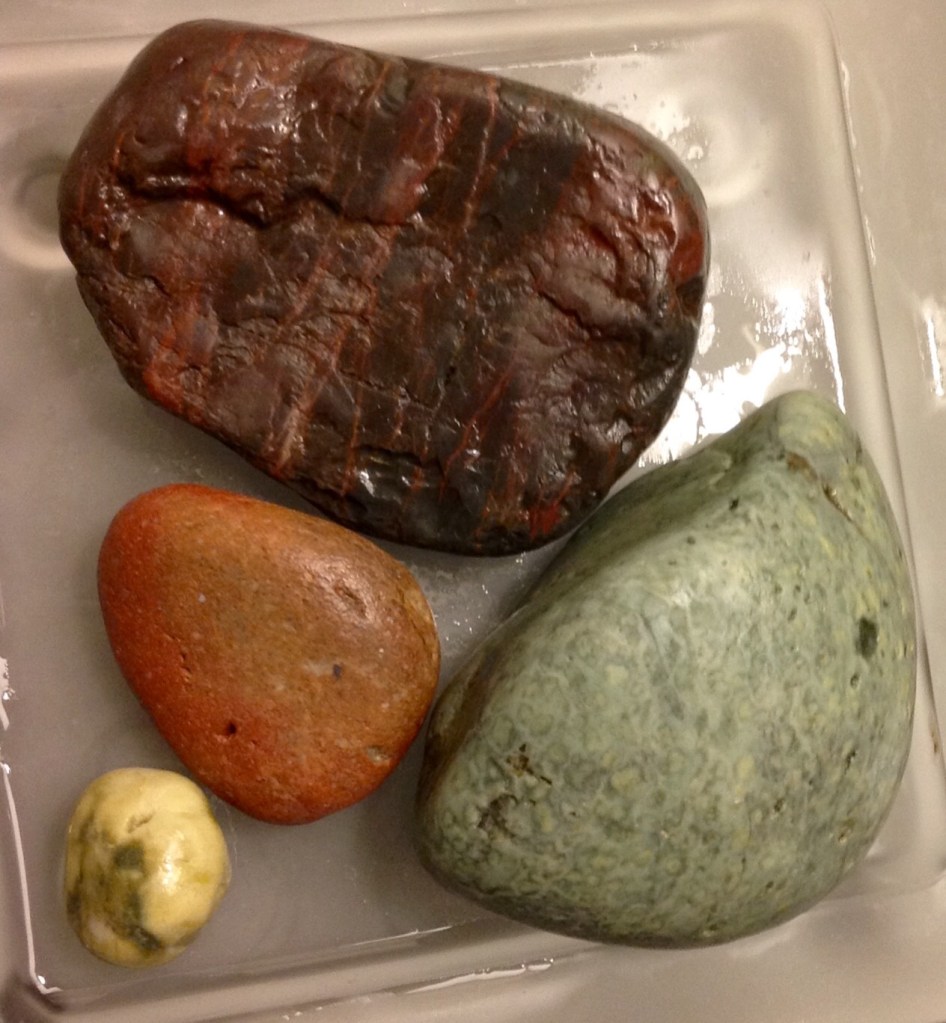
One of my green stones made it into the collection of rocks Wendy later photographed, delighting in the many different and beautiful ones she collected at the beach.  The first stone she collected at the beach was a large red one which resembled an actual human heart.
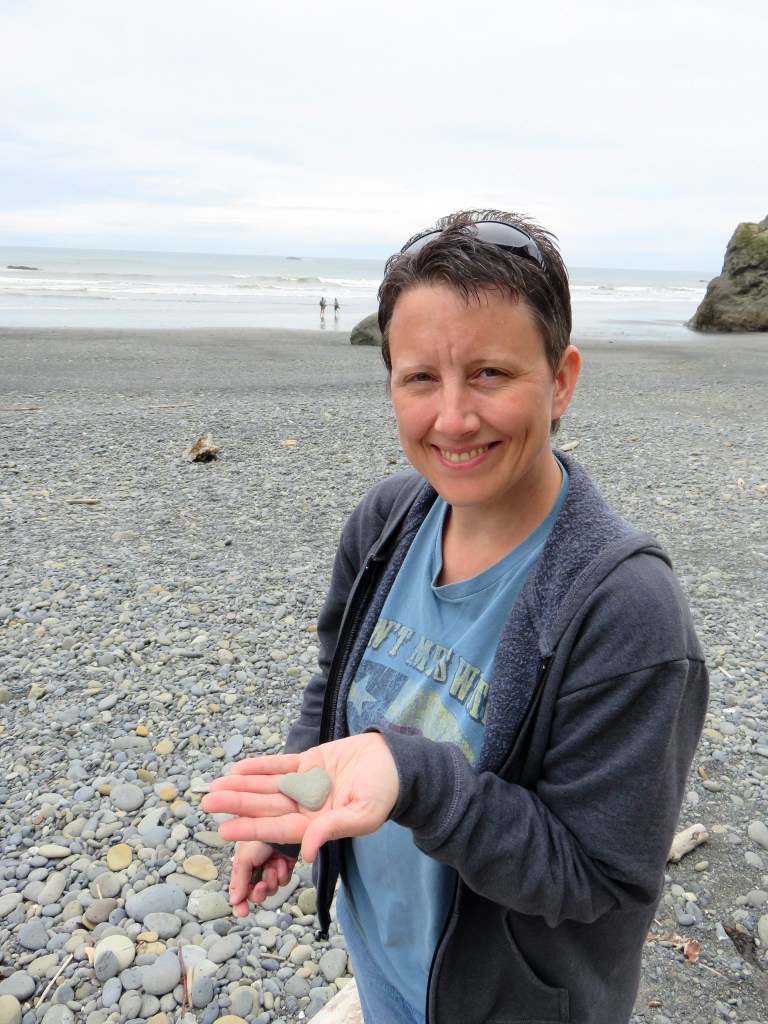
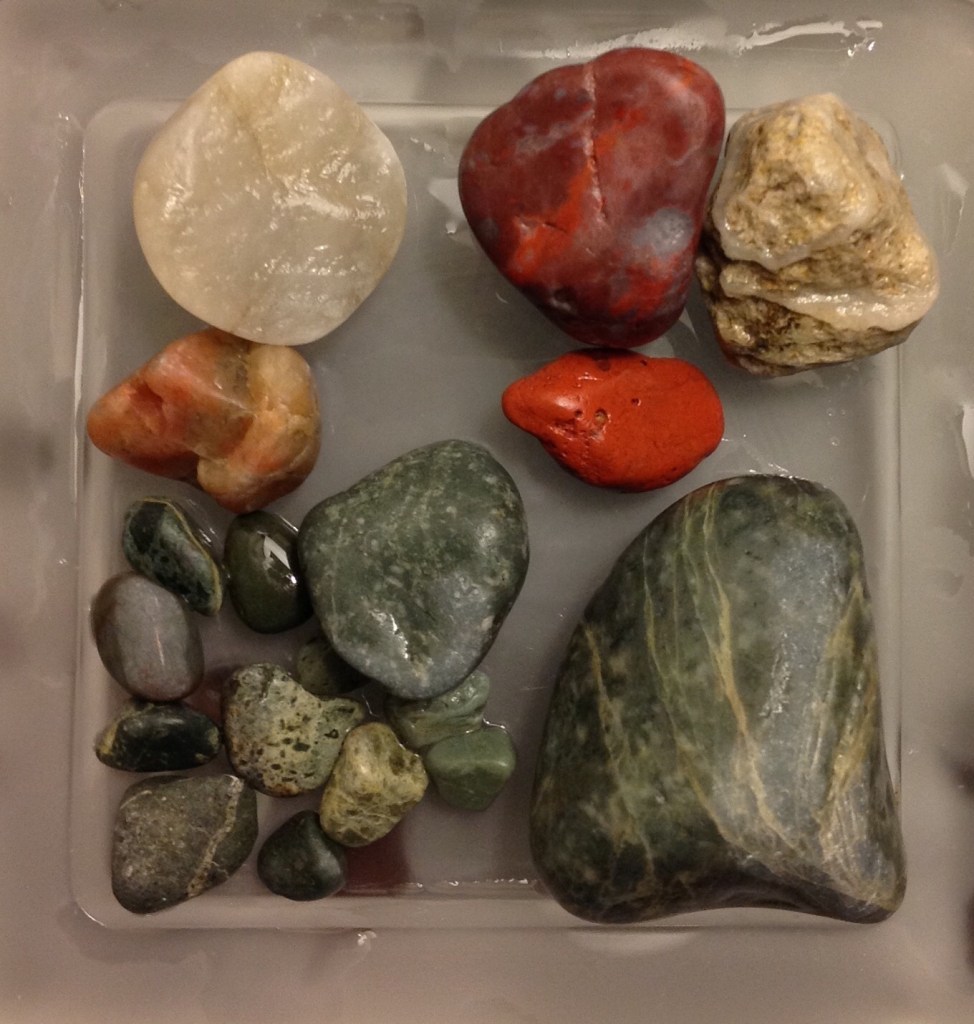
Abbey Island

We left the sea stacks behind and made our way over to Abbey Island. Early settlers to the area thought that the imposing block of an island resembled a cathedral. Tidewater pools around its base had sea anemones, both submerged and rising up out of the tide.

Anemone by Abbey Island
Acorn barnacles and a necklace of anemones

There were a couple of seaside organisms this boy, raised in the cross timbers in the middle of the continent, simply could not identify. I did figure out that white scales covering one rock were the calcareous bases of dead acorn barnacles. A large stone featured both acorn barnacles and a necklace of submerged anemones.

Destruction Island

Destruction Island

Some enterprising visitors had built different driftwood structures on the rocky beach. Destruction Island was visible four miles southwest of Ruby Beach, with its lighthouse made clearer by the superzoom camera. You might expect the name refers to shipwrecks, but I had read about how a group of Spanish sailors was massacred there in 1775 by the local Quinault Indians, lending it the name Isla de Dolores (Island of Sorrows), and twelve years later an English fur trading ship had a party leaving this island meet a similar fate on the Hoh River, leading its captain to name it the Destruction River and for that name to then attach itself to the island. The lighthouse was completed there in 1891 and automated in 1968, but is no longer in operation, and its light is now in the Westport Maritime Museum.

Last Night in the States

Blue Hydrangeas at Kalaloch Lodge

We drove back south to Kalaloch Lodge. On a walk around the property, I admired a large bush of blue and purple hydrangeas. During dinner in the lodge restaurant the sun was sparkling off the ocean outside. This would be our last night in the United States for five days. The next day we would make our way to the north shore of the Olympic Peninsula to catch a ferry to Victoria Island in British Columbia, Canada.

Kalaloch at Dusk

SLIDESHOW | PHOTO ALBUM

Honeymoon, Day 11: To Canada from the Port of the Angels >

< Honeymoon Day 9: Tacoma Glass

Posted in photos, travel, video | Leave a comment

Honeymoon, Day 9: Tacoma Glass

TRIP DATE: July 10, 2016 | SLIDESHOW | PHOTO ALBUM | Other Honeymoon Posts

When planning our honeymoon, I’d hoped to take Wendy up onto Mount Rainier for some hiking in the snow in July. Hence we stayed in Packwood, Washington to the south of the volcano, hoping to swing around southeast of Rainier National Park and visit its prime locations on our way to our next hotel, the Kalaloch Lodge on the Olympic Peninsula.
But the Paradise area of Rainier I like to visit averages 126 inches of rain each year, compared to Bartlesville’s average of 43 inches. So I knew that our itinerary, with only one open day to visit Rainier, was at risk of being rained out. Sure enough, it was cool and rainy when we awoke, and the Paradise area was forecast for rain all day. So it was time for Plan B: we’d visit Tacoma’s Museum of Glass to break up a 4.5 hour 240 mile drive to our next lodge, which was situated along the middle of the western shore of the Olympic Peninsula.

Day 9 Map

Small low clouds hugged the treetops as we drove west from Packwood to Morton and then north to Tacoma. We had to circle the Museum of Glass to search out a parking spot, landing on Pacific Avenue near the University of Washington, Tacoma. From there we used the marvelous Chihuly Bridge of Glass to walk across to the museum. That 500-foot-long pedestrian bridge has a 50-by-20-foot glass ceiling topped by 2,364 pieces from Dale Chihuly’s Seaform and Persian series.

Venetian Wall

My favorite part of the bridge is the Venetian Wall, eighty feet of glass boxes housing 109 sculptures from Chihuly’s Venetians, Ikebana, and Putti series. Wendy and I each composed our own shots of parts of the display. I actually made a little money off that wall some years back, when an angled shot of the wall I took in 2005 was purchased for use as the cover photo for a CD of Vivaldi cello sonatas.

Granger as Carmen Miranda

Wendy had fun with the Crystal Towers, which rise 40 feet above the bridge and bear huge Polyvitro crystals. She had me pose in front of one tower to give me the appearance of wearing an immense Carmen Miranda-style hat, adorned with glass instead of fruit.

Just west of the Museum of Glass, straddled by a railroad and the Thea Foss Waterway, is Thea’s Landing. Wendy and I admired that apartment block, which offers scenic living along the waterway, both named after the lady who founded the largest tugboat company in the western U.S. She was the inspiration for the Tugboat Annie character in a 1933 film and a 1957 Canadian television series. After thriving in the early 1900s, by 1980 this waterway on one edge of the Port of Tacoma had become a vacant industrial zone and part of the Commencement Bay Superfund site. It was cleaned up by 2006 and has been thoroughly redeveloped, now featuring the Museum of Glass and picturesque Foss Harbor Marina.

Below us a flag display included a rainbow flag, reminding us that we were in the liberal coastal area of the Pacific Northwest. We entered the museum by climbing the steps around the metal cone which exhausts heat from the hot shop, where artists create new glass pieces.

During our visit Benjamin Cobb was forming a red head. It was repeatedly returned to the furnace, with him sometimes heating it with a blowtorch, to soften the glass so he could push and tug it to form the facial features.

Still Life with Two Plums by Joey Kirkpatrick

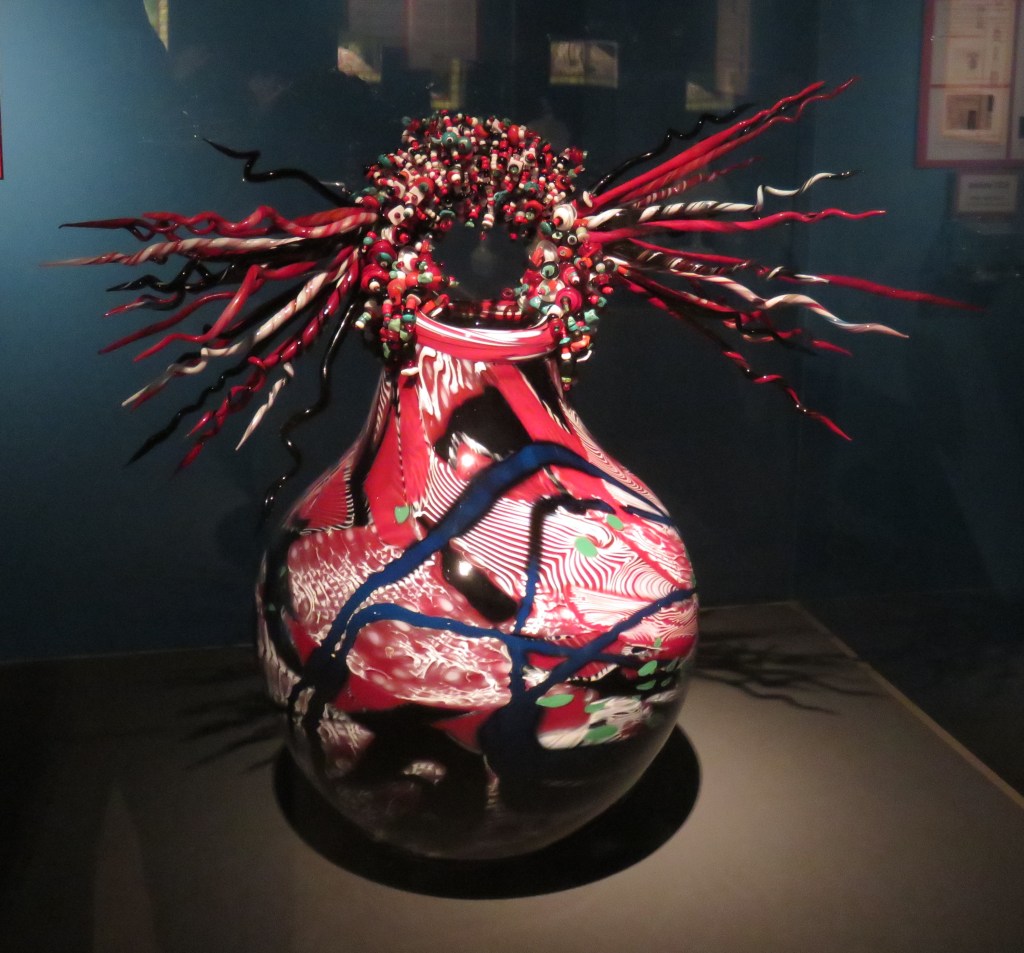
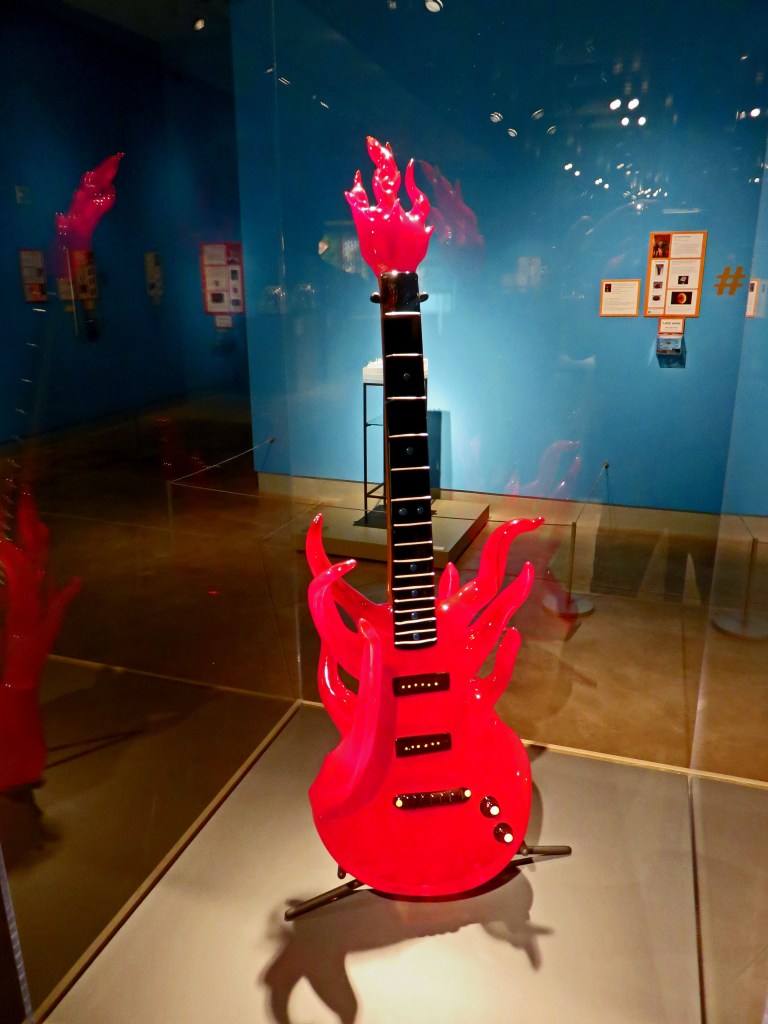
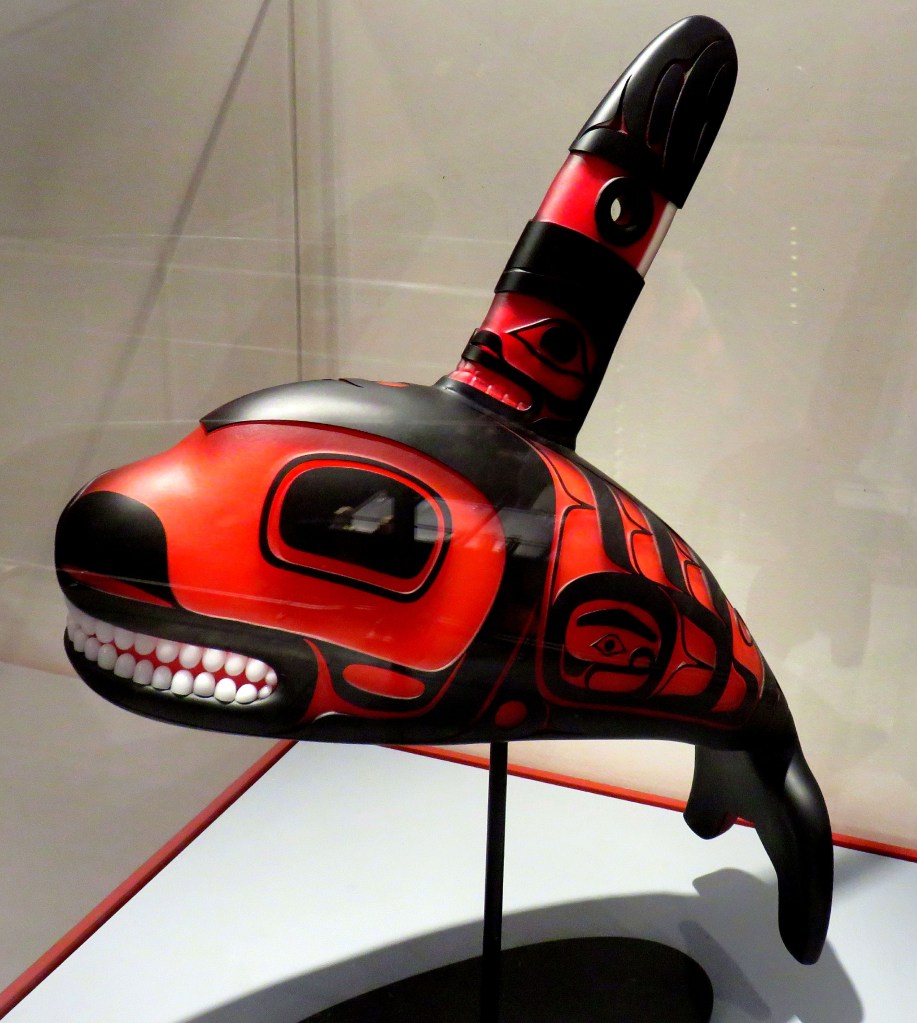
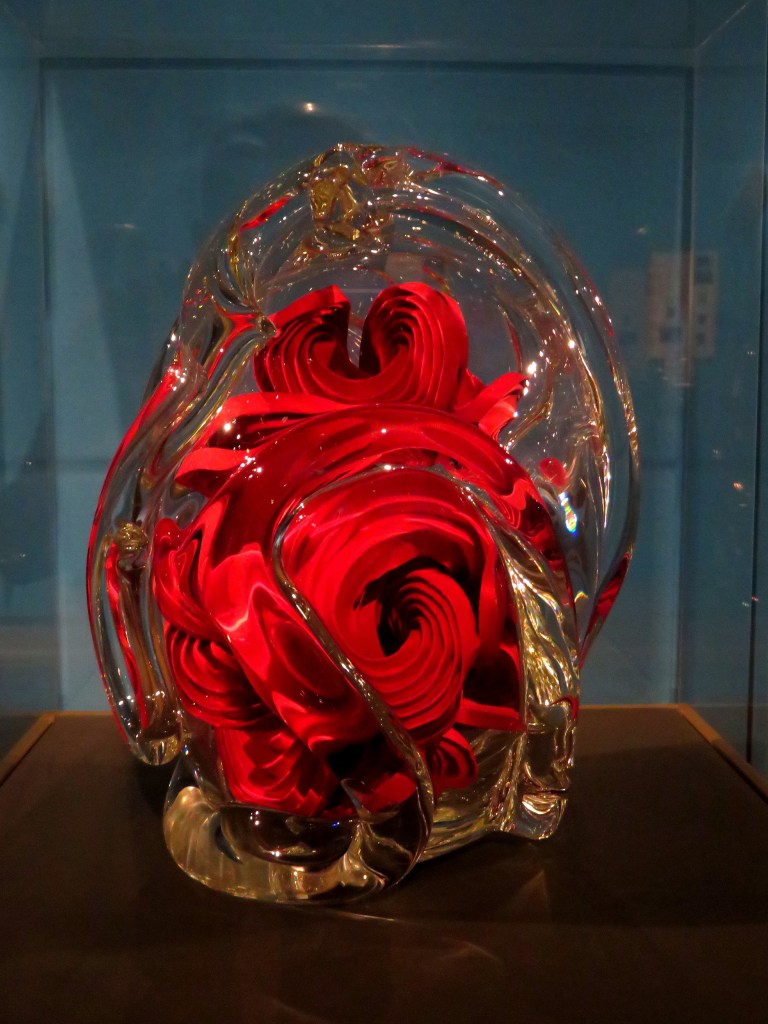
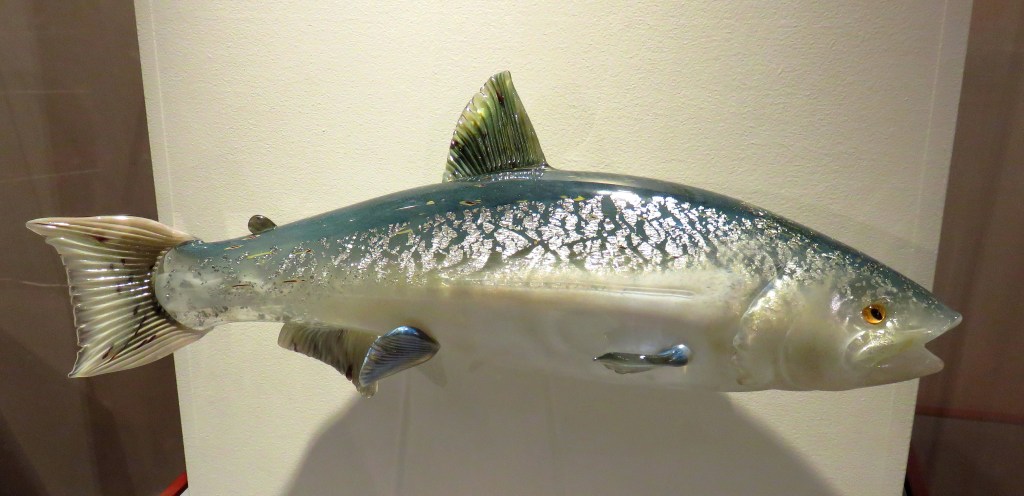
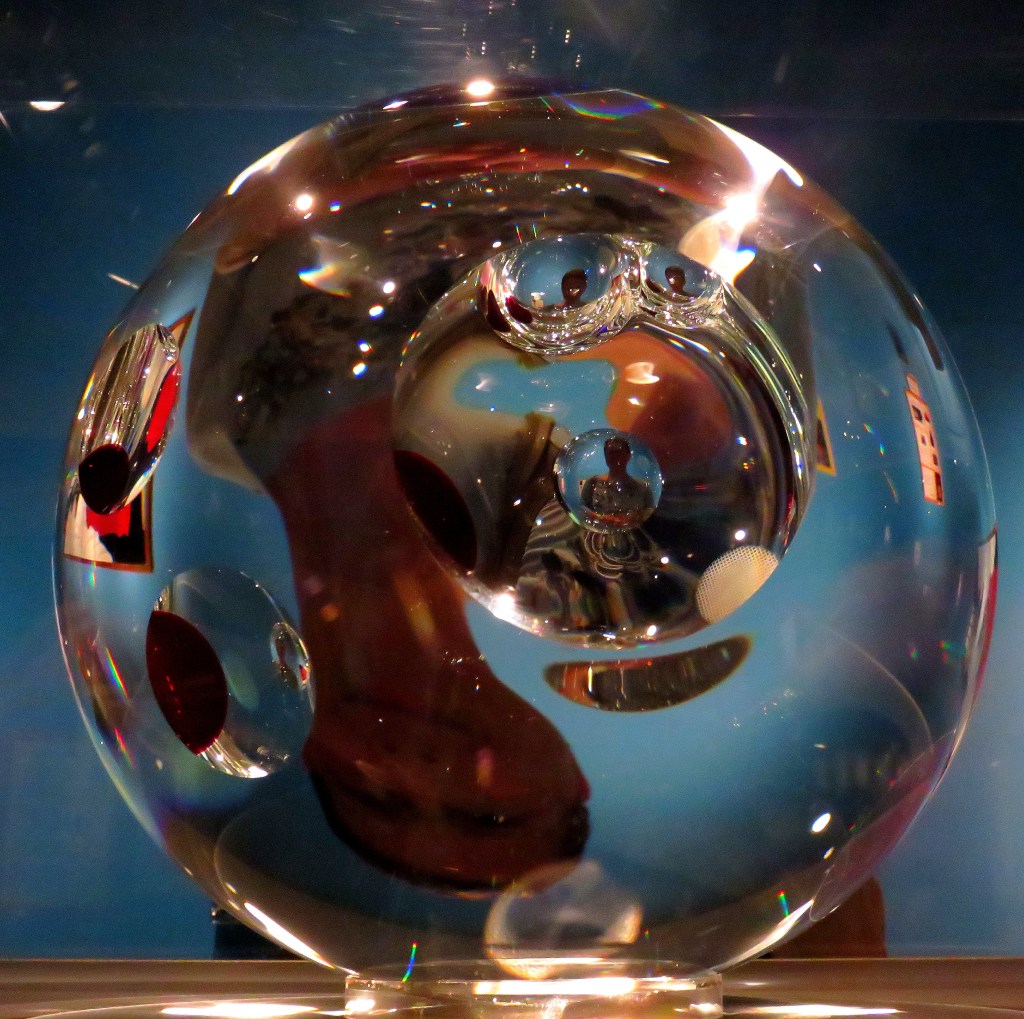
Museum pieces that caught our attention included Killer Whale by Preston SingletarySilver Side by Raven Skyriver, the immense Still Life with Two Plums and creative Making Before Meaning by Joey KirkpatrickFlaming Electric Guitar by Jasen Johnsen, and Canadiana Amulet Basket by Laura DoneferTriad by David Huchthausen had three spheres which created interesting distortions, and Let It Swirl by Martin Demaine and his son Erik, was impressive in the round.

We exited the museum around 4:30 p.m. and drove an hour west to the state capital of Olympia, where we found a delicious dinner downtown at Ramblin’ Jacks, one of the best meals on our honeymoon. Wendy’s chicken fried chicken was fluffy, crunchy, and juicy, with mashed potatoes as good as a mother could make. My French Dip was also juicy and delicious.

After a pit stop at a Fred Meyer in Tumwater, we headed west on highway 8 to Montesano, where we headed northwest on the scenic Wynoochee Valley, Wishkah, Hoquaim Roads to intersect coastal highway 101 for the drive north to Kalaloch Lodge. We made another pit stop at the tiny grocery in Humptulips, and I just had to know the etymology of that peculiar name. Humptulips is a word from the Salish native Americans and means “hard to pole” (no, I’m not kidding) because of the difficulty in poling canoes along the nearby eponymous river.

We were grateful to arrive at Kalaloch Lodge that night, although even its largest and nicest room had some shortcomings. More on that in the next post, but thankfully a visit the next day to Ruby Beach would more than compensate.

SLIDESHOW | PHOTO ALBUM

Honeymoon Day 10: Ruby Beach >

< Honeymoon Day 8: Mt. Saint Helens | Other Honeymoon Posts

Posted in art, photos, travel, video | Leave a comment

Honeymoon, Day 8: Mount St. Helens

TRIP DATE: July 9, 2016 | SLIDESHOW | PHOTO ALBUM | Other Honeymoon Posts

Little did we know, snug in our honeymoon suite at the Cannery Pier Hotel in Astoria, that four miles away, across the mouth of the mighty Columbia, lurked Dismal Nitch. That little cove on the Washington State side of river was so named by Captain William Clark when the Corps of Discovery was forced off the river on November 10, 1805 and spent six stormy days pinned to what Clark described as “that dismal little nitch.” Fierce wind and high waves at the rocky shoreline had Clark concerned for their safety:  “A feeling person would be distressed by our situation,” he wrote in wet misery as they endured the cold wind, rain, thunder, lightning, and hail.

Across the Columbia

Finally the storm broke and the Corps pressed on to reach the Pacific Ocean. They moved to Station Camp on the west side of Point Ellice just beyond Dismal Nitch, and camped at that location for 10 days, taking the famous vote by which they decided to move to the south shore of the Columbia River and spend the winter there before beginning their long journey home.

Wendy and I had stayed three nights on the Columbia’s south shore. On our last morning in Astoria, I watched ships passing by our room before we drove downtown for breakfast at the Blue Scorcher Bakery & Cafe.

Wendy called that worker-owned cooperative a “hipster bakery” and was unimpressed by their locally farmed, certified organic berries, which were too sour for her French toast. They crafted their own soda, too, which we’d encountered before in Austin, TX. You had to clean up your own mess, but at least their single-user restrooms were large and gender-neutral, which was nice.

Mergler Bridge
Dismal Nitch

We drove the 4.1 miles across the Astoria-Megler Bridge so we could cross into Washington State for a scenic forest drive towards Mount St. Helens. We stopped at Dismal Nitch, where we could see Astoria across the river, including the Astoria Column via the superzoom camera. I was amused by a sign asking us to limit our stay at Dismal Nitch to eight hours, as with that name we weren’t tempted to stay longer than eight minutes despite the view and the pretty gulls. Wendy must have thought I was quite the romantic, taking her to Dismal Nitch, which lies just east of Cape Disappointment and what Clark termed Point Distress.

Astoria Column from Dismal Nitch

The highway could not follow the rocky north shore of the Columbia, so it wound its way eastward along river valleys through the mountains. We made a short side trip to the Grays River Covered Bridge, the last of its kind still in use in Washington State. After the highway ducked back south to return to a friendlier portion of the river shore, we stopped and shopped at a pharmacy in little Cathlamet before heading eastward to Longview.  There we stopped in at a Fred Meyers and had lunch at the Guadalajara Grill and Cantina. I had been missing Mexican food, but Wendy claims Mexican food isn’t particularly good north of Texas and New Mexico, with some occasional exceptions like Enrique’s at Ponca City.

Mount St. Helens

The Mount St. Helens stratovolcano erupted in 1980. Eighteen years later I visited the mountain with fellow science teacher Wendy Robinson and her mother and uncle. I recalled being impressed by the quality of the displays at the Visitor Center, built in 1993 in a state park 30 miles from the mountain. Well, that center has not been updated, so its displays 18 years later looked faded and worn. But I still enjoyed the big topographic model of the volcano area and a display of items melted in the eruption. Wendy bought a jacket, something she’d need on the cold and windy heights of Johnston Ridge near the crater.

My strongest impression of visiting Mt. St. Helens 18 years after its latest big eruption was how quickly nature was reclaiming the ravaged landscape. Now the time of recovery had doubled to 36 years. It made me feel old to know it had been so long since the eruption, yet I was buoyed to be revisiting the mountain on my honeymoon and find nature busily renewing the landscape, much as my new bride had renewed the prospect of my life.

Mt. St. Helens erupted in 1980

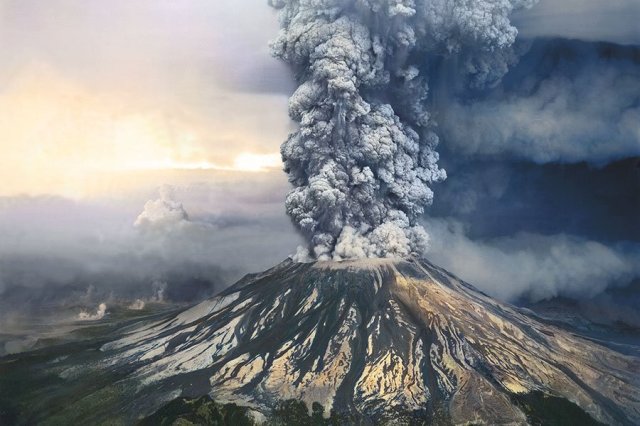
At 8:32 Sunday Morning, May 18, 1980, Mount St. Helens Erupted

Shaken by an earthquake measuring 5.1 on the Richter scale, the north face of this tall symmetrical mountain collapsed in a massive rock debris avalanche. In a few moments this slab of rock and ice slammed into Spirit Lake, crossed a ridge 1,300 feet high, and roared 14 miles down the Toutle River.

The avalanche rapidly released pressurized gases within the volcano. A tremendous lateral explosion ripped through the avalanche and developed into a turbulent, stone-filled wind that swept over ridges and toppled trees. Nearly 150 square miles of forest was blown over or left dead and standing.

At the same time a mushroom-shaped column of ash rose thousands of feet skyward and drifted downwind, turning day into night as dark, gray ash fell over eastern Washington and beyond. Wet, cement-like slurries of rock and mud scoured all sides of the volcano. Searing flows of pumice poured from the crater. The eruption lasted nine hours, but Mount St. Helens and the surrounding landscape were dramatically changed within moments.

Erlk Rock Viewpoint
Toutle River

Wendy and I drove along the Spirit Lake Highway toward the volcano, making a pit stop at the Forest Learning Center and stopping at the Elk Rock viewpoint, ten miles northwest of the crater. From there we could see how the Toutle River Valley had changed since my previous visit, with greenery amidst the immense ash flow.

It grew colder as we ascended for more spectacular views, and we were surprised by the cold and relentless ferocity of the wind near the end of the highway on Johnston Ridge at Loowit Viewpoint. Beautiful flowers contrasted with the brutality of the volcano, its crater shrouded in clouds.

Flowers at Loowit Viewpoint
Mt St Helens from Loowit Viewpoint

After a pit stop at the Johnston Ridge Observatory we needed to head to Packwood for our overnight stay. It was only 40 miles northeast of the volcano, but in that isolated mountainous terrain that meant a two-hour 120 mile drive. Along the way we stopped at the Lake Mayfield Resort & Marina for dinner.

The Crest Trail Lodge near Packwood was uninspiring after our stay at the Cannery Pier Hotel & Spa, but we were glad to rest after a long driving day. My hopes that we would get to visit Mt. Rainier the following day were dashed by rain, but we saved the day by visiting Tacoma’s Museum of Glass.

SLIDESHOW | PHOTO ALBUM

Honeymoon Day 9: Tacoma Glass >

< Honeymoon Day 7: The Flavels of Astoria

Posted in photos, travel | Leave a comment

Honeymoon Day 7: Flavels and Travels in Astoria

TRIP DATE: July 8, 2016 | SLIDESHOW | PHOTO ALBUM | Other Honeymoon Posts

Meador Post

On our last full day in Astoria we had lunch at T. Paul’s Urban Cafe, having been impressed by the Supper Club the night before. Our sandwiches were fine, which is better than it might sound, as I don’t often choose to eat sandwiches at restaurants. Since I effectively get less than 30 minutes for lunch on a workday, I usually just fix a boring turkey sandwich that won’t have me gaining weight. That habit leaves me unwilling to pay for most restaurant sandwiches, although on occasion Wendy talks me into enjoying a superior turkey sandwich at Subway.

Astoria Jail

Wendy and I enjoy touring old mansions, so we headed toward the Flavel House Museum. Along the way, we passed by the old city jail. It is a now a film museum and was featured in The Goonies, a 1985 Spielberg film. I’ve never seen that flick, which reportedly also featured the Flavel House Museum and other Astoria landmarks. Quite a few other movies have reportedly been shot in this little town: Short Circuit, The Black Stallion, Kindergarten Cop, Free Willy, Free Willy 2: The Adventure Home, Teenage Mutant Ninja Turtles III, Benji the Hunted, The Ring Two, Into the Wild, The Guardian and Cthulhu. Of all of those, I’ve only seen Short Circuit and wish I hadn’t.

Flavel House Museum

The Flavel House is a Queen Anne mansion built around 1885 as a retirement home for Captain George Flavel, a river bar pilot and real estate investor. The Columbia Bar is the shallow passage where a local pilot is taken aboard to deal with the treacherous tides, currents, and winds at the meeting of the Columbia River and the Pacific Ocean. The Columbia has no delta, instead spraying “like a fire hose” into the ocean. This area has claimed about 2,000 large vessels since 1792. These days about 16 bar pilots guide ships, often boarding vessels by helicopter. They are well compensated, earning about $180,000 per year.

Flavel House

Captain Flavel earned his money in similar fashion, sans helicopter, back in the 1800s. He and his wife, Mary Christina Boelling, lived in their retirement home with their two grown daughters, Nellie and Katie. The four of them had plenty of room in the 11,600 square foot home, which featured beautiful interior woodwork that was Eastlake-influenced in design. The Douglas Fir doors and windows were wood grained by a master craftsman to look like mahogany and burl rosewood. The wood likely came from a mill in Portland or San Francisco and was shipped to Astoria by steamer.

The home has 14-foot high ceilings on the first floor and 12-foot high ones on the bedroom level. So even though it had central heating, quite a luxury for the late 1800s, it also has a half dozen fireplaces. They had indoor plumbing, which was also quite unusual for that time and place.

The Captain’s son, George Conrad Flavel, never lived in the home since he was already married when it was built. Also a river pilot, the younger Flavel built for himself another grand home which is now being fixed up after years of abandonment. There is an interesting history on why the house sat empty for so long. I’ve also found online video of that old neglected home. It needed a lot of cleanup, as its last occupants of the Flavel clan were hoarders.

We enjoyed our self-guided tour of the original mansion; I found an online video of a guided tour you can indulge in if you like. We admired the interesting and beautiful plants outside.

Flavel House

After that we made our way to an art store downtown, where Wendy purchased some alcohol inks. Then we headed to the riverfront to visit the Columbia River Maritime Museum.

Columbia River Martime Museum

I’d visited the museum a decade earlier, and it hasn’t changed much, which is fine. The Columbia Lightship and the S.S. Legacy riverboat of Seattle were at the dock as well as a Coast Guard Cutter, the USCGC Steadfast.

The Coast Guard has long protected lives and policed the waterways of the treacherous Columbia Bar. The roadway side  of the museum features a display of a Coast Guard ship in heavy seas, demonstrating the violence of the ocean. That makes it all the more impressive how the guard’s standard rescue craft for 80 years was a relatively small 36-foot motor lifeboat. In all of that time, only one of those was lost in the line of duty. In January 1961 most of the crew of the Triumph perished in a severe storm in an operation that rescued the crew of the fishing vessel Mermaid on Peacock Spit.

Coast Guard Lifeboat

The Cape Disappointment lifeboat on display was named after a headland on the north side of the Columbia Bar. The nomenclature harkens back to the suffering of this area’s explorers.

I didn’t return to the Astoria Column during this visit, but from the riverfront I could use my superzoom camera to find folks out on its viewing platform. Whenever we return I look forward to taking Wendy to see its restored grandeur, and I hope we get to see a show in the Liberty Theatre, having admired its exterior façade.

Our last night in Astoria had us walking over for breakfast for dinner at the Pig ‘n Pancake near the hotel. We had enjoyed our stay in this maritime world, but it was time to cross the Columbia and climb our way to the windy crater of Mount St. Helens.

Last night in Astoria

SLIDESHOW | PHOTO ALBUM

Honeymoon Day 8: Mount St. Helens >

< Honeymoon Day 6: Astoria’s RiverfrontOther Honeymoon Posts

Posted in photos, travel | Leave a comment

Honeymoon, Day 6: Astoria’s Riverfront

TRIP DATE: July 7, 2016 | SLIDESHOW | PHOTO ALBUM | Other Honeymoon Posts

Meador Post

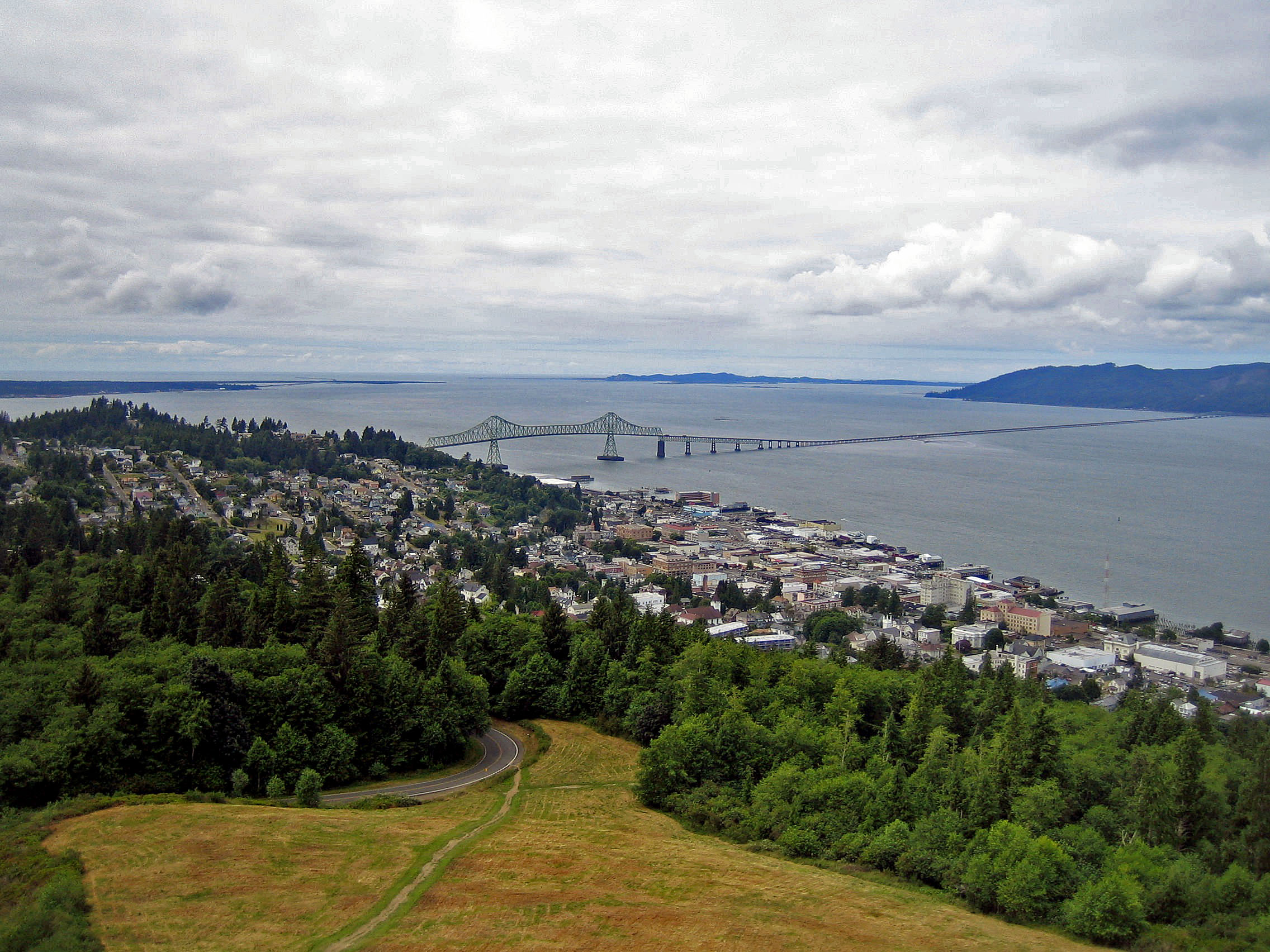
We relaxed for two days in Astoria at the mouth of the mighty Columbia. This little Oregon town of less than 10,000 has a picturesque setting, perched on the southern slopes above the river across from the State of Washington. Fort Astoria was established in 1811 as the first American-owned settlement on the Pacific coast, on land where the Clatsop Indians had lived for thousands of years.

astoria
I shot this view of Astoria a decade before returning on my honeymoon

Seven months earlier I had been riveted by Peter Stark’s Astoria: Astor and Jefferson’s Lost Pacific Empirewhich told of the harrowing seven-month journey westward of the Overland Astorians from St. Louis to what would become Astoria. Stark recounted how they suffered mightily going down and along the treacherous Snake River.

Amazingly, most of them made it to what would become Astoria, but the War of 1812 brought their enterprise to an end. On the return journey eastward they established the South Pass route which would become a key component of the Oregon Trail. About 200 years later Wendy and I jetted in first class comfort from Oklahoma to Oregon in only a few hours on our honeymoon; what a contrast.

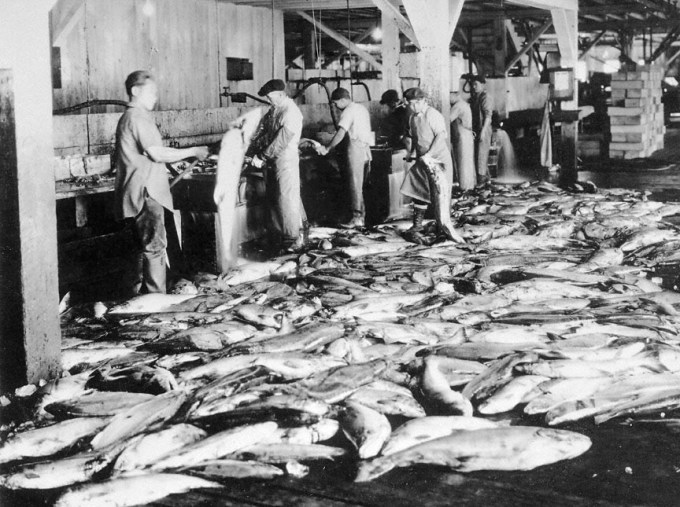
cannery-workers
Chinese cannery workers in Astoria

The town thrived back when lumber and fish seemed limitless. Finnish, Swedish, and Norwegian gill-netters worked the river by boat. Calvin Trillin noted in a 1993 New Yorker article, “Astoria’s waterfront was lined with canneries, where the salmon was processed by a contract-labor force so uniformly Chinese that when an automatic fish-skinner was finally invented it was known as an Iron Chink.” The New Yorker has a reputation for meticulous fact-checking, so yes, that is actually what the inventor called it.

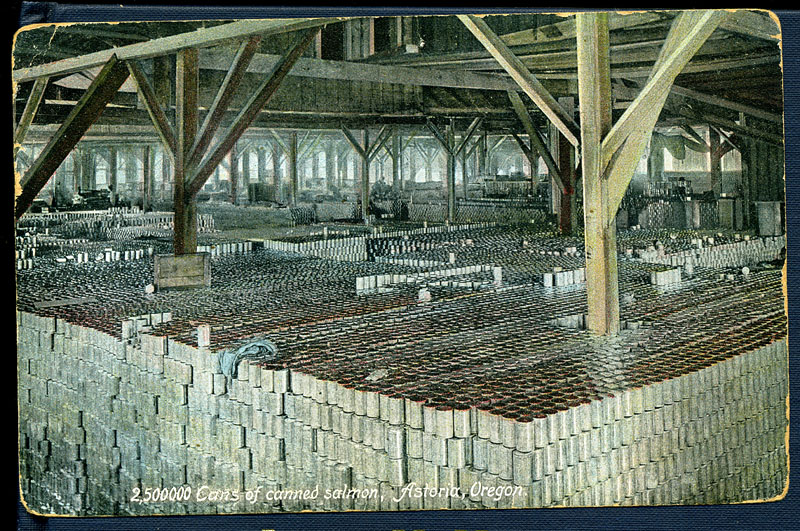
lots-of-salmon
2.5 million cans of salmon fill a cannery storeroom in the late 1800s

The town eventually boasted 22 canneries for chinook, coho, and sockeye salmon as well as steelhead trout. Over time, several Astoria canneries consolidated into what became the world headquarters of Bumble Bee Seafoods. In the 1960s Bumble Bee was the largest salmon-canning company in the world.

The town’s population peaked at 25,000 during World War II. After that, improved dredging of the Columbia shifted a lot of port business upriver towards Portland. The fish declined as well; locals noted drops in the fish runs as early as the 1870s, and years of upstream pollution, loss of spawning habitat, heavy fishing, and migration-blocking dams further reduced the salmon runs. Bumble Bee closed shop and moved to California in 1980, soon to be engulfed in buyouts, sales, and bankruptcy.

Commercial fishing, logging, and shipping still contribute to the Astoria economy but nowhere near the historic levels. The town has a variety of historic homes and has become a tourist destination with many museums and shops.

Blue heron

Wendy and I had planned for a couple of rhyming laundry stops along the trip: Astoria and Victoria. So we made use of a washer and dryer at the Cannery Pier Hotel the night we arrived in Astoria. We remained at the hotel the next morning. The occasional rumble of a passing ship and the sounds of sea birds reminded us we were far from the cross timbers and prairies of home. I watched the commercial fishing vessel Katrina go by while a blue heron fished the shallows near our room.

We finally roused ourselves to walk a half mile along the riverside trolley tracks for a late lunch at The Ship Inn. I enjoyed my fish and chips despite the restaurant smelling damp and briny. Rocks piled along the shore had been dumped years before by old sailing ships as they entered the Columbia, picking up sealed and canned salmon. A boiler on a concrete piling and a short forest of worn wood pilings were all that remained of a nearby shoreline cannery.

We saw the San Pablo trolling boat pass by and then the much larger Macaru Arrow cargo ship. The Coral Opal and Bulk Bolivia cargo ships were anchored out in the river.

Trolley

As we walked back along the trolley line, its 1913 trolley car rolled by. The trolley uses former freight railroad tracks and has been operating since 1999. Wendy and I enjoyed the signage on a trolley bridge warning bicyclists they could take a tumble if they weren’t careful.

Bicycle Warning

The day was chilly and gray as we stopped to view the many plaques at the Maritime Memorial Park by the river. The memorial is for those who lived and/or died in relation to the water, and the plaques are fascinating.

Mary Boyle “caught the big ones”, and we learned they called Gene Miner “Do-Do”. Scott Arnold was a “commercial fisherman died helping another”, Nancy McClain was “lost at sea” when she was about 21, and as for Big John Viuhkola, “The sea he loved claimed him.”

Maritime Memorial Plaques with Flowers

A long inscription wrote of the allure and danger of the sea:

Weep not for me that I go to sea.
I shan’t be lonely, though vastness surround me.
The brotherhood of the sea shall be my family.
The kinship of the deep my company.

Weep not for me, nor worry over harm.
My heart stays with you, still and warm.
In sunrise and starlight my hearth and home
I carry you with me wherever I roam.

Weep not for me, whether bad luck or good.
Tossed about in a shell of steel and wood.
An ancient salt sea sails within my blood –
I but follow its tide through ebb and flood.

Weep not for me that I go to sea:
in the limitless ocean I am free.

Aries Leader glides past our hotel room

During our stay Wendy came to love looking up passing vessels on marinetraffic.com to learn where they were from, where they were bound, and what they carried. It was relaxing to watch the huge cargo ships slowly hum their way downriver past our balcony. I shot some video of the Aries Leader, a ship carrying automobiles in its hold, as it rumbled past.

For dinner we drove over to T. Paul’s Supper Club, where Wendy delighted in the tender and flavorful salmon and vegetables, commenting that “they really know how to season.” We ended our day with a trip across Youngs Bay for supplies at the local Fred Meyer, an immense one-stop shop. Fred opened his first store in Portland in 1922, and his stores now average 150,000 square feet and carry more than 225,000 items.

We had another full day in Astoria ahead of us, time enough to delve into local history by visiting a nearby mansion and the maritime museum.

SLIDESHOW | PHOTO ALBUM

Honeymoon Day 7: Flavels and Travels in Astoria >

< Honeymoon Day 5: To the Oregon Coast | Other Honeymoon Posts 

Posted in photos, travel | Leave a comment